
Fulgurites are created when lightning strikes the ground, yet they are surprisingly scarce in the fossil record.
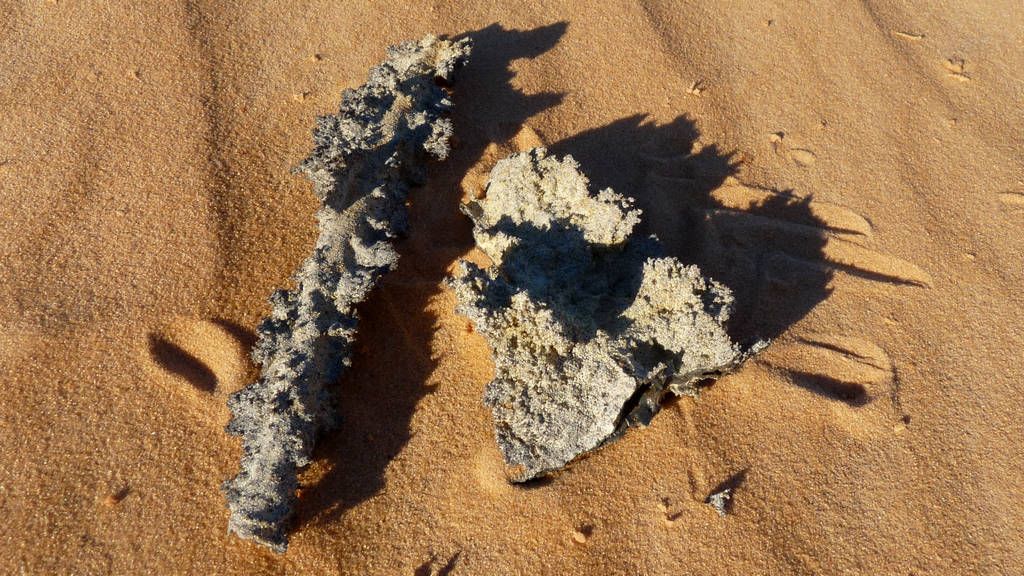
A fulgurite, often referred to as a lightning stone, is a fossilized, irregular tube of silicate glass that forms when quartz sand melts due to the intense heat of a lightning strike. This phenomenon typically occurs when the ground is exposed, such as in sandy environments. Fulgurites can vary significantly in size, with lengths ranging from a few centimetres to up to one metre. Their shapes may be simple or, in some cases, remarkably complex, resembling the intricate structures of tree roots.
Estimates of fulgurite formation
A fulgurite is formed when lightning strikes the ground, though this is not a guaranteed occurrence. Given the unpredictable nature of lightning, it is impossible to ascertain the exact number of fulgurites produced; estimates are the best we can manage. For instance, geophysicists Matthew A. Pasek and Marc Hurst estimated that around 45 lightning strikes happen every second on Earth, with roughly a quarter of these striking the Earth’s surface. As 80-90% of lightning strikes take place over land, scientists have suggested that up to 10 fulgurites could form every second.1
This assumes that every lightning strike that reaches the ground results in the formation of a fulgurite. Another physicist, Don DeYoung, estimated that up to 100 lightning strikes occur each second, with approximately a quarter of them reaching the Earth’s surface. He further suggested that only 1% of these ground strikes lead to the formation of fulgurites.2 According to DeYoung’s calculations, a fulgurite forms roughly every four seconds, amounting to more than 11 million fulgurites annually. These figures, however, remain speculative.
The precise percentage of lightning strikes that produce fulgurites is still unknown. What is certain is that fulgurites form infrequently and can appear anywhere on land. When one is discovered, it is considered a rare and fortunate find.
Fulgurites and Earth’s geological age
DeYoung went beyond estimating the present rate of fulgurite formation; he also sought to calculate how many fulgurites might currently exist on Earth.3 His calculations were based on a timespan of 4 billion years. Adopting very conservative assumptions, such as the idea that only 1% of ground strikes produce fulgurites, he estimated that the fossil record should contain, on average, 78.6 fulgurites per square metre. For the 540 million years following the Precambrian, this average would drop to between 10 and 11 fulgurites per square metre.
The matter becomes even more intriguing when we consider Pasek and Hurst’s estimates, which propose that every lightning strike reaching the ground leads to the formation of a fulgurite.4 Based on this assumption, over a period of 4 billion years, we would expect to find around 7,857.4 fulgurites per square metre. For the 540 million years since the Precambrian, this would yield approximately 1,060.7 fulgurites per square metre. Even with these high numbers, if we assume that only half of all ground strikes create fulgurites, the figures would still be considerable: 3,928.7 per square metre for 4 billion years, and 530.35 per square metre for 540 million years.
Although these are merely estimates, they highlight a key issue. If the Earth is truly millions or even billions of years old, we would expect to find a vast accumulation of fulgurites. Yet, very few are present in the fossil record. While fulgurites that are millions of years old have occasionally been discovered, such as those in the Sahara which have been dated to 250 million years ago, these finds are far too infrequent to support the notion of such an ancient Earth.5
Where are the missing fulgurites?
The question remains: where are the fulgurites, and why is the Earth not covered in them? The most straightforward explanation is that the missing fulgurites simply never formed. This would imply that the Earth is not millions or billions of years old. By considering a much shorter timescale, such as the few thousand years suggested in the Bible, the puzzle of the missing fulgurites in the fossil record is effectively resolved.
By the way, we recommend reading the articles:
- Did Moses Invent the Alphabet?
- DNA: Comparing Humans and Chimpanzees
- Earth – the Only Planet with Fire
- Do Tardigrades Disprove Evolution?
- Anxiety Disorders: What Guidance Does the Bible Offer?
Footnotes
- Pasek, M. A. & Hurst, M., ‘A Fossilized Energy Distribution of Lightning’, Scientific Reports, 28 July 2016, https://www.nature.com/articles/srep30586.
- DeYoung, D. B., ‘A Survey of Lightning’, Creation Research Society Quarterly, vol. 49, no. 4, 2013, pp. 281-286.
- Thomas, B., ‘The Case of the Missing Fulgurites’, Institute for Creation Research, 25 August 2016, https://www.icr.org/article/case-missing-fulgurites.
- Ibid.
- Patowary, K., ‘Fulgurite: What Happens When Lightning Strikes Sand’, Amusing Planet, 21 July 2015, https://www.amusingplanet.com/2015/07/fulgurite-what-happens-when-lightning.html.
© Source of main image: Canva.

The portal EvolutionOfThinking.org, created by the Research and Education Institute, focuses on education and the dissemination of knowledge related to research on various aspects of human well-being.

