
Tardigrades are microscopic creatures recognised as the most resilient organisms on Earth. What is the source of their remarkable resilience?
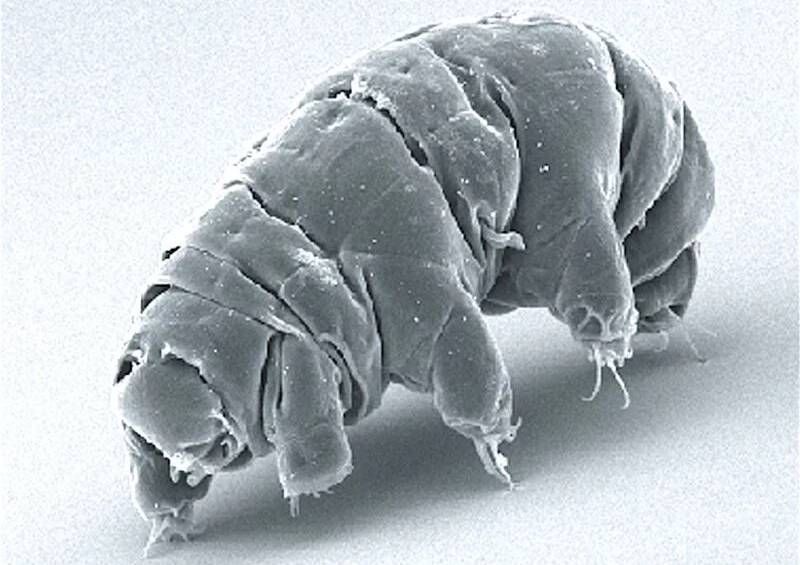
Tardigrades are tiny creatures classified as microfauna. They range in size from 0.1 to 1.2 mm, making them visible only under a microscope. Their bodies are cylindrical, with a poorly defined head, a round mouth opening, and four pairs of limbs ending in claws. Due to their resemblance to more familiar animals, they are often referred to as ‘water bears’.
The Latin name Tardigrada refers to the slow movement of these creatures. There are over 1,100 known species, some of which live in water, while others inhabit land, even in extreme conditions.1 Hundreds of thousands of tardigrades can be found in the lawns in front of our homes.2
Legendary Resilience
In 2012, tardigrades became widely recognised as the most resilient animals on Earth. This conclusion was reached by the authors of a scientific article titled What Can We Learn from the Toughest Animals on Earth? Water Bears (Tardigrades) as Multicellular Model Organisms in Order to Perform Scientific Preparations for Lunar Exploration, published in Planetary and Space Science.3 It has been found that tardigrades can survive a range of extreme conditions, including:
- the absence of water and food,
- the presence of liquid helium at -267°C, i.e., just a few degrees above absolute zero (0 K, or -273.15°C),
- high temperatures up to 151°C,
- a water pressure of 600 MPa (6000 atmospheres) – six times greater than the pressure at the bottom of oceanic trenches,
- exposure to vacuums while being bombarded with electrons,
- exposure to an X-ray radiation dose 250 times higher than the lethal limit for humans.4
Tardigrade resilience does, however, have its limits. They can survive temperatures of around 150°C, but only for a few minutes.5 Even so, they remain truly remarkable.
Cryptobiosis
How do tardigrades survive such extreme conditions? Their ability to enter a state known as cryptobiosis is key. Also referred to as latent life, cryptobiosis is a dormant state in which metabolic activity is drastically reduced in response to unfavourable environmental conditions. When exposed to a life-threatening factor, tardigrades curl into a barrel-like shape, completely halting their metabolism, and are able to survive in this state for over 100 years. Although other species can enter cryptobiosis, tardigrades exhibit an exceptional level of resilience, making them nearly indestructible.6
The Dsup Protein
Recent studies on Ramazzottius varieornatus have shown that it possesses a unique protein called Dsup (short for Damage Suppression).7 This protein enables tardigrades to survive exceptionally high doses of radiation. During cryptobiosis, Dsup surrounds the DNA, creating a protective barrier that shields it from radiation and removes reactive elements. Once the threat has passed, the organism can revive without damage.8
Could Tardigrades Have Evolved?
Tardigrades pose a significant evolutionary challenge for scientists, particularly in relation to their exceptional resilience. According to Charles Darwin’s theory of evolution, organisms evolve solely in response to changes in their natural environment. Species that fail to adapt become extinct, while those that successfully adjust to new conditions and establish an ecological niche survive and reproduce—at least until further environmental changes require them to adapt again. This is the process of natural selection.
The issue lies in the fact that tardigrades appear to have developed traits that are not strictly required for their survival. The secular geological history of the Earth does not suggest that such extreme conditions ever existed on the planet in a way that would pose a threat to tardigrades. Life on Earth has never been exposed to radiation levels, temperatures near absolute zero, or oceanic pressures as extreme as those tardigrades can endure. As Jon Copley, a professor at the University of Southampton, put it: ‘With such an arsenal of survival adaptations, tardigrades seem to be over-engineered.’9
Tardigrades – Evidence of Intelligent Design
The term ‘over-engineered’ is, perhaps unintentionally, quite fitting in this context. Based on our understanding of evolution, it could not have produced an organism capable of withstanding threats that do not exist in its natural environment. This raises the question: where do tardigrades come from? It seems clear that they must be the work of an Intelligent Designer. And if one organism is undeniably the creation of God the Creator, then why not the entire Earth?
By the way, we recommend reading the articles:
- Ants: Complex Creatures
- Bear Dogs – Gone Forever?
- The Five Wonders of Atheism – The Origin of the Universe
- Viking Bones and Radiocarbon Dating
- The Fermi Paradox – Where Are They?
Footnotes
- Encyclopaedia Britannica, Tardigrade. Available at: https://www.britannica.com/animal/tardigrade.
- Brinson, H.M., 2010. Water Bear Wonders. Answers in Genesis, 3 June. Available at: https://answersingenesis.org/biology/microbiology/water-bear-wonders/.
- Guidetti, R. et al., 2012. What can we learn from the toughest animals of the Earth? Water bears (tardigrades) as multicellular model organisms in order to perform scientific preparations for lunar exploration. Planetary and Space Science, 74(1), December, pp. 97–102. Available at: https://www.sciencedirect.com/science/article/abs/pii/S0032063312001341.
- Catchpoole, D., 2017. Tardigrades too tough for evolution. Creation, 40(1), January, p. 27. Available at: https://creation.com/tardigrades-too-tough-for-evolution.
- Kopczyńska, M., Niesporczaki absolutne. Genetyka.bio. Available at: https://genetyka.bio/niesporczaki-absolutne/.
- Catchpoole, D., op. cit.
- Can be translated into Polish as tłumienie uszkodzeń.
- Hashimoto, T. et al., 2016. Extremotolerant tardigrade genome and improved radiotolerance of human cultured cells by tardigrade-unique protein. Nature Communications, 20 September. Available at: https://www.ncbi.nlm.nih.gov/pmc/articles/PMC5034306/.
- Copley, J., 1999. Indestructible. New Scientist, 23 October. Available at: https://www.newscientist.com/article/mg16422095-100-indestructible/.
© Source: Wikimedia Commons. Author: Philippe Garcelon. License: CC BY 2.0.

The portal EvolutionOfThinking.org, created by the Research and Education Institute, focuses on education and the dissemination of knowledge related to research on various aspects of human well-being.

