
Why does humanity pursue perfection and happiness? Where does the internal drive to find peace of mind, symbolised by the paradise lost, originate?
Suffering is an inseparable part of our lives. The world is plagued by various misfortunes, ranging from disputes and diseases to wars in which thousands of people die. On one hand, humans tend towards violence if they believe the end justifies the means. On the other hand, humanity harbours a deep desire for an ideal world, free from worries and tragedies, where everyone can enjoy health and universal goodness. For some, this is so important that they wish to become better people than they are.
Psychologists such as Carl Gustav Jung propose the existence of archetypes within humans—primordial images that seem to arise from human nature itself.1 One of these archetypes, particularly the Lost Paradise, is a concept humanity longs to recover.2 Clearly, humanity harbours a profound desire to achieve or return to such a Paradise. This raises the question of where such a longing originates, given that, according to evolutionary theory, human lives have always been shaped by death and violence.
The Golden Age of Humanity
The archetype of the Lost Paradise appears in ancient mythology. Greek myths describe four ages, with the first being the Golden Age. According to Hesiod, a Greek poet who was contemporaneous with Homer, this was a time when the newly created world was ruled by Cronus, the father of Zeus. During this age, all creatures on Earth were content, free from sickness, old age, and negative emotions such as fear.
The Roman poet Ovid, who lived during the time of Jesus Christ, similarly portrays the Golden Age. This era was also commemorated in the Roman Saturnalia festival, named after Saturn, the Roman equivalent of the Greek Cronus. In Indian mythology, the Golden Age is described in a similar manner, known as Satya Yuga or Krita Yuga. The Aztecs also divided human history into several epochs, with the first, called the First Sun, characterised by universal happiness.3
Lost Lands, Sacred Mountains, and Cosmic Trees
Ancient myths not only refer to a past period of perfection but also to places where this perfection existed. Among these are paradisiacal or lost islands, the most famous being Atlantis. Tibetan myths tell of the underground kingdom of Shambhala, while Celtic myths describe Avalon, the Isle of Apples, where King Arthur is believed to be buried.4
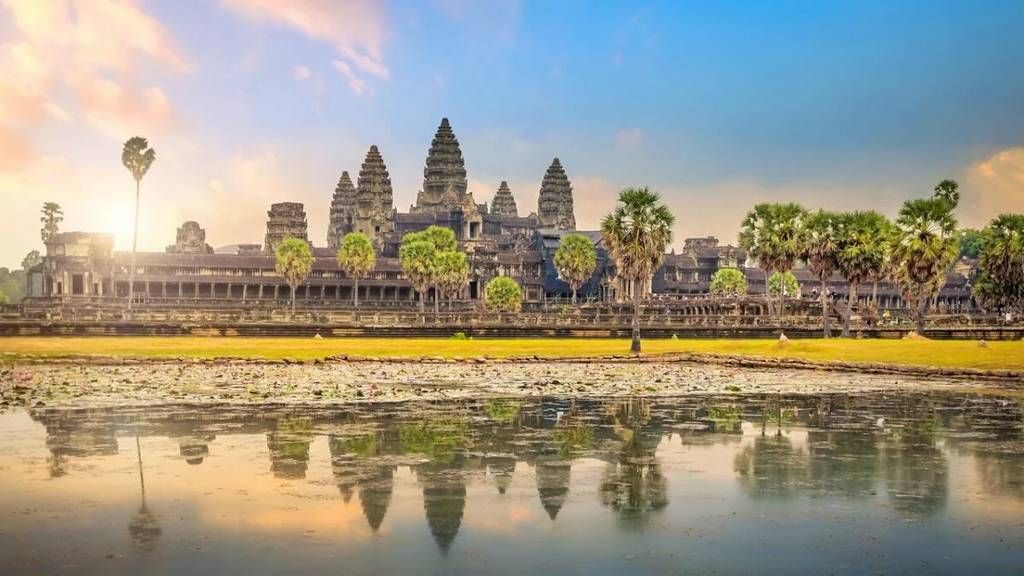
Certain real places also evoke the memory of the lost Paradise and serve as sacred sites for pagan religions, where humanity can connect with the divine. These include mountains, such as Mount Fuji in Japan, which are reminiscent of the mythical world mountain, where the heavenly realm meets the earthly. A similar role is played by the Angkor Wat temple in Cambodia, located on an artificial island called the Isle of the Pink Apple Tree.5
The aforementioned apple tree is one of many mythical trees found in various traditions. The most well-known is Yggdrasil in Norse mythology, a sacred ash tree at the centre of the Nordic cosmos, linking all realms, including Midgard (the world of humans) and Asgard (the world of gods). Trees also played a significant role in other pagan religions, particularly in sacred groves, which were widespread among Indo-European peoples, including the Slavs. Some sacred groves have survived in India to the present day.
The Biblical Paradise: The Garden of Eden
The biblical Book of Genesis describes the original Paradise, where humans lived in direct communion with their Creator—the Garden of Eden. The text states that a river flowed from Eden to water the garden before dividing into four branches.6 This suggests that the garden’s centre was elevated, with the river emerging from a hill. The Tree of Life may have stood on this hill, its fruit meant for Adam, Eve, and their descendants.7
This biblical “Golden Age” ended when Adam and Eve ate the fruit from the Tree of Knowledge of Good and Evil.8 From that moment, they were forced to live outside the garden, and each successive era in human history reflected an increasing decline in human existence. Humanity lost the Paradise it once inhabited, yet the desire to return to it has endured, shaping history and culture. This theme has been explored in literature, as exemplified by Paradise Lost by John Milton9 or Utopia by Thomas More. Humanity has also attempted to recreate Paradise in the real world by constructing its own utopias, sometimes with disastrous consequences—a subject beyond the scope of this discussion.
Will Humanity Regain the Lost Paradise?
If the archetype of Paradise is so deeply rooted in humanity that it evokes both a longing for its return and the desire to create a new paradise on Earth, why do evolutionists maintain that it never existed? The enduring desire for a perfect life, the ancient myths of a Lost Golden Age, the recurring theme of paradise and utopia in world literature, and repeated attempts to build utopian societies all suggest that humanity once had, and subsequently lost, its original Paradise.
Above all, these elements provide evidence that the biblical account of the Garden of Eden describes real events. Every key theme present in ancient myths—the Golden Age, the primordial hill, the sacred grove, the sacred tree, longevity, and a life of happiness—has its counterpart in the biblical Garden of Eden. Moreover, the motif of a paradise island may reflect the belief that, before the Flood, the Earth was a single vast supercontinent surrounded by a primordial ocean.
Evolutionists cannot explain why human nature—presumed to have adapted to brutal survival—harbours a deep longing for a life free from disease, violence, and death. The Bible, however, offers an answer to this question. Moreover, it provides hope that, through the sacrificial death of Jesus Christ, God will restore humanity to its lost paradise.10
By the way, we recommend reading the articles:
- The Origin of Viruses: Three Possible Variants
- Interactions Between Viruses and Human Organisms
- The Tower of Babel – Extra-Biblical Narratives
- Does the Big Bang Theory Exclude the Existence of God?
- The Anthropic Principle: Why Does the Universe Accommodate Life?
Footnotes
- Cherry, K., 2022. What Are the Jungian Archetypes? Very Well Mind, 2 May. Available at: https://www.verywellmind.com/what-are-jungs-4-major-archetypes-2795439.
- Jacoby, M., 2006. Longing for Paradise: Psychological Perspectives on an Archetype. Inner City Books.
- Palla, A., 2008. Z raju do raju – 4 epoki. Znaki Czasu, 12/08, pp. 12–15.
- Palla, A., 2009. Rajska wyspa. Znaki Czasu, 01/09, pp. 26–29.
- Ibid.
- The Bible, New King James Version, 1982. Genesis 2:10.
- Palla, A., 2009. Prawzgórze Edenu. Znaki Czasu, 05/09, pp. 20–23.
- The Bible, New King James Version, 1982. Genesis 3.
- Weathers, W., 1953. ‘Paradise Lost’ as Archetypal Myth. College English, 14(5), February, pp. 261–264.
- The Bible, New King James Version, 1982. John 3:16.

The portal EvolutionOfThinking.org, created by the Research and Education Institute, focuses on education and the dissemination of knowledge related to research on various aspects of human well-being.

