
A clear understanding of the physicochemical structure of viruses relies on the development of precise terminology. As Dariusz Struski notes in another article in this series on viruses, using accurate virological terms helps make the subject more accessible and easier to grasp.
In technical and scientific nomenclature, the term virus is not used in a single, strictly defined sense, although it is commonly employed in textbooks, discussions, scientific papers, or conversations, even among scientists.
It is useful to become familiar with the terms and definitions below. Using precise virological terminology makes it easier to understand viruses and their study. The following key terms and their meanings will be referred to throughout this series of articles.
Virological terminology – terms and definitions
- Viroid – A molecule of nucleic acid.
- Nucleosome – Nucleic acid + enzymatic proteins.
- Nucleocapsid – Nucleic acid + enzymatic proteins + structural protein shell.
- Capsid – The structural protein shell.
- Virion – Nucleic acid + optional enzymes + protein shell + lipid envelope.
Surprisingly, virological terms are often used loosely and guided more by intuition than consistency, which unfortunately leads to confusion and hinders effective communication. The term virus currently has three different contexts in biology. The first is equivalent to a viroid, the second to a virion, and the third to a nucleocapsid.
Essentially, only the viral nucleosome is not conceptually treated as a virus.
The term viroid is presently reserved for one particular situation, namely the presence of foreign RNA in the cytoplasm of plant cells.1
Even in this context, there is sometimes a temptation to refer to a viroid as a virus.
Virological terminology – assumptions
In this series of articles, the terms outlined above will be used, even though many virologists may regard the classification of a viroid as a general term for any ‘naked’ fragment of nucleic acid as inappropriate. In my view, this approach is justified, as it provides clarity and consistency in explaining the central idea, which focuses on the ‘fate’ of viruses in the human body and the consequences that arise. Since viroids are also described as subviral particles, they can be considered part of a virus. This series has simply adopted this perspective.
Viroid or virion?
To ensure clarity, it is important to first establish what the term ‘virus’ signifies in the context of these discussions, particularly within this series of articles. Since the word is deeply embedded in public awareness, abandoning it would serve little purpose. The key is to define its meaning clearly. The following definition has been adopted: a virus is an extracellular and therefore ‘resting’ form of a viroid.
In our articles, the common use of the word virus is thus narrowed to two forms of bioparticle conglomerates: virion and nucleocapsid, both of which exist in the extracellular environment.
The virion can be considered the most ‘sophisticated’ virus, as it contains all possible virus components, namely:
- Nucleic acid,
- Enzymatic proteins attached to the nucleic acid strand,
- Proteins forming a protective shell (called capsid proteins) that shield the nucleic acid,
- A lipid envelope protecting the entire complex from water (preventing dissolution) and from desiccation.
Not all viruses possess a lipid envelope.
The diverse world of viruses
Incidentally, the viral lipid envelope is simply a portion of the cell membrane of the cell from which the virus is expelled. Some nucleocapsids have the physicochemical property that the membrane adheres to the structural proteins (capsid proteins) during the nucleocapsid’s extrusion from the cell, and it ‘sticks’ to the virus rather than detaching from it.
The most ‘sophisticated’ virions are those known as Herpesviruses and Poxviruses, as each contains two DNA strands. Poxviruses, incidentally, are the largest pathogenic viruses in humans. They are of such considerable size that the largest can be observed under a light microscope, which is occasionally used in diagnostics when necessary.
How large is the largest virus?
The largest virus found to date is called Pithovirus sibericum. It was discovered in an amoeboid protozoan of the genus Acanthamoeba. It is of an exceptional size, measuring 1.5 × 0.5 µm, making it bigger than many bacteria and even some eukaryotic sporozoan cells. It does not, however, cause disease in humans.
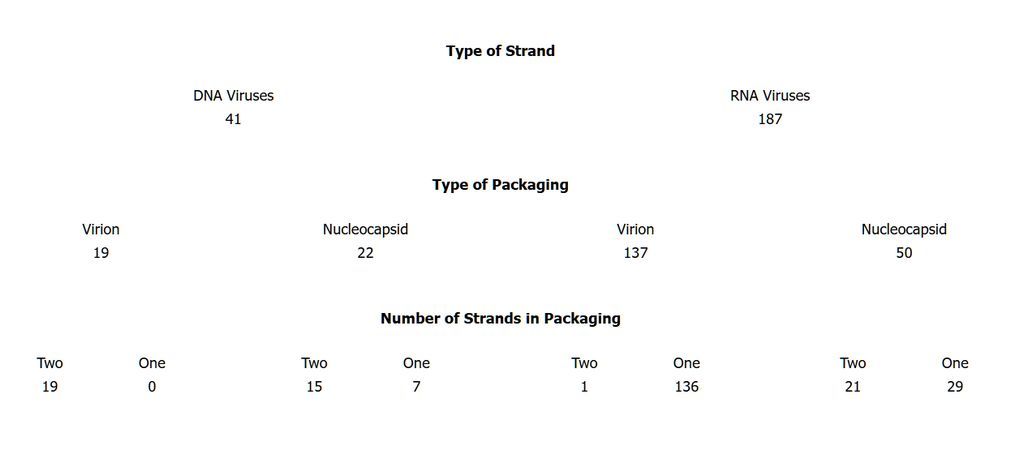
Due to the mutually exclusive presence of nucleic acids – i.e., a virus can possess either DNA or RNA, never both simultaneously – viruses are divided into two major groups: DNA viruses and RNA viruses. Below is a breakdown of the number of human-pathogenic viruses according to type of strand, ‘packaging’, and the number of strands in the ‘packaging’:
Statistical insights
A few conclusions can be drawn from this simple statistic: there are 41 pathogenic DNA viruses and 187 RNA viruses, which means that there are four times as many RNA viruses as there are DNA viruses. Why? Perhaps because nearly all RNA viruses are transmitted by animals, making the external environment less impactful. Moreover, they begin their activity within the cytoplasm, acting faster than DNA viruses, which require entry into the cell nucleus. Meanwhile, among human-pathogenic viruses, no DNA virus has a single strand ‘packaged’ into a virion. All human-pathogenic virion DNA viruses have two strands, resembling the general principle of mobile DNA fragments (plasmids or transposons).
The only double-stranded RNA virion, although it has two strands, does not contain distinct complementary strands but rather two identical copies of the same strand. This is the case with HIV-1.
About the Author
Dariusz Struski – A medical doctor specializing in family medicine with 32 years of professional experience in Poland, Sweden, and Norway. Former head of the Family Medicine Training Center in Wrocław. Currently a lecturer in Evidence-Based Medicine and family medicine, with a particular interest in infectious diseases.
By the way, we recommend reading the articles:
- Rethinking Ecosystem Engineering
- Abiogenesis: Could Life Have Arisen from Non-Living Matter
- The Transformation of Fins into Limbs
- The Evolutionary Roots of Racism
- Was Jesus Christ a Historical Figure?
Footnotes
- Goździcka-Józefiak, A. (ed.) 2019. Wirusologia, 1st edn. Warsaw: Wydawnictwo Naukowe PWN.
© Source of main image: leonardo.ai.

The portal EvolutionOfThinking.org, created by the Research and Education Institute, focuses on education and the dissemination of knowledge related to research on various aspects of human well-being.

