
The Earth’s axial precession is a subtle phenomenon that is barely perceptible during a lifetime. How did ancient civilizations uncover the phenomenon of precession?
Planetary precession refers to the slow and regular shift of a planet’s axis, resulting in a broad cone-like trajectory in the sky lasting for many centuries. This movement is similar to the oscillation of a spinning top, a common sight in children’s games. One full precessional cycle on Earth lasts around 25,920 years. Dividing the large arc into 360 degrees reveals that the celestial north pole shifts by 1° every 72 years, a change that is subtle but noticeable to those who have the patience and wisdom to watch over many generations.
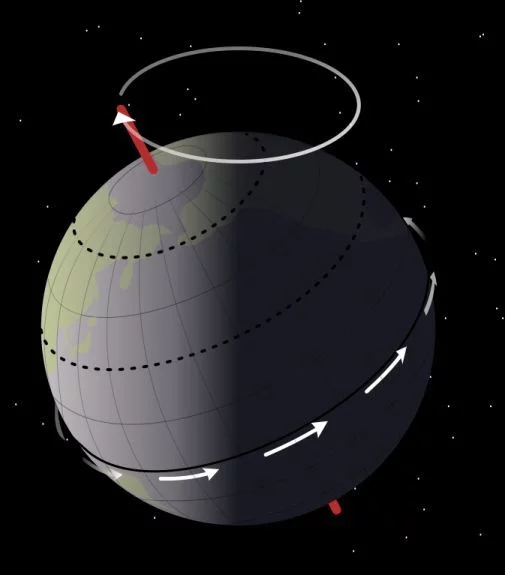
Precession and the Shift of the North Star
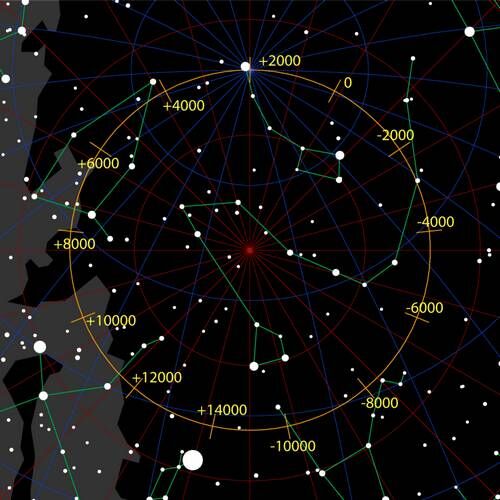
At present, the north celestial pole is located within 1° of Polaris, a star in the Ursa Minor constellation. This near alignment is why Polaris is known as the “North Star.” Nevertheless, two thousand years ago, there was no star directly aligned with the true north. Kochab, also in the Ursa Minor constellation, was the nearest option, situated approximately 5 to 6° away from the northern celestial pole. Because Earth’s axis precesses slowly, various stars located near the pole eventually become the North Star. Some notable examples are Thuban in Draco, Vega in Lyra, and Alderamin in Cepheus.
The precession of Earth’s axis also influences the timing of equinoxes and solstices. The spring equinox, in particular, holds great significance, occurring annually on March 20th or 21st, and is marked on the ecliptic by the point known as the “First Point of Aries.” Approximately 2,500 years ago, during the height of astrological study, the Sun appeared in the constellation Aries at the time of the spring equinox—hence the origin of the term “First Point of Aries.” However, today, this point has shifted into the constellation Pisces, and in approximately 1,500 years, it will move into the constellation Aquarius due to Earth’s gradual axial precession.
Ancient Knowledge of Precession
Ancient civilizations were known for their exceptional ability to observe the stars and other celestial events. Were they, however, able to notice the incredibly slight precessional shift of Earth’s axis? Hipparchus of Nicaea, a well-known Greek astronomer from 190 to 120 BC, is recognized as the first to discover precession. Surprisingly, he managed to determine its speed accurately, albeit with a slight margin of deviation.1
Precession Known in Mesopotamia
Indirect evidence implies that ancient civilizations might have known about precession or felt its impacts. The Sumerians were the first to map out the ecliptic in 360 degrees, with the Babylonians later improving on this by splitting the circle into 12 sections of 30 degrees each. These divisions were then linked to star patterns that matched where they were located on the ecliptic. The shifting location of the First Point of Aries (the vernal equinox) had significant meaning for ancient cultures, both astronomically and astrologically.
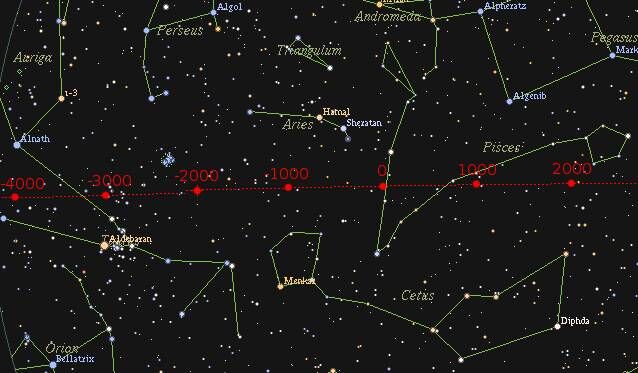
The ecliptic division, created for calendrical purposes, is also useful for studying Earth’s axial precession. Each astrological era, which spans 30° along the ecliptic, lasts about 2,160 years due to the First Point of Aries shifting at a rate of 1° every 72 years. The eras consist of the Age of Aries, the Age of Pisces, and the upcoming Age of Aquarius. It should be emphasized that the zodiac constellations and astrological eras do not align perfectly. During the period from AD 1 to AD 2160,2 the Age of Pisces is believed to occur, but the astronomical transition from Pisces to Aquarius will not happen for another 600 years.3
Precession in Egyptian Art
Located in the Egyptian Temple of Hathor at Dendera, which was built in the 1st century BC during the Greco-Roman period, is a celestial map that seems to mirror attributes from the 3rd millennium BC. The celestial sphere is shown as being upheld by twelve figures, with four placed at the corners. These four symbols are believed to represent the two equinoxes and the two solstices. Above them, in the sky, are representations of four zodiac constellations: Taurus, Leo, Scorpio, and Aquarius.4
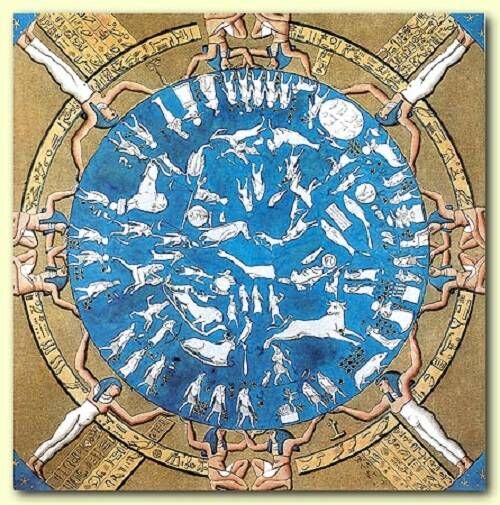
Why do these particular zodiac signs appear in these positions despite the fact that in the 1st century BC, the equinoxes and solstices were located in different constellations such as Aries, Cancer, Libra, and Capricorn? This celestial map seems to show a time when Taurus was the position of the First Point of Aries. The era of Taurus lasted from around 4320 BC to 2160 BC. The configuration of constellations on the Dendera sky map implies that the Egyptians viewed the Age of Taurus with religious or cultural importance, showing their potential understanding of the precession of the equinoxes.5
Other Ancient Symbols of Precession
Early mythologies also incorporate the ancient knowledge of precession. During the 1960s, Professor Giorgio de Santillana, a science historian at MIT, and Professor Hertha von Dechend from Frankfurt University collaborated on a book called Hamlet’s Mill. The title alludes to a myth from Iceland’s past about a celestial grinder that spins around the planet. Shakespeare’s choice to name the play Hamlet is rooted in his reworking of the legend for this famous drama).6
The writers of Hamlet’s Mill note that numerous ancient myths include numbers connected to the precession cycle, which is made up of the 25,920-year Earth axial precession. The numbers listed are 12, 36, 54, 72, 108, 240, and 360. Multiplying 72 by 360 equals 25,920, which is the number of years in Earth’s precessional cycle. The symbolic application of numbers can be seen in Hindu mythology, as the “wheel of time” is divided into 12 spokes representing the 12 zodiac constellations and thus the 12 astrological ages. Additionally, the 720 offspring of the deity Agni may symbolize the period of 72 years needed for the First Point of Aries to move 1° on the ecliptic because of precession.7
Summary
The evidence shows that ancient civilizations had knowledge about Earth’s axial precession. Despite what some evolutionists argue, ancient humans showed extraordinary talent and keen observation skills. Their remarkable intelligence enabled them to build massive buildings such as the Great Pyramid and understand the gradual change in the position of the stars. The Bible also confirms the cognitive abilities of ancient humans. Scripture states that following Noah’s flood, individuals had lifespans of 200 to 500 years.8 Their extended lifetimes would have given them the chance to witness slow shifts in Earth’s precession and pass down this information through myths to future generations.
By the way, we recommend reading the articles:
- Eugenics and Its Consequences
- Self-Transcendence – The Forgotten Human Need
- Unicorns in the Bible – Myth or Reality?
- What is the Higgs Boson?
- Exploring the Origins of Religion
Footnotes
- See https://mathshistory.st-andrews.ac.uk/Biographies/Hipparchus/.
- Some, including followers of the New Age movement, believe that we are currently in the Age of Aquarius.
- See https://www.wwu.edu/astro101/a101_precession.shtml, confirmed using the Stellarium program.
- Palla, A.J. (2008) ‘Tajemnica zodiaku’, Znaki Czasu, September, pp. 14–17.
- Palla, A.J. (2008) ibid.
- Nienhuis, J.I. (2009) Tajemnice epoki lodowcowej. Warszawa: Wydawnictwo Amber, pp. 46–50.
- Nienhuis, J.I. (2009) ibid.
- The Bible, New King James Version,1982, Genesis 11:10-31.
© Source of main image: Canva.

The portal EvolutionOfThinking.org, created by the Research and Education Institute, focuses on education and the dissemination of knowledge related to research on various aspects of human well-being.

