
We tend to assume that our understanding of the world has progressed gradually, evolving with each generation building upon the achievements of the last. But is this assumption correct? Recent findings challenge the conventional narrative of steady, incremental evolution in human civilization. Ancient civilizations may have possessed advanced knowledge and skills that still astonish us today. What historical and archaeological evidence helps us understand the true capabilities of ancient humanity?
In Part One, we delve into the remarkable accomplishments of ancient civilizations in construction and architecture, exploring the sophistication and ingenuity of their achievements.
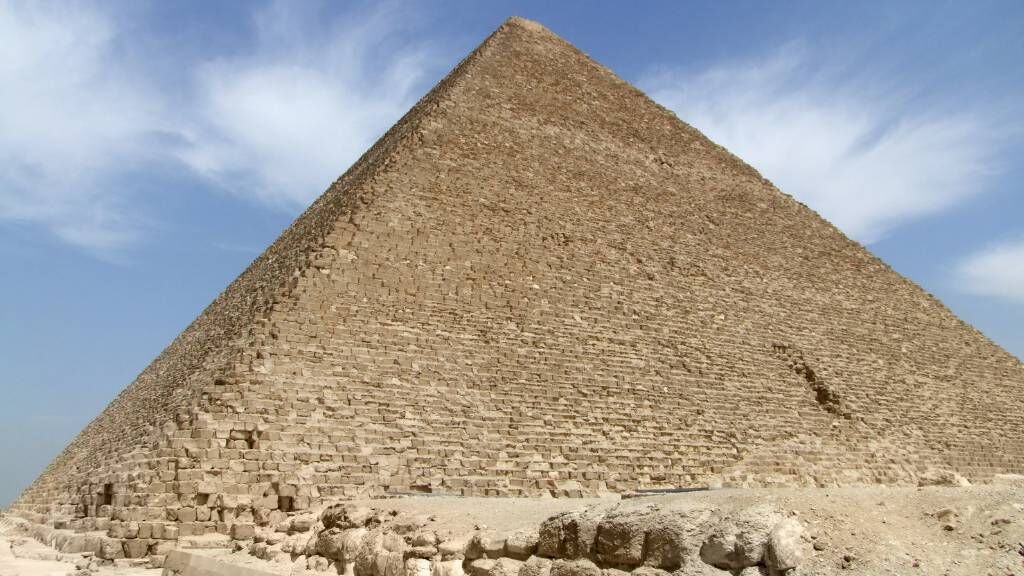
The Great Pyramid of Giza in Egypt
The most famous structures in Egypt are the three pyramids at Giza. Among the trio, Khufu’s pyramid is the most renowned, inspiring awe across generations. Secular scientists date this structure to the 26th century BCE1, while creationist scientists date it to around 2000 BCE.2 It is believed to have been built by Pharaoh Khufu of the Fourth Dynasty.
The sheer fact that the pyramid was constructed by ancient people is, in itself, a remarkable achievement worthy of great admiration. Most of the stone blocks used in its construction weigh between 2.5 and 3 tonnes, with some reaching over 50 tonnes. Altogether, the pyramid comprises approximately 2.3 million of these massive blocks.3 Today, scientists believe that the stones were transported using ramps.4 Considering their immense weight, we do not know if this was indeed the case. However, the solution must have been ingeniously simple.
Even more impressive is the fact that the Great Pyramid of Khufu exhibits intriguing properties. Recently, a team of physicists discovered that, under certain conditions, the pyramid can focus electromagnetic energy within its chambers and beneath its foundations.5 Scientists have considered this a coincidence, but is it possible that the ancient Egyptians had knowledge of electromagnetism?
There are also references to other intriguing features of the Great Pyramid. For instance, F# happens to be the resonant frequency inside the King’s Chamber.6 Additionally, a recently reconstructed primitive yet intricate mechanism within the pyramid is believed to have served as protection for the King’s Chamber.7 Undoubtedly, the Great Pyramid of Khufu still holds many unsolved mysteries.
The Indus Valley Civilization
In what is now modern-day Pakistan, a remarkable civilization once thrived in the Indus Valley, captivating scientists to this day. This civilisation comprised a network of cities spread along the Indus River valley, with Harappa and Mohenjo-Daro being the most prominent among them. According to scientific estimates, the civilisation reached its peak between 2600 and 1900 BCE8, while creationist perspectives suggest it emerged around the end of the third millennium BCE.9
These cities are remarkable in several respects, showcasing advanced achievements in agriculture, architecture, and engineering. They appear to have been planned meticulously, as though designed from scratch. Furthermore, the buildings in Harappa and Mohenjo-Daro exhibit uniformity, being constructed using the same materials and following similar architectural forms.10 This suggests that, even in such a distant era, people were engaged in advanced urban planning.
The cities of the Harappan civilisation also featured a sophisticated water supply and sewage system. Numerous public baths were built, the most notable being the Great Bath in Mohenjo-Daro. The wastewater drainage system was also highly complex and efficient,11 indicating that society in the Indus Valley civilisation had reached a high level of development.
The Civilization in the Andes
Near Lake Titicaca, in what is now Bolivia, stands the ancient temple complex of Tiwanaku, also known as Tiahuanaco. This site served as the capital of the Tiwanaku Empire between 200 and 1000 CE.12 The complex is divided into two main sections. The first includes notable features such as the Akapana Pyramid and the Kalasasaya Temple, along with other ceremonial structures. The second section, called Puma Punku, is an artificial platform featuring a sunken courtyard and an ancient structure atop it.
Puma Punku holds some of archaeology’s most intriguing mysteries. Why is this site so important? Here, scattered stone blocks with exceptionally precise shapes and indentations lie across the landscape. Their shapes suggest they may once have belonged to a much larger structure. Crafted with remarkable accuracy, these stones leave scientists wondering how such precision was achieved without the aid of modern technology.13
The Inca civilization, which emerged in the Andes in the 12th century and endured until the 16th century, left a legacy of remarkable achievements. The ancient city of Cuzco, located in what is now Peru, along with iconic structures such as the citadel of Sacsayhuamán, was built with meticulously polished stone blocks that fit together perfectly. The walls were built without mortar, yet you cannot even slip a knife blade between the stones.14 This is yet another example of the remarkable knowledge and skill demonstrated by the Inca civilization—qualities that continue to inspire admiration among people today.
Conclusions
These examples are just a few among many.15 Do they indicate that ancient civilizations had access to advanced technologies? Some theories suggest this, while others even propose that extraterrestrial beings may have contributed to—or directly built—these structures.16 Modern scientists, however, have demonstrated that monumental works like the Great Pyramid of Khufu could likely have been constructed with relatively basic tools. If so, ancient builders must have employed these tools with exceptional skill. Furthermore, certain aspects of these structures exhibit qualities that still astonish us today.
This suggests that ancient civilizations were populated by highly intelligent and creative individuals, possessing knowledge that may have been quite advanced. This concept challenges the theory of humanity’s gradual intellectual evolution, aligning more closely with the biblical narrative. The Book of Genesis, for instance, describes how Noah’s descendants lived for more than 400 years after the flood.17 Such longevity could indicate strong human health, and thus manual and mental skills, which could help explain the remarkable architectural achievements of the ancient world.
To be continued in Parts 2 and 3.
By the way, we recommend reading the articles:
- The Anthropic Principle: Why Does the Universe Accommodate Life?
- The Mythology and Origins of Dragons Across Cultures – Part 1
- Legends of Dragons from Around the World and Their Origins – Part 2
- Exploring the Origins of Religion
- Does the Bible Imply that the Earth is Flat?
Footnotes
- Budowle.pl, The Great Pyramid (Giza, Egipt) – one of the seven wonders of the world, the Great Pyramid of Giza, Available at: https://www.budowle.pl/budowla/wielka-piramida.
- Landis, D. (2012). The Genius of Ancient Man. Master Books, p. 25.
- Calvert, A., Piramida Cheopsa, Khan Academy. Available at: https://pl.khanacademy.org/humanities/ap-art-history/ancient-mediterranean-ap/ancient-egypt-ap/a/old-kingdom-pyramid-of-khufu.
- Down, D. and Ashton, J. (2006). Khufu Built the Big One – Chapter 5. Unwrapping the Pharaohs. Master Books. Available at: https://answersingenesis.org/archaeology/ancient-egypt/khufu-built-the-big-one/.
- Georgiou, A. (2018). Ancient Egypt: Incredible Electromagnetic Discovery in Great Pyramid of Giza’s Hidden Chambers. Newsweek, 31 July. Available at: https://www.newsweek.com/ancient-egypt-incredible-electromagnetic-discovery-great-pyramid-gizas-hidden-1049578.
- Landis, D., The Genius of Ancient Man, op. cit.
- Natasha, P. (2021). ‘Primitive Machine’ Within Great Pyramid of Giza Reconstructed. HT, 23 March. Available at: https://www.histecho.com/primitive-machine-within-great-pyramid-of-giza-reconstructed/.
- Allchin, R.F. et al., Indus civilization. Encyclopaedia Britannica. Available at: https://www.britannica.com/topic/Indus-civilization.
- Landis, D. (2015). The Secrets of Ancient Man. Master Books, p. 45.
- Landis, D., The Secrets of Ancient Man, ibid.
- Harappa.com, Sanitation in the Indus Valley. Available at: https://www.harappa.com/category/slide-subject/sanitation
- Cartwright, M. (2014). Tiwanaku. World History Encyclopedia, 17 March. Available at: https://www.worldhistory.org/Tiwanaku/.
- Patowary, K. (2015). The Mystery of Puma Punku’s Precise Stonework. Amusing Planet, 16 May. Available at: https://www.amusingplanet.com/2015/05/the-mystery-of-puma-punkus-precise.html.
- Landis, D., The Genius of Ancient Man, op. cit., p. 70.
- Landis, D. (2013). Ancient Man and Intelligence: Were People Originally Dumb Brutes or Brilliant? In The New Answers Book 4. Master Books. Available at: https://answersingenesis.org/human-evolution/brilliant-or-dumb-brutes/.
- Drake, N. (2017). 7 Sites Some People Think They Were Built by Aliens. National Geographic, 26 October. Available at: https://www.nationalgeographic.com/travel/article/ancient-sites-built-by-aliens.
- The Bible, New King James Version, 1982, Genesis 11:10-32.
© Source of main image: Canva.

The portal EvolutionOfThinking.org, created by the Research and Education Institute, focuses on education and the dissemination of knowledge related to research on various aspects of human well-being.

