
The Miller-Urey experiment is one of the most well-known scientific attempts to support the theory of abiogenesis. Interestingly, however, it could be argued that it demonstrated the opposite.
Abiogenesis, also referred to as chemical evolution or spontaneous generation, is the hypothesis that life could have originated naturally from non-living matter. This idea dates back to the ancient Greeks, who believed that living organisms could emerge spontaneously.1 In the 19th century, however, this theory gained renewed scientific interest, bolstered by leading figures such as Charles Darwin. Though Darwin did not state his beliefs on this issue outright, he entertained the idea that life might have arisen through spontaneous generation rather than through an act of intelligent intervention.2 It was not until the 1920s that more rigorous scientific research on abiogenesis began to emerge. The most widely accepted hypothesis at that time became the ‘primordial soup’ theory, suggesting that the first living organisms arose from a nutrient-rich, prebiotic environment.
What Was the Miller-Urey Experiment?
In 1952, Stanley Miller, a graduate student at the University of Chicago, conducted a now-famous experiment under the guidance of chemist Harold Urey to confirm this hypothesis. Miller and Urey used connected flasks containing gases simulating the Earth’s early atmosphere, electrodes simulating atmospheric discharges (energy source), heated water simulating the ocean, and trapped cooled water, in which they hoped to find the amino acids necessary for life to arise. Scientists believed the primordial atmosphere was strongly reducing3, i.e., oxygen-free, consisting mainly of methane, ammonia, water vapor, and hydrogen.
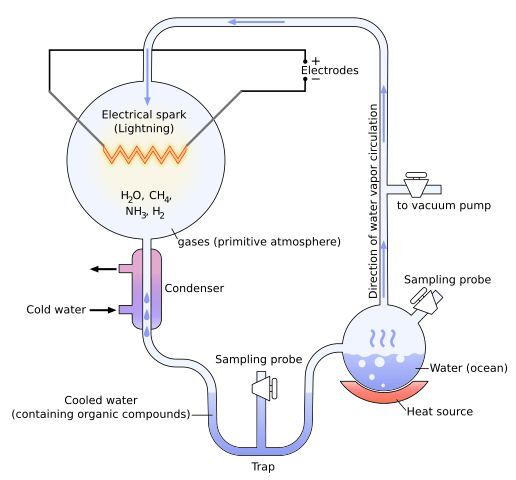
The experiment yielded interesting results. After a week, the trapped water contained five amino acids: glycine, α-alanine, β-alanine, aspartic acid, and α-aminobutyric acid.4 These results were considered a success for the theory of abiogenesis. Additionally, after Miller’s death in 2007, scientists reexamined the samples and found over 20 different amino acids in total.5
In 2010, researchers uncovered the results of a lesser-known experiment conducted by Miller in 1958, in which he used hydrogen sulfide in place of hydrogen. The findings from this experiment closely mirrored those of his 1952 experiment.6 While scientists now believe that Earth’s prebiotic atmosphere was significantly less reducing than Miller initially assumed, they suggest that localised conditions may still have allowed for the formation of amino acids.7
Issues with the Experiment
Can we conclude from this experiment that life could truly arise on its own? Regrettably, we cannot. This experiment encounters several substantial limitations, and only a few of these will be explored here. A primary issue is that less than half of the amino acids generated in the experiment can create the protein peptides vital for life. The other essential amino acids would require significantly more complex natural conditions to form, presenting a major challenge for any theory of spontaneous life formation.8
A more significant issue, however, is that these amino acids made up only a tiny fraction of the substances found in the flask. The Miller-Urey experiment predominantly produced a variety of tar-like, carcinogenic substances that are highly inhospitable to life. In fact, glycine comprised only 1.05% of the mass in the trapped sediment, alanine followed at 0.75%, and the next amino acid appeared in merely trace amounts, at 0.026%.9 As Miller himself noted, ‘The total amount [of amino acids] proved small in relation to the energy used’.10 Thus, amino acids trapped by this toxic residue could not accomplish anything.
The Miller-Urey Experiment and the Problem of Homochirality
Further challenges arise, among which the issue of homochirality is particularly significant.11 Molecular chirality refers to the property of certain chemical molecules, especially organic ones, to exist in either left- or right-handed forms. Two identical molecules that are mirror images but cannot be superimposed are known as enantiomers. When these enantiomers are present in roughly equal proportions, the resulting blend is called a racemic mixture or racemate. In nature, such racemic mixtures are commonly formed, and the amino acids generated in the Miller-Urey experiment also resulted in a racemic mixture.12
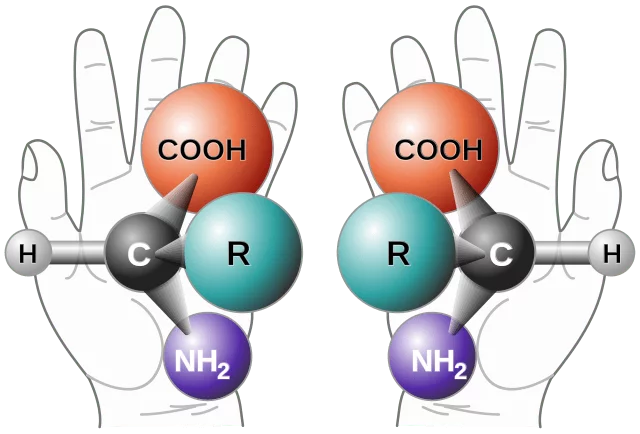
The problem is that all life on Earth relies almost entirely on left-handed amino acids and right-handed hydrocarbons. Almost all enzymes in our cells are adapted to work with left-handed amino acids and right-handed hydrocarbons.13 Life on Earth is essentially homochiral. Even more concerning, the mirror-image molecules—right-handed amino acids and left-handed hydrocarbons—are toxic to life. Consequently, the racemic mixture of amino acids produced in the Miller-Urey experiment would be unusable for life. To date, all efforts to naturally induce homochirality in amino acids have been unsuccessful.
Summary
Additional challenges to the spontaneous emergence of life include issues such as stable polymerization14, DNA coding, the formation of protein structures, energy harnessing, storage, and cellular utilization, among many others.15 The Miller-Urey experiment did not address these complexities. In fact, the issues raised by the experiment suggest that it may have taken us further from solving the mystery of life’s origins rather than bringing us closer.
The simplest biological cell is vastly more complex in structure than any form of non-living matter. This complexity suggests the possible involvement of an intelligent agency in the origin of life. If a bacterial cell presents characteristics that seem purposefully arranged, it invites us to consider whether an Intelligent Designer might indeed be responsible.
By the way, we recommend reading the articles:
- Göbekli Tepe – A Great Mystery for Historians
- Social Darwinism and Its Impact on Society
- Interactions Between Viruses and Human Organisms
- Defining the Human-Animal Divide
- Unicorns in the Bible – Myth or Reality?
Footnotes
- Lacey, T., Abiogenesis: Can Life Come from Non-Living Chemicals?, Answers in Genesis (2021). Available at: https://answersingenesis.org/origin-of-life/abiogenesis/.
- Peretó, J., Català, J., Darwinism and the Origin of Life, Evolution: Education and Outreach, Vol. 5 (2012), pp. 337–341. Available at: https://evolution-outreach.biomedcentral.com/articles/10.1007/s12052-012-0442-x.
- Reducing in the sense of diminishing the oxidation of molecules, which is damaging to life.
- Miller, S.L., Production of Amino Acids Under Possible Primitive Earth Conditions, Science, Vol. 117, No. 3046 (1953), p. 529. Available at: https://www.abenteuer-universum.de/pdf/miller_1953.pdf.
- Myers, P.Z., Old Scientists Never Clean Out Their Refrigerators, Pharyngula (Science Blogs) (2008). Available at: https://web.archive.org/web/20081017231050/http://scienceblogs.com/pharyngula/2008/10/old_scientists_never_clean_out.php.
- Parker, E.T., et al., Primordial Synthesis of Amines and Amino Acids in a 1958 Miller H2S-Rich Spark Discharge Experiment, Proceedings of the National Academy of Sciences USA, Vol. 108, No. 14 (2011), pp. 5526–5531. Available at: https://www.ncbi.nlm.nih.gov/pmc/articles/PMC3078417/.
- Myers, P.Z., op. cit.
- Bergman, J., Why the Miller–Urey Research Argues Against Abiogenesis, Journal of Creation, Vol. 18, No. 2 (2002), pp. 28–36. Available at: https://creation.com/why-the-miller-urey-research-argues-against-abiogenesis.
- Ibid.
- Miller, S.L., op. cit.
- Sarfati, J., Origin of Life: The Chirality Problem, Journal of Creation, Vol. 12, No. 3 (1998), pp. 263–266. Available at: https://creation.com/origin-of-life-the-chirality-problem.
- Bergman, J., op. cit.
- Ibid.
- Sarfati, J., Origin of Life: The Polymerisation Problem, Journal of Creation, Vol. 12, No. 3 (1998), pp. 281–284. Available at: https://creation.com/origin-of-life-the-polymerization-problem.
- Doyle, S., How to Read the Secular Literature on Chemical Evolution (i.e. ‘Abiogenesis’) Critically, Creation Ministries International (2017). Available at: https://creation.com/origin-of-life-research.
© Source of main image: Canva.

The portal EvolutionOfThinking.org, created by the Research and Education Institute, focuses on education and the dissemination of knowledge related to research on various aspects of human well-being.

