
The term “axis of evil” has a range of implications, but in cosmology, it is referred to as “evil” because it could fundamentally challenge the validity of the Big Bang theory.
Cosmic Microwave Background (CMB) radiation is a form of cosmic radiation that reaches us uniformly from all directions across the Universe. Its existence was first predicted by scientists in 1948. According to current theories, around 380,000 years after the Big Bang, the Universe had cooled to an average temperature of approximately 3000 K. However, as the Universe has continued to expand, this radiation has cooled significantly, now measuring just a few degrees above absolute zero (Kelvin). Today, we observe this ancient radiation in the microwave region of the electromagnetic spectrum, providing us with a glimpse into the early conditions of the Universe.1
In 1965, radio astronomers Arno Penzias and Robert Wilson discovered a specific type of radiation with a temperature slightly below 3 K (-270°C). Known as the Cosmic Microwave Background (CMB), this discovery provided compelling evidence for the occurrence of the Big Bang.2
Research on the Cosmic Microwave Background (CMB) continued, raising a significant question: is the temperature of the CMB entirely uniform? If it were, astrophysical theories suggest that clusters of matter, which later attracted more matter to form stars and galaxies, could not have developed. Thus, scientists concluded that there must be slight regional temperature variations, estimated at around 0.0003 K.
The COBE satellite, launched in 1989, confirmed that the temperature of the Cosmic Microwave Background (CMB) is nearly uniform across the sky. Only later did statistical analyses reveal slight temperature fluctuations; however, these were ten times smaller than the predictions of the Big Bang model at that time—measuring just 0.00003 K.3
The Axis of Evil and the Cold Spot
These fluctuations were later confirmed by another satellite, WMAP, which enabled scientists to create a detailed statistical map of the CMB. Analysing WMAP’s data, researchers quickly identified two intriguing features in the radiation. The first was a broad band of warmer-than-average temperatures. While the Big Bang model accounts for smaller, localised temperature variations, it does not offer an explanation for such an extensive region of elevated temperature. This unusual strip was dubbed the ‘axis of evil’. Although it appears prominently in only one area of the map, it spans the entire circumference. A subsequent map produced by the Planck mission confirmed the presence of the axis of evil, making it even more prominent.4
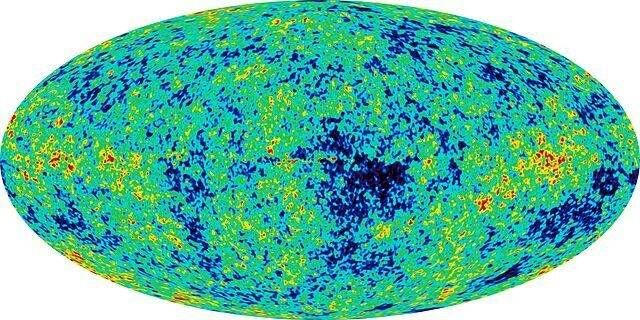
The ‘cold spot’ is a distinct feature of the cosmic microwave background (CMB), where the temperature dips by about 0.00007 K below the average. This anomaly is thought to correspond with an enormous region known as the ‘Great Void’—a sparse area of the Universe with minimal matter. For the Great Void to account for the cold spot, it would need to be situated roughly 6 to 10 billion light-years away and span a vast 500 million to 1 billion light-years in diameter. By comparison, the distance to the Andromeda Galaxy, our closest spiral galaxy, is a mere 2.5 million light-years. The cold spot’s presence was later confirmed by the Planck mission, strengthening the case for its importance in cosmological studies.5
Axis of Evil and the Solar System
The term ‘cosmic axis of evil’ was not coined merely because its scale challenges the standard Big Bang model; it also possesses a particularly intriguing characteristic. This axis appears to align strikingly well with our Solar System, specifically with the solar ecliptic—the path along which the Sun and planets travel across the sky. In other words, the ‘axis of evil’ seems to correspond with the orbital plane of the planets in our Solar System. But how is this possible?
This axis seems to split the Cosmic Microwave Background (CMB) into two distinct halves: the overall temperature of the upper half is marginally cooler than that of the lower half. Temperature analyses of the CMB, especially through quadrupole and octupole studies6 also support this division. It appears to align with the points where the ecliptic and Earth’s celestial equator intersect. Remarkably, these points are also close to 90° from the Solar System’s movement vectors in space.7 How is this possible? Scientists have yet to fully understand or explain these findings.

Does this imply that the Cosmic Microwave Background (CMB) is somehow remarkably aligned with the Solar System? The standard Big Bang model does not predict any such correlation, as this would suggest that our Galaxy—or even the Solar System—holds a unique cosmological significance. In other words, it would imply that we occupy a special, perhaps central, position in the Universe.8 This notion, however, has been set aside by contemporary scientists, who favor the Copernican principle, which asserts that we are not in any uniquely privileged location within the Universe.
Axis of Evil and the Big Bang
Is it possible that we occupy a central position in the Universe? While we cannot affirm or refute this with complete certainty, there appears to be a strong likelihood that the CMB field is somehow influenced by our local planetary environment. Without such an explanation, we would be left with an improbable coincidence. Danny R. Faulkner, an American astronomer, has even proposed that the CMB might more accurately be termed the ‘Local Microwave Background’ (LMB). This interpretation would suggest that the microwave radiation does not originate from the outer reaches of the Universe but is instead produced locally.9
If this is indeed the case, then the CMB/LMB could no longer serve as direct evidence supporting the Big Bang theory. In other words, all of modern cosmology would have to be set aside. Lawrence M. Krauss, an American-Canadian cosmologist and physicist, commented on the axis of evil problem as follows:
‘The new results are either telling us that all of science is wrong and we’re the center of the universe, or maybe the data is imply incorrect, or maybe it’s telling us there’s something weird about the microwave background results and that maybe, maybe there’s something wrong with our theories on the larger scales’.10
Dr. Faulkner agrees with these doubts and adds, ‘Given that this would make nearly everything published in cosmology over the past half century wrong, cosmologists will have tremendous resistance to this possibility’.11
Conclusion
Research into the Cosmic Microwave Background (CMB) and its unusual characteristics is still unfolding. Nonetheless, it is worth considering the possibility that this radiation may not ultimately confirm the Big Bang theory. While the Creator could have employed a Big Bang in the process of forming the Universe, this may not have been a necessity. If future findings indicate that the CMB is unrelated to a spontaneous origin of the Universe, the Big Bang theory may face substantial reconsideration or even risk relegation to the status of an unproven hypothesis, one based more on belief than empirical science. In such a scenario, the most logical alternative would point to the Universe’s origin through intelligent design, suggesting an intentional act of creation by an Intelligent Designer—God, the Creator.
By the way, we recommend reading the articles:
- What is the Higgs Boson?
- Earth’s Axial Precession in Ancient Thought
- Exploring the Origins of Religion
- Defining the Human-Animal Divide
- The Tower of Babel – Extra-Biblical Narratives
Footnotes
- Aron, J., “Planck Shows Almost Perfect Cosmos – Plus Axis of Evil,” New Scientist (2013), https://www.newscientist.com/article/dn23301-planck-shows-almost-perfect-cosmos-plus-axis-of-evil/#.UydM6hAXd2A.
- Faulkner, D.R., “The Axis of Evil and the Cold Spot: Serious Problems for the Big Bang?” Answers in Genesis (2018), https://answersingenesis.org/big-bang/axis-evil-cold-spot-serious-problems-big-bang/.
- Ibid.
- Ibid.
- Ibid.
- These are mathematical constructs that enable dividing a given sphere into several equal parts. Dipoles divide the sphere into two parts, quadrupoles into four, and octupoles into eight, thus allowing for the analysis of average values (in this case, temperature) within these parts.
- Hartnett, J., “CMB Conundrums,” Journal of Creation, vol. 20, no. 2 (2006), pp. 10-11, https://creation.com/cmb-conundrums.
- Ibid.
- Faulkner, D.R., “Comments on the Cosmic Microwave Background,” Answers Research Journal (2014), pp. 83–90, https://answersresearchjournal.org/cosmic-microwave-background/.
- “The Energy of Empty Space That Isn’t Zero,” Edge.org (2006), https://www.edge.org/conversation/the-energy-of-empty-space-that-isn-39t-zero.
- Faulkner, D.R., “Comments…,” op. cit.
© Source of main image: Canva.

The portal EvolutionOfThinking.org, created by the Research and Education Institute, focuses on education and the dissemination of knowledge related to research on various aspects of human well-being.

