
The entire universe is a complex structure made up of individual galaxies. These galaxies are grouped into clusters, which in turn form superclusters separated by vast cosmic voids containing only single galaxies. Galaxies themselves are remarkable objects, appearing in a range of shapes and sizes. Spiral galaxies are particularly striking and offer an impressive view through a telescope. They also appear to offer evidence relevant to the question of the universe’s age.
What are galaxies?
A galaxy is a vast system composed of gravitationally bound stars, interstellar dust and gas, planets, and dark matter. Galaxies are often described as ‘islands of stars’. As is frequently observed in nature, no two objects are identical, and galaxies are no exception. They differ in size, ranging from the smallest dwarf spheroidal galaxies to the largest, such as IC 1101, which spans a diameter of four million light-years and contains an estimated one hundred trillion stars.1 Our own galaxy, measuring approximately one hundred thousand light-years across, contains between one hundred and four hundred billion stars.2
Galaxies are commonly classified into three principal types: spiral, elliptical, and irregular. Spiral galaxies may or may not exhibit a central bar and are further categorised according to the tightness of their spiral arms. Elliptical galaxies are classified by shape, from nearly circular to highly elongated. Lenticular galaxies occupy an intermediate position between spiral and elliptical types, while Magellanic-type galaxies are transitional between spiral and irregular forms. There are also ring galaxies, such as Hoag’s Object and the Cartwheel Galaxy.
Spiral galaxies
The most recognisable galaxies are spiral in form. They contain a central core and several arms that differ in curvature. Some also feature a bar that passes through the galactic nucleus. The Milky Way, often referred to simply as the Galaxy, is classified as a barred spiral galaxy.
Spiral galaxies are striking features of the night sky, although they are usually visible only through telescopes. The most well-known spiral galaxy beyond the Milky Way is the Andromeda Galaxy, which can be seen with the naked eye. Other notable spiral galaxies include the Triangulum Galaxy, the Whirlpool Galaxy, the Pinwheel Galaxy, and the Black Eye Galaxy.
Theories on the formation of galaxies
Secular scientists maintain that galaxies developed through natural processes. They are believed to have emerged several hundred million years after the Big Bang, approximately thirteen billion years ago. However, the precise cause of their formation remains unknown. Two main categories of theories attempt to explain the origin of galaxies.3 The first proposes a top-down model, in which galaxies formed through the collapse of large-scale gas clouds. The second suggests a bottom-up process, where clusters of newly formed stars gradually combined to form galaxies.
Regardless of which theory is favoured, secular scientists generally agree that galaxies originated in the early universe, around thirteen billion years ago. The Milky Way is believed to be of comparable age.
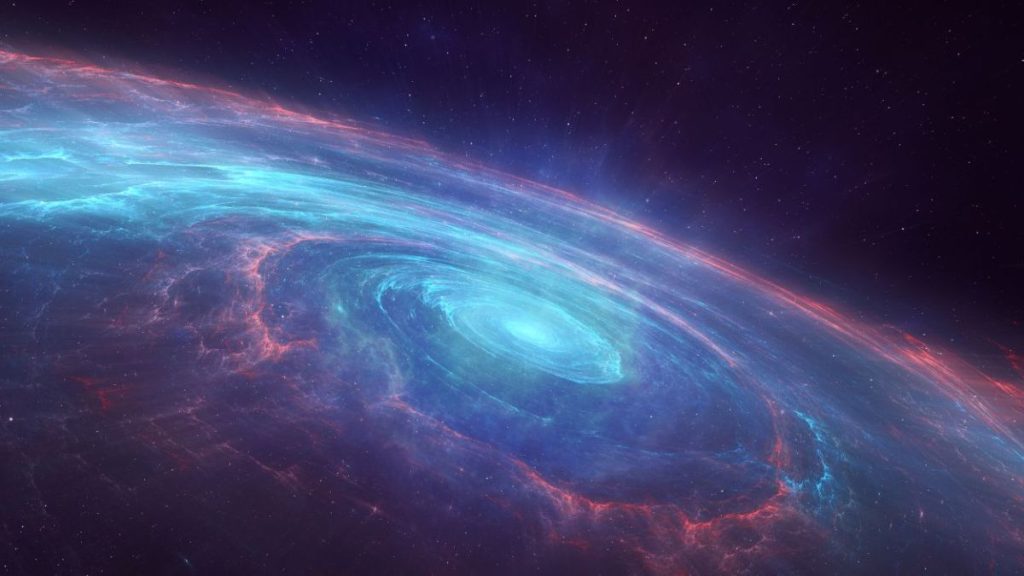
Spirals with a twist
A major issue concerns the age of galaxies. As early as the 1930s, astronomers observed that stars located in the outer regions of galaxies orbit their dense central cores more slowly than stars situated closer to the centre. This phenomenon is known as differential rotation.4 Although the outer stars move at approximately the same absolute speed as the inner ones, a problem arises because they must follow much larger orbital paths around the galactic nucleus.6 As a result, their angular velocity is significantly lower than that of stars nearer the centre.
This means that after only a few revolutions of the outer stars, the spiral arms of galaxies should become noticeably twisted around the nucleus and lose their structure.7 Within several hundred million years, the spiral arms would be expected to become so distorted that the galaxy would no longer appear as a spiral.8 For example, it is estimated that our solar system requires around two hundred million years to complete one orbit around the Milky Way. If it had already completed several orbits, the galaxy would by now appear heavily twisted.
Not just the Milky Way
This problem is not confined to the Milky Way. Across the universe, numerous galaxies are observed that are not significantly twisted. If these galaxies were billions of years old, they would already exhibit substantial distortion. Yet this is not the case. Such observations suggest that galaxies are much younger than current secular science and the Big Bang theory claim. They cannot be billions, or even hundreds of millions, of years old.
Astronomical data also show that fully formed galaxies exist near the edge of the observable universe. The most distant known galaxy, GN-z11, an irregular galaxy, is located 13.4 billion light-years away.9 The most distant spiral galaxy identified to date, BRI 1335-0417, was discovered recently and lies at a distance of 12.4 billion light-years.10 These findings indicate that spiral galaxies have not undergone notable evolutionary change. This raises a fundamental question: what is their actual age?
Conclusion
A growing body of scientific evidence, including astronomical observations, suggests that the universe is significantly younger than proposed by secular science. The Bible states that God created all things relatively recently, including the stars, and by extension, the galaxies. Spiral galaxies appear to provide observable evidence in support of a young universe.
By the way, we recommend reading the articles:
- Christianity and the Discovery of Exoplanets
- The Sun – A Unique Star
- The James Webb Space Telescope and Its Surprising Discoveries
- Exploring Theories of a Godless Universe (Part One)
- Exploring Theories of a Godless Universe (Part Two)
- Exploring Theories of a Godless Universe (Part Three)
Footnotes
- Constellation Guide (2021) ‘IC 1101’, Constellation Guide, 18 January. Available at: https://www.constellation-guide.com/ic-1101/
- Masetti, M. (2015) ‘How Many Stars in the Milky Way?’, NASA, 22 July. Available at: https://asd.gsfc.nasa.gov/blueshift/index.php/2015/07/22/how-many-stars-in-the-milky-way/
- Iwanicki, G. (n.d.) ‘Czym są galaktyki?’, Urania. Available at: https://www.urania.edu.pl/galaktyki/czym-sa-galaktyki.html
- Lisle, J. (2006) ‘The Age of The Universe, Part 2’, in Taking Back Astronomy. Master Books. Available at: https://answersingenesis.org/astronomy/the-age-of-the-universe-part-2/
- Theoretical models predicted that stars farther from the galactic center would move slower, similar to planets around the Sun. However, this is not the case. The velocity of these stars is comparable to, if not greater than, those closer to the galactic center. According to scientists, this is due to the influence of dark matter in the galactic arms. Nonetheless, even dark matter does not resolve the issue of differential rotation in spiral galaxies.
- Stars in the galactic core move very slowly.
- Faulkner, D.R. (2011) ‘Galaxies – Unexplained Spirals’, Answers Magazine, 6(1), pp. 54–56. Available at: https://answersingenesis.org/astronomy/cosmology/galaxies-unexplained-spirals/
- DeYoung, D. and Lisle, J. (2010) ‘Does Astronomy Confirm a Young Universe?’, in The New Answers Book 3. Master Books. Available at: https://answersingenesis.org/astronomy/age-of-the-universe/does-astronomy-confirm-a-young-universe/
- University of Tokyo (2020) ‘The farthest galaxy in the universe’, 15 December. Available at: https://www.u-tokyo.ac.jp/focus/en/press/z0508_00153.html
- Nowak, A. (2021) ‘ALMA odkrywa najbardziej starożytną galaktykę spiralną’, Urania, 21 May. Available at: https://www.urania.edu.pl/wiadomosci/alma-odkrywa-najbardziej-starozytna-galaktyke-spiralna
© Source of main image: Canva.

The portal EvolutionOfThinking.org, created by the Research and Education Institute, focuses on education and the dissemination of knowledge related to research on various aspects of human well-being.

