
The ocean floor holds many geological secrets. Recent research shows that, contrary to earlier assumptions, the rate of seafloor spreading varies over time and is currently decreasing. What forces might be driving this change?
A supercontinent and its breakup
All reputable scientists agree that the continents now visible on Earth were once joined together as a single supercontinent known as Pangaea. At a certain point in geological history, this landmass divided into two major sections: Laurasia in the north and Gondwana in the south. These subsequently fragmented into smaller landmasses, eventually forming the continents as we recognise them today. This process forms the basis of plate tectonic theory, which concerns not only the movement of continental plates but also that of oceanic plates.
A notable example of the boundaries that define modern tectonic plates can be found in the middle of the Atlantic Ocean. This is the Mid-Atlantic Ridge, which in some places spans up to 1,600 kilometres in width and rises prominently above the surrounding ocean floor on both its eastern and western flanks. The ridge marks the boundary between several major tectonic plates: it separates the North American plate from the Eurasian plate in the north, and from the African plate in the south. It also divides the South American plate from the African plate.
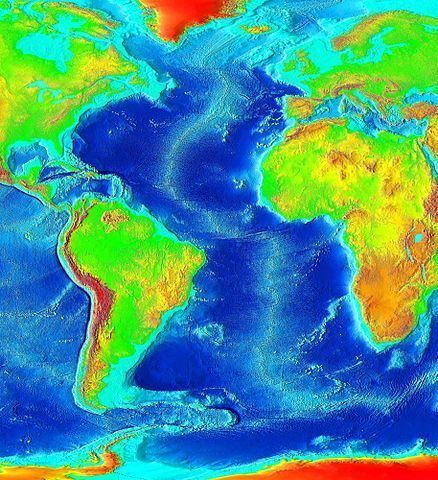
How is the ocean floor formed?
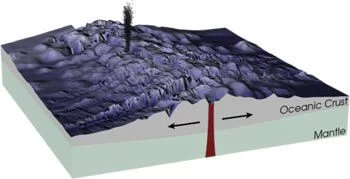
The Mid-Atlantic Ridge drives the gradual separation of continents at a rate of approximately 1 to 10 centimetres per year, depending on the specific location.1 In effect, this is the rate at which the ocean floor expands. The process occurs because, at the centre of the Mid-Atlantic Ridge, there is a spreading zone—a narrow region where magma rises from the Earth’s mantle. As this magma reaches the surface and comes into contact with seawater, it cools and solidifies, forming new oceanic crust.
This entire process of spreading and seafloor formation is propelled by convection currents within the Earth’s mantle. Beneath the Mid-Atlantic Ridge, these currents transport magma upward before redirecting it laterally towards subduction zones, such as those found along the western coasts of the Americas. In those zones, the material descends once again into the mantle. At the same time, the convection currents exert a pulling force on the overlying tectonic plates, contributing to their movement.
Scientists observe a decline in seafloor spreading
Since the development of plate tectonic theory, evolutionary scientists have generally assumed that the rate of seafloor spreading has remained relatively constant. This assumption was believed to apply over the past 175 million years, following the breakup of Pangaea.2 Recent research, however, challenges this long-standing view.
Researchers from Brown University and the University of California, Santa Barbara, analysed 18 ocean ridges across the globe to investigate variations in their spreading rates. The pace of seafloor expansion has a direct impact on the Earth’s climate, particularly through its influence on atmospheric gas levels, which are partly affected by volcanic emissions.3 Increased rates of seafloor spreading are associated with higher levels of volcanic activity.
Researchers analysed ocean floor rocks and their magnetic signatures, which, according to conventional dating methods, extend back 19 million years. The findings indicate that the rate of seafloor spreading has declined.4 This deceleration is thought to have begun approximately 15 to 16 million years ago. From that point until approximately 5–6 million years ago, and continuing to the present, the rate of seafloor expansion is estimated to have decreased by about 35–40%.5
In addition, it was discovered that subduction near Borneo (Indonesia) ceased entirely around 5 million years ago, based on evolutionary timescales. Scientists acknowledge that the cause of this cessation remains unknown.6
The biblical perspective
Secular scientists have yet to provide a clear explanation for the observed slowing of seafloor spreading. This phenomenon, however, was anticipated by creationist researchers who maintain that the supercontinent Pangaea fragmented into smaller landmasses during the biblical Flood.7 According to the Bible, the Flood lasted a year,8 which would imply that the breakup of Pangaea occurred within that same timeframe, rather than over a span of 175 million years.
In 1993, creationist geophysicist John Baumgardner developed a model demonstrating that catastrophic plate tectonics are possible, in contrast to conventional evolutionary assumptions. His model proposes that the breakup of Pangaea took place rapidly and catastrophically during the global Flood.9 As a result, by the end of the Flood, the rate of continental drift would have slowed considerably, reaching the pace observed today.
Although rooted in a creationist framework, Baumgardner’s work is still recognised by some scientists as one of the most comprehensive models of continental drift. It is also considered by its proponents to offer the most coherent explanation for the documented decline in seafloor spreading rates.
By the way, we recommend reading the articles:
- Mount St. Helens: A Living Research Laboratory
- Stromatolites: Unveiling the Mystery of the “Living Stones”
- Durupinar – Has Noah’s Ark Been Found?
- How Long Did Crude Oil Actually Take to Form?
- Where Did the Waters of the Flood Go?
Footnotes
- Encyclopaedia Britannica (n.d.) ‘Mid-Atlantic Ridge’. Available at: https://www.britannica.com/place/Mid-Atlantic-Ridge
- Masterson, A. (2017) ‘Pangaea break-up fueled climate change’, Cosmos, 13 November. Available at: https://cosmosmagazine.com/earth/climate/pangaea-break-up-fuelled-early-climate-change/
- Masterson, A. (2017) ‘Pangaea break-up fueled climate change’, Cosmos, 13 November.
- Clarey, T. (2022) ‘Seafloor Spreading Matches Creation Predictions’, Institute for Creation Research, 23 May. Available at: https://www.icr.org/article/subduction-predictions
- Science Daily (2022) ‘Seafloor spreading has been slowing down’, 14 April. Available at: https://www.sciencedaily.com/releases/2022/04/220414125055.htm
- Clarey, T. (2022) ‘Seafloor Spreading Matches Creation Predictions’, Institute for Creation Research, 23 May.
- Wieland, C. and Batten, D. (1997) ‘Probing the earth’s deep places’, Creation, 19(3), June, pp. 40–43. Available at: https://creation.com/probing-the-earths-deep-places
- The Bible, New King James Version, 1982, Genesis 7:11; 8:13–14.
- Wieland, C. and Batten, D. (1997) ‘Probing the earth’s deep places’, Creation, 19(3), June, pp. 40–43.
© Source of main image: Canva.

The portal EvolutionOfThinking.org, created by the Research and Education Institute, focuses on education and the dissemination of knowledge related to research on various aspects of human well-being.

