
This discovery was unforeseen by evolutionary scientists. Recently, evidence of an ancient rainforest was uncovered in Antarctica, with the findings published in the reputable Nature journal.1
The authors of the study state that this forested part of Antarctica was located near the South Pole when the forest was thriving, at roughly 82° south latitude.1 How could temperate rainforests have existed so close to the South Pole and survived over four months of complete darkness each year?
Research
Johann Klages from the Alfred Wegener Institute, along with a group of European scientists, extracted a sediment core from the Amundsen Sea in West Antarctica using a drilling ship between February and March 2017.2 The sediments were dated to the Cretaceous period, with an estimated age of 84 to 94 million years1. CNN reported the following:
‘CT scans of the sediment core revealed pristine samples of forest soil, pollen, spores and even root systems so well preserved that [the researchers] could identify cell structures. The soil included examples of pollen from the first flowering plants found this close to the South Pole.’2
Today, temperatures in Antarctica range from -60°C to -10°C, but based on the types of fossilized plants, it was determined that the average temperature in this region once stood at 11.6°C1,2. Tina van de Flierdt, co-author of the study and a professor at Imperial College London, told CNN:
‘The preservation of this 90-million-year-old forest is exceptional, but even more surprising is the world it reveals… Even during months of darkness, swampy temperate rainforests could grow near the South Pole, unveiling an even warmer climate than we expected.’2
Inadequate interpretations
Can the conclusions drawn by scientists be taken at face value? Plants of this kind do not grow in today’s polar climates, where sunlight is minimal for extended periods. The suggestion that such forests once thrived near the South Pole despite months of darkness seems difficult to reconcile with current understanding.
CNN reported:
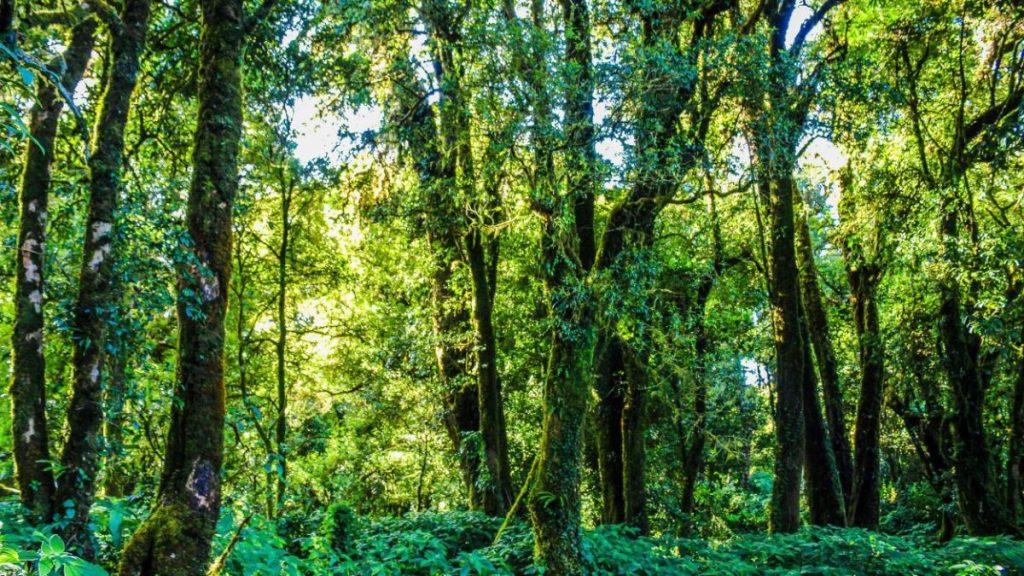
‘Scientists stated that the forests were similar to those currently found on New Zealand’s South Island.’2
That is likely where they once grew, before the Earth was submerged by a global flood around 4,400 years ago.3,4 These trees and plants thrived in a temperate climate, far from the South Pole, but were suddenly buried, fossilised, and swiftly transported to their current position.
Conclusion
If the Book of Genesis is understood as a genuine historical record, then the presence of a rainforest near the South Pole is not a mystery, but a clear affirmation of the biblical account.
By the way, we recommend reading the articles:
- The Complex Design of Mosquito Eggs
- Mount St. Helens: A Living Research Laboratory
- Antimatter – A Challenge for the Big Bang Theory
- Can Scientists Prove That the Universe Cannot Be Eternal?
- The Flood in Native American Legends of the Grand Canyon
Footnotes
- Klages, J.P. et al., 2020. Temperate Rainforests Near the South Pole During Peak Cretaceous Warmth. Nature, 580, pp.81–86.
- Strickland, A., 2020. Evidence of Ancient Rainforests Found in Antarctica. CNN. Available at: https://www.cnn.com/2020/04/01/world/antarctica-rainforest-intl-scn/index.html.
- Clarey, T., 2016. Embracing Catastrophic Plate Tectonics. Acts & Facts, 45(5), pp.8–11.
- Clarey, T., 2020. Carved in Stone: Geological Evidence of the Worldwide Flood. Dallas, TX: Institute for Creation Research, pp.153–179.
Based on: T. Clarey, Flood Model Solves Antarctica Rainforest Mystery, Acts & Facts, Institute for Creation Research, June 2020, p. 9.
© Source of main image: Canva.

The portal EvolutionOfThinking.org, created by the Research and Education Institute, focuses on education and the dissemination of knowledge related to research on various aspects of human well-being.

