
It is widely believed and accepted that we fully understand the processes that led to the formation of our Solar System, as outlined in nearly every astronomy textbook. However, a closer examination reveals significant challenges and unresolved questions concerning the self-formation of our planetary system.
The prevailing evolutionary model posits that, following the Big Bang, matter in the universe began to form. Initially, this gaseous matter was evenly distributed, though certain regions contained slightly more than others. In these denser areas, the gas began to clump together. As the material accumulated, it grew so dense that chemical reactions initiated, releasing energy. This process is thought to have led to the birth of the first stars.
The explosion of these stars resulted in the creation of new elements, which then began circulating through space. As new stars formed, dust and rocks composed of these heavier elements began to accumulate around them. These rocks collided and merged, eventually forming large rocky bodies known as planetesimals, which were large enough to attract other rocks. Over time, the planetesimals grew sufficiently large to become the planets we know today.
The question remains: did our Solar System, along with all other planetary systems, form in this manner? Upon closer inspection, it becomes clear that this model of planet formation has several significant shortcomings.
The Formation of Stars and the Development of the Protoplanetary Disk
The initial challenges arise from the very process of star formation. The prevailing theory of stellar evolution suggests that when a molecular cloud (referred to as the solar nebula) collapses under the influence of gravity, a protostar is formed. As the protostar becomes increasingly dense, nuclear fusion eventually commences, marking the birth of a star.
However, several physical processes hinder this gravitational collapse, preventing the gas from simply condensing. These include the thermodynamic pressure of the gas, its magnetic fields, and its angular momentum. Each of these factors opposes the gravitational forces, maintaining the cloud in a state of hydrostatic equilibrium. Consequently, the cloud cannot collapse sufficiently to spontaneously initiate nuclear fusion. In other words, the established laws of physics preclude the spontaneous formation of stars.1
The Angular Momentum Problem
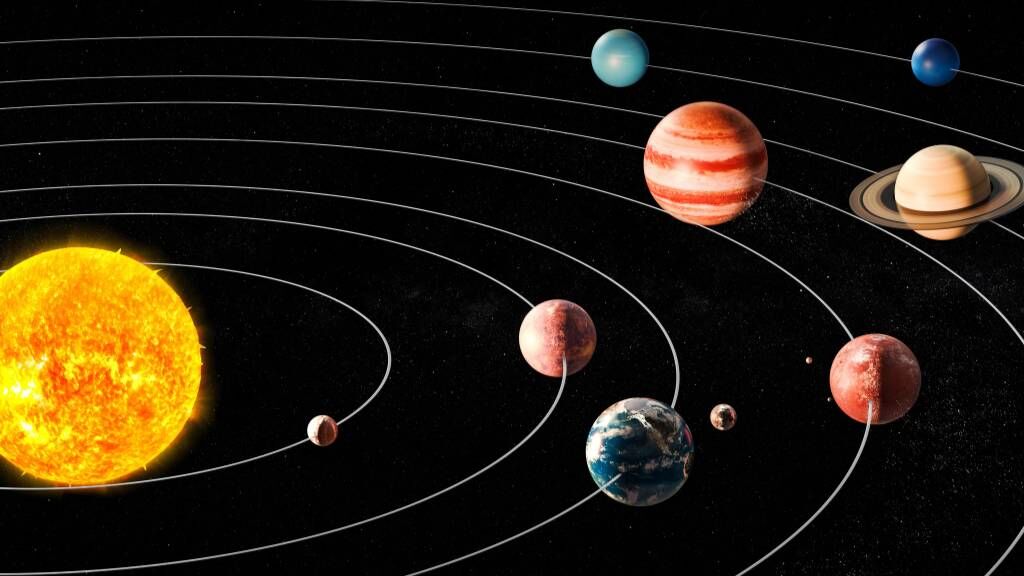
The issue of angular momentum presents another significant challenge. According to the laws of physics, as a collapsing protostar increases in rotation, it should concentrate all its angular momentum within itself. However, the Sun accounts for only 1% of the angular momentum in the entire Solar System, despite containing 99.86% of its mass. The remaining 0.14% of mass and 99% of angular momentum are found in the planets, particularly in Jupiter.2
In other words, the Sun should be rotating much faster than it actually does, while the planets should be orbiting the Sun more slowly than they currently do. Instead, the opposite is observed. How, then, did nearly all the angular momentum transfer from the protostar to the protoplanetary disk and, subsequently, to the planets? Scientists have proposed several solutions, including the controversial ion transfer mechanism.3 However, neither this explanation nor any of the alternative solutions fully resolve the issue.
How Did the Planets of the Solar System Form?
Another issue concerns the formation of planets from rocky fragments orbiting the Sun. The prevailing theory of the Solar System’s formation suggests that dust particles first coagulated to form progressively larger rocky blocks known as planetesimals. Once these planetesimals reached several kilometers in size, gravity was expected to take over, causing them to attract one another and eventually form planets.
However, the unresolved question remains: how did dust particles coagulate to form planetesimals in the first place? Gravity cannot account for this at such small scales. Several potential solutions have been proposed. The bonding of microscopic dust particles into rocky blocks might have been caused by static electricity, organic compounds, or the desublimation of cold gas (its transition from gas to solid). Yet, these processes have not been observed in our Solar System. As a result, the formation of planets continues to be a mystery for scientists.4
The Solar System Could Not Have Formed Naturally
These are not the only issues challenging the theory of our planetary system’s formation. However, they are sufficient to undermine the idea that the Solar System formed purely through natural processes. The most plausible explanation remains that our planetary system was divinely created by God, as outlined in the Holy Scriptures.5
By the way, we recommend reading the articles:
- Can a “Toxic” Frog Poison Itself?
- Does the Bible Justify Slavery?
- The Fourth Dimension – Part 1: The Shape of the Universe
- The Fourth Dimension – Part 2: Exploring the Intersection of Science and Spirituality
- Did Kangaroos Evolve in Australia?
Footnotes
- Hartnett, J.G., 2016. Planetary system formation: exposing naturalistic storytelling. Creation Ministries International, 14 April. Available at: https://creation.com/the-naturalistic-story-about-planet-formation.
- Carroll, B.W. and Ostlie, D.A., 2007. An Introduction to Modern Astrophysics (2nd ed.). Boston: Pearson, Addison Wesley, pp. 862–863.
- Ray, T., 2012. Losing spin: the angular momentum problem. Astronomy & Geophysics, 53(5), pp. 5.19-5.22. Available at: https://academic.oup.com/astrogeo/article/53/5/5.19/208905.
- Faulkner, D.R., 2021. What about the Origin of the Solar System and the Planets? Answers in Genesis, 6 February. Available at: https://answersingenesis.org/astronomy/solar-system/origin-of-solar-system-and-planets/.
- The Bible, New King James Version, 1982, Genesis 1:14-19.
© Source of main image: Canva.

The portal EvolutionOfThinking.org, created by the Research and Education Institute, focuses on education and the dissemination of knowledge related to research on various aspects of human well-being.

