
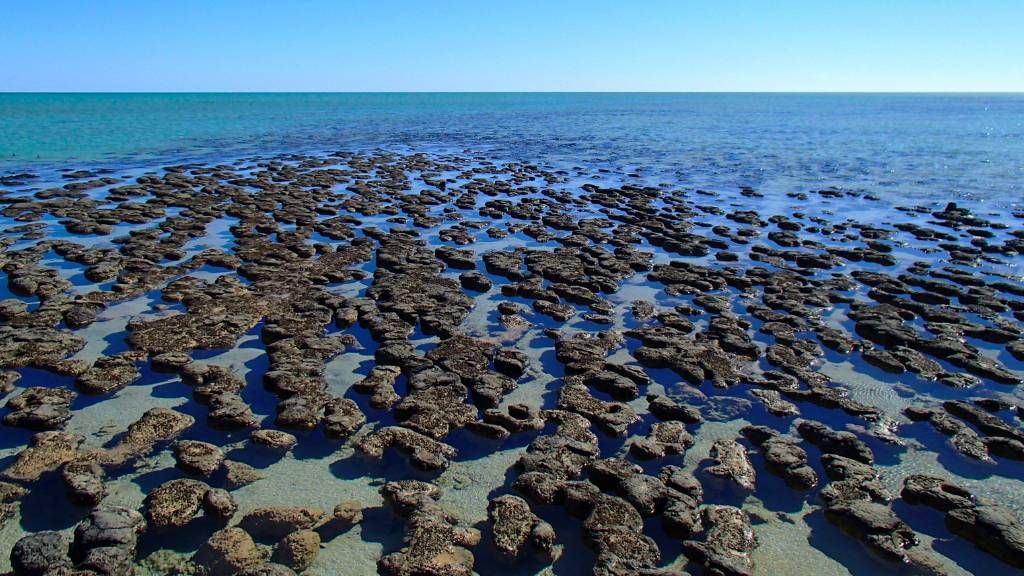
Stromatolites are unusual rock formations, typically found in the oldest known sedimentary rocks. Living stromatolites are now extremely rare. While they appear to be stones, each is a slowly growing colony of bacteria.
What are stromatolites and who discovered them?
Stromatolites are made up of millimetre-thick layers (laminae) of cyanobacteria (blue-green algae) and sediments, held together by calcium carbonate precipitated from seawater.
They were first identified in the early 20th century by Charles Walcott, former director of the United States Geological Survey (USGS), in Paleoproterozoic rocks in Ontario, Canada. Walcott believed these structures were a type of ancient reef formed by algae.
In the 1950s, paleontologists determined that stromatolites are the result of biological activity.1 This was soon confirmed by the discovery of living stromatolites in Australia. Later, several authors suggested that some fossilised stromatolites may have a non-biological origin.2,3
The evolutionary puzzle
Secular scientists believe stromatolites were among the earliest forms of life on Earth, with some dating back to 3.7 billion years ago.4 Fossilised stromatolites are found worldwide in Archean and Proterozoic carbonate rocks, and to a lesser extent in Cambrian and later layers. Scientists suggest that the sharp decline in stromatolites in post-Cambrian rocks may have been due to the sudden appearance of organisms that consumed cyanobacteria.5
From an evolutionary standpoint, determining the timeline for the origin of life on Earth presents a significant challenge if stromatolites evolved around 3.7 billion years ago.6 Secular scientists assert that the Earth is 4.55 billion years old, meaning life would have had to form and develop the ability to photosynthesize and colonise in less than a billion years, otherwise cyanobacteria could not have evolved so quickly.
The same secular scientists are also convinced that between 4.1 and 3.8 billion years ago, a period of heavy bombardment occurred2 – a time of intense meteorite impacts on both Earth and the Moon. Such impacts would have destroyed the Earth’s crust, and therefore, any life forms that existed before 3.8 billion years ago. This would require explaining the formation of the atmosphere, oceans, abiogenesis, and photosynthesis in just 100 million years. From an evolutionary perspective, this is an unreasonably short timeframe for such a series of events.6,7
Living fossils
Although secular scientists claim that stromatolites date back billions of years, there is no evidence of evolution in them. Modern stromatolites are considered living fossils, much like the coelacanth fish.
Until 1956, stromatolites were thought to be extinct. However, that year, scientists discovered living stromatolites in Shark Bay, Australia, in waters with high salinity.8 Later, living stromatolites were also found in other highly saline marine environments, such as the Bahamas and atolls in the Central Pacific, as well as in freshwater lakes and streams in Canada, Japan, Australia, Germany, France, and Spain. The unique chemical composition of these freshwater bodies enables stromatolites to thrive.5,8
Living stromatolite colonies are now being discovered in even more varied environments. Recent studies have shown that they exist on land in Australia, in wetlands5 – not submerged in water, but on the surface of calcium-rich, spring-fed ecosystems. This suggests that living stromatolites may be much more widespread than previously thought.
Is science in trouble?
This is not the first time the scientific community has struggled to explain various phenomena and discoveries. What was once considered certain often turns out to be an incorrect theory as more discoveries are made. Stromatolites are another example. They were believed to be extinct, yet they are still present. They were thought to have evolved, but according to evolutionary timelines, there simply wasn’t enough time for them to arise spontaneously. They are not the only example. It is for each individual to draw their own conclusions regarding the significance of this.
By the way, we recommend reading the articles:
- How Did Life Begin?
- Who Were the Neanderthals?
- Do UFOs Exist? – Part 1: Reported Sightings
- Do UFOs Exist? – Part 2: The Forces Behind the Phenomenon
- What Happened to the Waters Above the Firmament?
Footnotes
- Wicander, R. & Monroe, J.S., 2016. Historical Geology: Evolution of Earth and Life Through Time. 8th ed. Boston, MA: Cengage Learning.
- Lowe, D.R., 1994. Abiological Origin of Described Stromatolites Older than 3.2 Ga. Geology, 22(5), pp.387–390.
- Hladil, J., 2005. The Formation of Stromatactis-Type Fenestral Structures During the Sedimentation of Experimental Slurries—A Possible Clue to a 120-Year-Old Puzzle About Stromatactis. Bulletin of Geosciences, 80(3), pp.193–211.
- Mueller, P.A. & Nutman, A.P., 2017. The Archean-Hadean Earth: Modern Paradigms and Ancient Processes. In: Bickford, M.E., ed. The Web of Geological Sciences: Advances, Impacts, and Interactions II. Boulder, CO: Geological Society of America Special Paper 523, pp.75–237.
- Proemse, B.C. et al., 2017. Stromatolites on the Rise in Peat-Bound Karstic Wetlands. Scientific Reports, 7, p.15384.
- Tomkins, J.P. & Clarey, T., 2016. Cellular Evolution Debunked by Evolutionists. Creation Science Update. Available at: https://www.icr.org/article/cellular-evolution-debunked-evolutionists.
- Awramik, S.M. & Grey, K., 2005. Stromatolites: Biogenicity, Biosignatures, and Bioconfusion. Proceedings of the SPIE, 5906, pp.1–9.
- Frazer, J., 2017. Stromatolites Defy Odds by A) Living B) on Land. Scientific American. Available at: https://blogs.scientificamerican.com/observations/stromatolites-defy-odds-by-a-living-b-on-land/.
Adapted from: T. Clarey, “Stromatolites: Evidence of Pre-Flood Hydrology”, Acts & Facts, Institute for Creation Research, May 2018, pp. 10–12.
© Source of main image: Canva.

The portal EvolutionOfThinking.org, created by the Research and Education Institute, focuses on education and the dissemination of knowledge related to research on various aspects of human well-being.

