
The Bible states that the Flood covered the entire Earth, submerging its surface under water. Today, however, the continents are dry. This raises a crucial question: where did the waters of the Flood go, and what became of them?
Critics of the biblical account of Noah’s Flood often raise the question: if the Flood engulfed the entire Earth, where did the water go? Another point of debate is the height of the mountains, which the Flood is said to have submerged. Although the issue of mountain elevation is considered in this article: Did Noah’s Flood Cover the Himalayas?, it does not fully account for the fate of the waters. A more plausible explanation, similar to the theory of continental drift, lies in tectonic plate movement.
The Earth’s Crust and Isostatic Movements
In this article, the focus will be on vertical movements, known as isostatic movements, rather than horizontal ones. The term isostasy describes a state of equilibrium maintained by blocks of the Earth’s crust, which are influenced by two primary forces: gravity (the pull of the Earth) and hydrostatic force (buoyancy generated by the Earth’s liquid mantle). When this balance is disturbed, isostatic movements take place.
The Earth’s crust is divided into two types: continental and oceanic. Continental crust typically has a thickness of around 35-40 km, while oceanic crust measures approximately 5-7 km.1 They also differ in composition and density. Oceanic crust consists of basalt (density ~3 g/cm3), while continental crust is made of granite (density ~2.7 g/cm3)2. These differences result in continental crust being lighter than oceanic crust due to the lower density of granite.
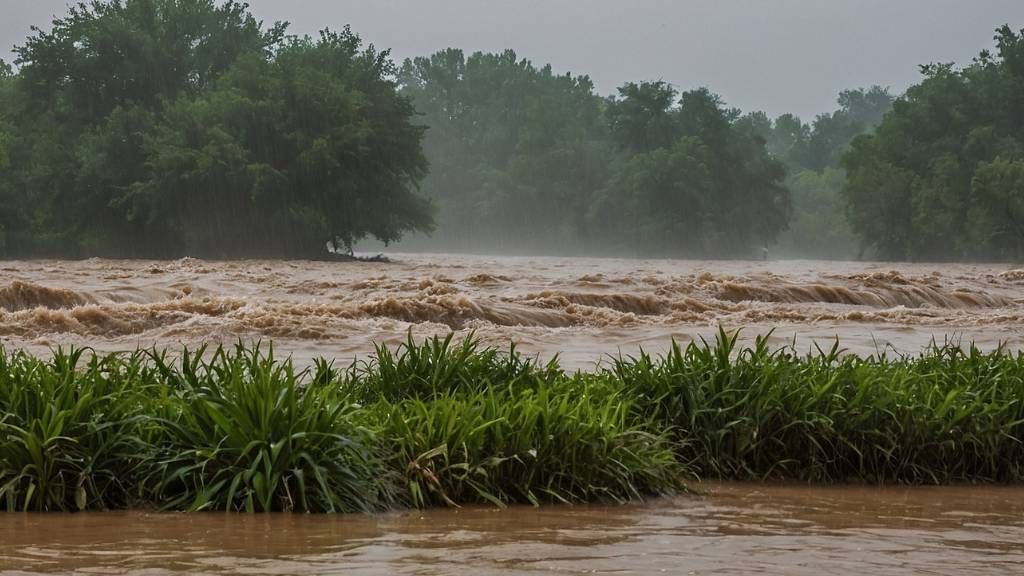
The Floodwaters and Their Impact on the Earth’s Crust
Before the Flood, the world consisted of a single ocean encircling the supercontinent of Pangaea.3 During Noah’s Flood, water levels rose significantly, covering the oceanic crust and submerging the continental crust to a lesser extent. Even the mountains were buried under about 15 cubits of water, equivalent to 7–8 meters.4 These variations in water volume and density caused the oceanic crust to sink, resulting in the uplift of the continental crust. This uplift raised the continents relative to the sinking ocean floor.5
As the oceanic crust sank, additional space was created for the floodwaters. This caused the water to drain from the continents into the lower-lying areas, gradually exposing them. As a result, the continents began to emerge above the floodwaters. Additionally, tectonic plate collisions led to the formation of mountain ranges and high plateaus,6 thickening the granite-based continental crust in the process. Consequently, as the waters receded, the highest mountains emerged first, followed by lower mountains and, eventually, flatter, lower-lying regions.
Where Did the Floodwaters Go?
The waters that initially surged from beneath the Earth’s surface and fell from the heavens onto the Earth before the Flood7 eventually flowed into the oceans. In other words, the waters of the pre-Flood ocean merged with the floodwaters to form the oceans we have today. This transformation was facilitated by isostatic movements, which elevated the continents and lowered the ocean basins.
This explanation is not accepted by proponents of evolution, as they adhere to the principle of geological uniformitarianism. This principle suggests that the processes happening today have always occurred in the same way and at the same rate. This, however, may not have been the case. Today, there is a wealth of evidence suggesting that Noah’s Flood did indeed occur and cover the entire globe. The question of where the floodwaters went can be effectively addressed by referencing the governing laws of geophysics.
By the way, we recommend reading the articles:
- What is the Higgs Boson?
- Does the Bible Imply that the Earth is Flat?
- Human Races: A Scientific Perspective
- Earth’s Axial Precession in Ancient Thought
- What Happened to the Waters Above the Firmament?
Footnotes
- Alvey, A. et al., What is the thickness of Earth’s crust?, Geoscientist, 28(7), 2018, pp. 10–15. Available at: https://www.geolsoc.org.uk/Geoscientist/Archive/August-2018/Roberts-Crust
- Continental crust, Encyclopaedia Britannica. Available at: https://www.britannica.com/science/continental-crust
- The Bible, New King James Version, 1982, Genesis 1:9–10.
- The Bible, New King James Version, 1982, Genesis 7:20.
- Oard, M., How did the waters of Noah’s Flood drain off the continents?, Creation, 37(3), July 2015, pp. 28–30. Available at: https://creation.com/how-did-the-waters-of-noahs-flood-drain
- Morris, J.D., Did Noah’s Flood Cover the Himalayan Mountains?, Institute for Creation Research, 1 September 2003. Available at: https://www.icr.org/article/did-noahs-flood-cover-himalayan-mountains
- The Bible, New King James Version, 1982, Genesis 7:11.
© Source of main image: Leonardo.ai.

The portal EvolutionOfThinking.org, created by the Research and Education Institute, focuses on education and the dissemination of knowledge related to research on various aspects of human well-being.

