
The Himalayas, the tallest mountain range on Earth, have peaks that exceed 8,000 meters. To cover these mountains, a volume of water many times greater than the total volume of the oceans would be required. Evolutionists use this argument to claim that Noah’s flood could not have occurred. Are they correct?
It is occasionally argued that for the floodwaters to submerge all of the world’s mountain peaks, the volume of water required would need to surpass the total amount present in the oceans several times.1 The Himalayas, including Mount Everest, the highest peak at 8,848 meters above sea level, are frequently referenced in this discussion. Did the biblical flood, however, necessarily need to cover these mountains?
What does the Bible say?
This claim stems from a passage in the Bible that says that the floodwaters covered all the mountains. This is written in Chapter 7 of the Book of Genesis: ‘And the waters prevailed exceedingly on the earth, and all the high hills under the whole heaven were covered. The waters prevailed fifteen cubits upward, and the mountains were covered.’ (verses 19-20). The fifteen cubits referred to in verse 20, based on ancient measurements, can be roughly converted to 7-8 metres.2 In other words, the Bible states that Noah’s flood submerged all the high mountains to a depth of several metres.
A logical question arises: did this include towering mountains such as the Himalayas, with the highest peak on Earth? To answer this, one must turn to the Bible, which offers an intriguing depiction of the world before the flood. In Chapter 1 of the Book of Genesis, we read: ‘Then God said, “Let the waters under the heavens be gathered together into one place, and let the dry land appear”; and it was so. And God called the dry land Earth, and the gathering together of the waters He called Seas. And God saw that it was good.’ (verses 9-10). This passage describes the gathering of oceanic waters into one place and the emergence of dry land, suggesting a single landmass.
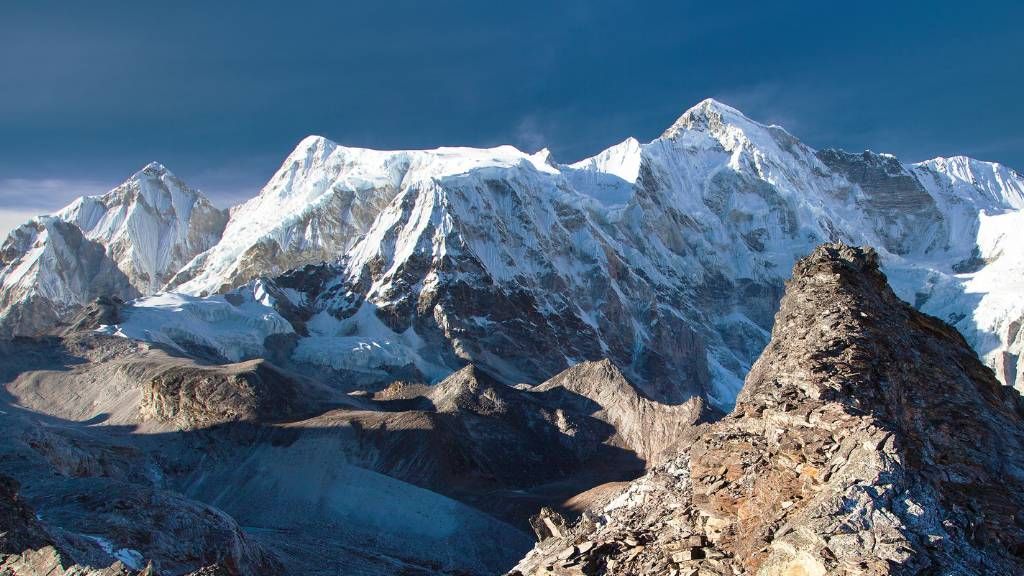
Mountain-building processes
Scientific research has shown that, in the past, Eurasia, Africa, the Americas, Australia, and Antarctica were once joined together as one massive continent. This evidence supports the theories of continental drift and tectonic plates and is consistent with the Biblical account of a single landmass and ocean before the flood.
Today, the world’s highest mountains are the Himalayas and the other ranges in that region, with the Andes following closely behind. Other prominent mountain ranges, such as the Alps, the Caucasus, and the Cordilleras, are also noteworthy. All these ranges, along with others, share a key feature: they were formed during the Alpine orogeny, or Alpine folding. Geologists regard the Alpine orogeny as the most recent phase of mountain folding in Earth’s history.
The process of continental drift directly contributed to the formation of these mountains. The collision of tectonic plates caused the uplift of rocks, leading to the creation of mountain ranges. The Himalayas formed from the collision of the Indian plate with the Eurasian plate. The Alps resulted from the collision between the African plate and the Eurasian plate. The Andes formed as the South American plate overrode the oceanic Nazca plate, leading to the subduction of the latter.
The Himalayas and Noah’s Flood
Evolutionists attribute this process to the passage of millions of years. However, there is evidence suggesting that the entire Alpine orogeny took place in a very short period—during Noah’s flood, which lasted only one year. The Bible refers not only to rain but also to ‘all the fountains of the great deep were broken’,3 which is understood as the sudden release of vast underground water reserves onto the Earth’s surface. Such a violent event, accompanied by earthquakes, would likely have been capable of breaking apart the uniform Earth’s crust, leading to the smaller tectonic units we observe today.
The process of continental drift began with the flood, which was responsible for the formation of mountain ranges like the Andes, Alps, and Himalayas. Therefore, the Himalayas did not exist during Noah’s flood. They formed subsequently, when the Indian plate collided with the Eurasian plate, and the tectonic activity that led to this was set in motion by the flood.4
Conclusion
Given that the Himalayas and other mountains formed during the Alpine orogeny did not exist before Noah’s flood, which mountains were present at that time? They were likely much lower. Today, there are other lower mountain ranges, many of which are thought to have formed through different geological processes, such as the Caledonian orogeny. Creationist scientists are exploring whether these mountains also formed during the flood or existed earlier.5,6 Regardless, it’s clear that the mountains before the flood were not as tall as the Himalayas are today. As such, Noah’s flood would have been able to cover all the mountains of that time, as described in the Bible.
By the way, we recommend reading the articles:
- Chinese Pictograms and the Story of Genesis
- Intelligent Design or Just an Illusion of Design?
- The Platypus: An Evolutionary Enigma
- Who Created God?
- What is the Higgs Boson?
Footnotes
- Morris, J. D., Did Noah’s Flood Cover the Himalayan Mountains?, Institute for Creation Research, September 1, 2003, available at: https://www.icr.org/article/did-noahs-flood-cover-himalayan-mountains.
- Both the Sumerian and Egyptian cubit measured slightly over 50 cm.
- The Bible, New King James Version, 1982, Genesis 7:11.
- Oard, M., How did the waters of Noah’s Flood drain off the continents?, Creation, 37(3), July 2015, pp. 28-30, available at: https://creation.com/how-did-the-waters-of-noahs-flood-drain.
- Clarey, T. L., Werner, D. J., The pre-Flood world resembled Pangaea, Journal of Creation, 34(2), August 2020, pp. 8-11, available at: https://creation.com/pre-flood-like-pangaea.
- Snelling, A. A., Noah’s Lost World, Answers in Genesis, April 1, 2014, available at: https://answersingenesis.org/geology/plate-tectonics/noahs-lost-world/.
© Source of main image: Canva.

The portal EvolutionOfThinking.org, created by the Research and Education Institute, focuses on education and the dissemination of knowledge related to research on various aspects of human well-being.

