
The evolutionary history of vertebrates is riddled with unresolved questions, one of the most significant being the shift from jawless vertebrates (Agnatha/jawless vertebrates) to vertebrates with jaws (Gnathostomata/jawed vertebrates). Although many vertebrate fossils have been uncovered over the past few centuries, a transitional form between jawed fish and their jawless predecessors has yet to be found.
The theory of evolution and the origin of jaws
Evolutionists maintain that jaws developed from gill arches in fish considered to be among the earliest or most primitive vertebrates. According to this hypothesis, a presumed vertebrate ancestor with nine and eight gill arches is thought to have undergone structural changes in the three anterior arches, resulting in the formation of the basic elements of the early jaw1,2: the main part of the upper jaw, the jaw core, and a new skull bone with a specialized joint connecting to the jaw.
However, for jaws to function, very significant modifications are required, as noted in a recent article: ‘The evolution of the upper jaw also requires further study, as its modification appears to be more complex than the modification of the lower jaw’.3 Highly specialized muscles, neurological features, and proper connections are needed in order for a jaw to be fully functional. Therefore, as a recent vertebrate evolution textbook states: ‘The evolution of developmental processes that led to the emergence of movable jaws is highly controversial’.1
The early stages
Secular scientists believe that the earliest stage in vertebrate evolution is represented by jawless fish such as lampreys and hagfish. They propose that the next stage was the emergence of ostracoderms, or armoured jawless fish, an extinct group that lived primarily during the late Silurian and early Devonian periods. These fish present a challenge to evolutionary theory, as they were remarkably advanced, possessing anatomical features not found in any fish alive today.4 Moreover, they appear very suddenly in the fossil record, yet fully developed and exhibiting a high level of complexity.
The sudden emergence of jaws in armored fish
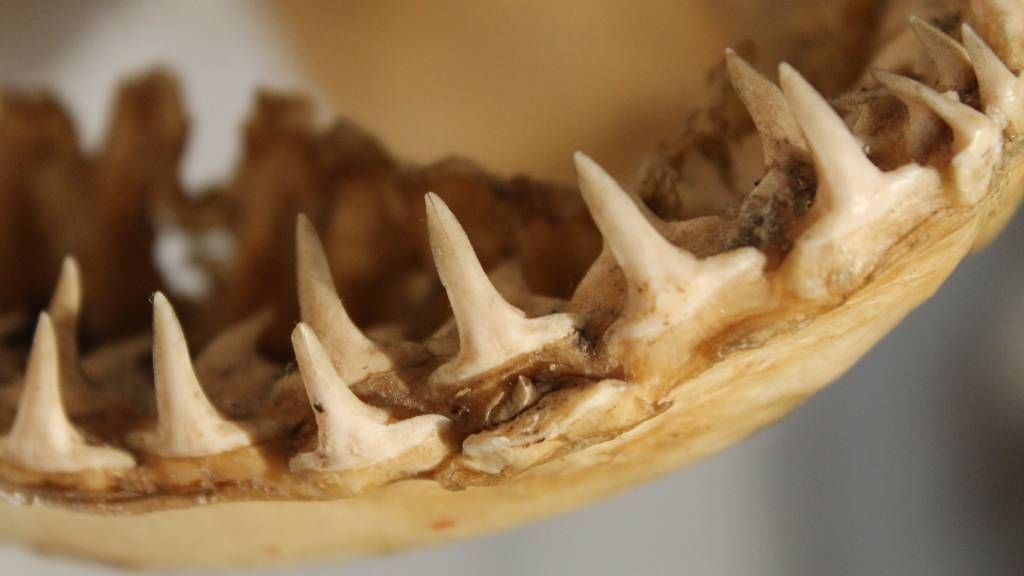
The next group in this evolutionary sequence includes armoured fish known as placoderms, which, according to evolutionary dating, emerged in the late Silurian period and became extinct at the end of the Devonian. To evolutionists’ surprise, placoderms possessed fully developed jaws of considerable complexity, complete with large, sharp teeth. At the same time, their presumed ancestors, the ostracoderms, coexisted with them for approximately 30 million years without showing any notable decline.
Additionally, the fossil record shows that placoderms coexisted with jawed bony fish resembling those found today. One evolutionary article noted that ‘the broad diversity of placoderms coexisted with lungfish and primitive ray-finned fish’.5
Another factor that complicates this evolutionary puzzle is an assumption made by scientists when constructing the hypothetical phylogenetic tree of vertebrates, that a transition occurred between cartilaginous and bony fish. This supposed transition, however, took place abruptly at the end of the Silurian. Evolutionists acknowledge that the sudden appearance of both cartilaginous and bony fish, without identifiable evolutionary ancestors, has created what they describe as a significant temporal and evolutionary gap between modern lineages’.6 Furthermore, early claims that placoderms represented a transitional form proved to be unfounded. Subsequent research revealed that their distinctive features were not transitional at all; phylogenetic studies identified them as specialised rather than primitive.6
Other jawed fish also emerge abruptly during the evolutionary period in question, including both lobe-finned and ray-finned species.
Furthermore, throughout the period from the late Silurian to the end of the Devonian, no evidence has been found of transitional fish exhibiting partially developed jaws. Jawed fish appear abruptly in the fossil record, leaving the proposed narratives of jaw evolution without empirical support. Evolutionists themselves have acknowledged that ideas concerning the origin of gnathostomes are undergoing continual revision, and that the complex question of jawed vertebrate origins remains a significant challenge for researchers.5
Explaining the mystery of Devonian fossils
Evolution offers no explanation for the sudden appearance of a wide variety of jawed fish near the beginning of the Devonian period. The explanation for this phenomenon is found in the Book of Genesis.
If we accept that all creatures, including fish, were created according to their kinds, and that the immense diversity of marine life was transported and buried during a global flood, then the fossil record aligns closely with what is observed in Devonian deposits.
By the way, we recommend reading the articles:
- Extrabiblical Testimonies of the Flood
- Anchiornis – A ‘Transitional’ Creature?
- Hyperbaric Oxygen Therapy and Pre-Flood Longevity
- The Relationship Between Theistic Evolutionism and Death
- Natural Selection – Truth or Fiction?
Footnotes
- K. P. Dial, N. Shubin and E. L. Brainerd (eds.), Origin of the Vertebrate Dentition: Teeth Transform Jaws into a Biting Force, in Great Transformations in Vertebrate Evolution, 2015, Chicago, IL: The University of Chicago Press.
- M. J. Benton, Early Palaeozoic Fishes, in Vertebrate Paleontology, 2015, West Sussex, UK: John Wiley & Sons Ltd.
- J. L. Fish, ‘Evolvability of the vertebrate craniofacial skeleton’, Seminars in Cell and Developmental Biology, 2019, 91: 13–22.
- F. Sherwin, ‘Osteostracans Aren’t Ancestors’, Acts & Facts, 2020, 49(12): 14.
- P. E. Ahlberg, ‘Birth of the jawed vertebrates’, Nature, 2009, 457: 1094–1095.
- M. D. Brazeau and M. Friedman, ‘The origin and early phylogenetic history of jawed vertebrates’, Nature, 2015, 520(7548): 490–497.
Adapted from: J. P. Tomkins, ‘The fossils still say ‘no’: the mystery of jawed vertebrates’, Acts & Facts, Institute for Creation Research, February 2021, pp. 12-14.
© Source of main image: Canva.

The portal EvolutionOfThinking.org, created by the Research and Education Institute, focuses on education and the dissemination of knowledge related to research on various aspects of human well-being.

