
The James Webb Space Telescope began its operations just over a month and a half ago, yet it has already sparked considerable interest among scientists researching the origins of the Big Bang.
For modern astronomers, radio astronomers, and astrophysicists, the Big Bang is a well-established scientific fact. Textbooks at both school and university level describe the Universe’s origin as occurring around 13.8 billion years ago. Several smaller theories are also associated with the Big Bang model, with the theory of inflation being the most prominent.
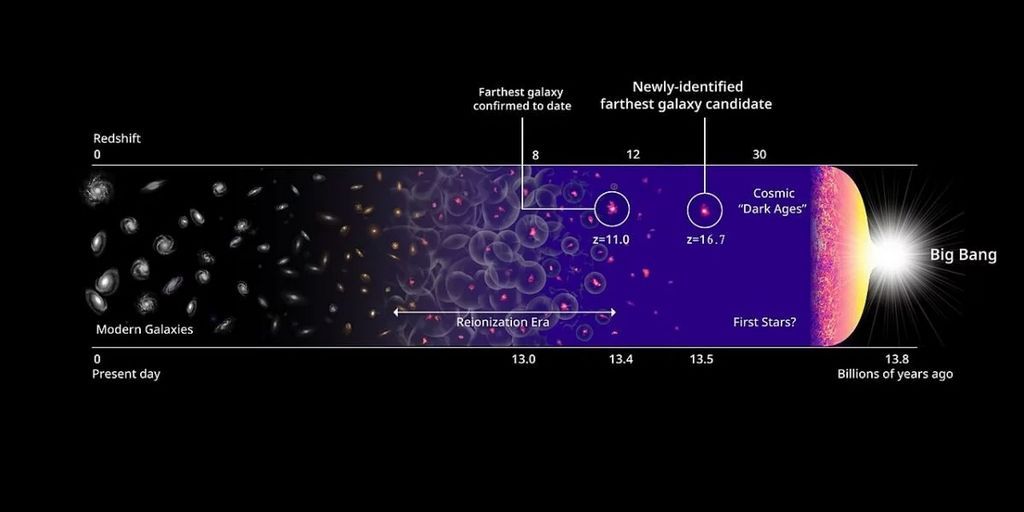
The most widely accepted evidence supporting the Big Bang is the cosmic background radiation (CBR). In addition, the Hubble Space Telescope has captured numerous images of deep field regions, revealing galaxies that are extremely distant. The most distant galaxy photographed by Hubble is GN-z11, with a redshift (denoted as ‘z’) of 11, indicating that it likely formed approximately 400 million years after the Big Bang.
The James Webb space telescope (JWST)
One of the key objectives of the James Webb Space Telescope (JWST) is to exceed the achievements of previous telescopes. While it is often seen as the successor to the Hubble Space Telescope, the relationship between the two is more complex. Unlike Hubble, which observes visible light, the JWST is designed to detect infrared light. This enables it to capture images of objects that are both farther away and more redshifted.
The first images from the JWST were so surprising that they prompted a reevaluation of scientific theories regarding the origins of the Universe. An article published in the online journal Nature discusses several challenges that have emerged as a result.1
‘My God, there are so many galaxies!’2
Scientists argue that the further we look into the Universe, the further back in time we peer, and thus, the fewer galaxies we should expect to find. The period between 250 and 350 million years after the Big Bang, known as the cosmic dawn, marks the appearance of the first stars and galaxies. Given this, scientists anticipated seeing only a small number of galaxies when observing such distant regions.
The JWST, however, revealed that even at these vast distances, many galaxies are present. One study of the deep fields captured by Webb identified 44 previously unknown objects, in addition to 11 already known, which are believed to have formed less than 300 million years after the Big Bang. As astronomer Jeyhan Kartaltepe from the Rochester Institute of Technology in New York remarked, ‘Rarely do we come across an empty space that contains nothing’.3 Scientists must, therefore, reassess their hypotheses about the early Universe.
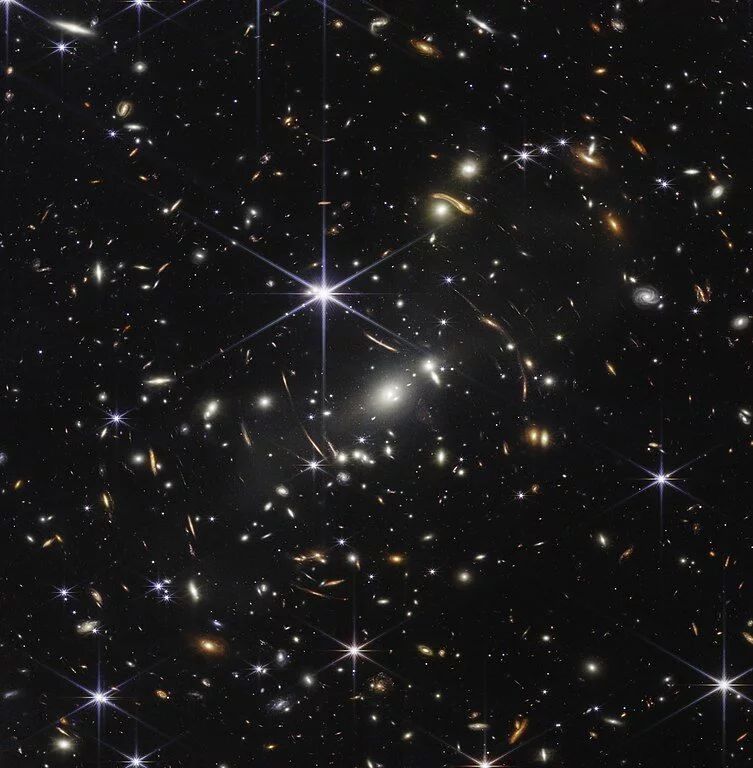
The search for the most distant galaxy
Earlier, we mentioned GN-z11, the farthest galaxy identified by the Hubble Space Telescope. Thanks to the JWST, we now know that even more distant galaxies exist. Currently, these galaxies are only candidates, meaning their identification as galaxies still requires full verification. Once confirmed, however, they will set new records for distance.
One such candidate is the galaxy GLASS-z13, which has a redshift of 13.1 (with higher redshifts generally indicating greater distance).4 It was discovered alongside another galaxy that is closer to us.5 Scientists were particularly astonished by the brightness of these galaxies, suggesting the presence of highly advanced galaxies at such an early stage in the Universe’s development.
Before long, additional candidates with even higher redshifts were discovered. One such galaxy, provisionally named CEERS-93316, has a redshift of 16.7, placing its formation just 250 million years after the Big Bang.6 If this finding is confirmed, it will be the most distant and oldest galaxy identified by the JWST to date. This discovery is only the beginning, as scientists are likely to identify even more distant galaxies in the near future. One preprint even suggests the possibility of galaxies with redshifts reaching as high as 207.7
The most distant galaxies are surprisingly mature
The most perplexing discovery for scientists relates to the shape of the most distant galaxies. Previous observations from the Hubble Space Telescope led to the conclusion that distant galaxies tend to be irregular in form. The prevailing theory suggested that this irregularity was a result of the higher density of the early Universe, where galaxies were believed to interact gravitationally and collide, causing disturbances in their structures.
The JWST, however, has uncovered the possibility that there are up to ten times more spiral galaxies in distant regions of the Universe than scientists had initially expected.8 Allison Kirkpatrick, an astronomer at the University of Kansas in Lawrence, remarked, ‘With the resolution of JWST, we can observe that galaxies had spiral structures much earlier than we had previously thought.’ When asked about the existing theory, she stated, ‘We will need to look into this.’9 Another preprint describes several well-formed massive galaxies that are thought to have existed just 500 million years after the Big Bang.10
Furthermore, the JWST’s analysis of the chemical composition of galaxies with redshifts of 5 and above, indicating their existence just 1.3 billion years after the Big Bang or earlier, has uncovered a surprisingly high concentration of heavier elements, known as metals11 , such as oxygen.,12 Previously, it was believed that the formation of elements heavier than lithium took billions of years, beginning after the Big Bang. These findings, however, suggest that such elements were already present in the young Universe. Kirkpatrick contends that these discoveries ‘require us to reconsider the pace at which new stars form.’13
Conclusion
The discoveries made by the JWST have the potential to fundamentally challenge the Big Bang theory, given how surprising they are to scientists. Kirkpatrick candidly confessed, ‘There are times I lie awake at 3:00 in the morning and wonder if everything I’ve done up until now was wrong.’14 Meanwhile, for Eric J. Lerner, a physicist who argues that the Universe has no beginning, the findings of the JWST completely undermine the Big Bang theory.15 However, most scientists contend that these discoveries merely necessitate a revision of certain hypotheses within the Big Bang framework.16
It is undeniable that the JWST has revealed even the most distant galaxies to be remarkably similar to those in our own galactic neighbourhood. Rather than revealing a gradual evolutionary process, the Universe appears strikingly uniform—contrary to the evidence scientists had anticipated for its evolution. This aligns with the biblical narrative of the Universe’s creation by God in a single day—the fourth day of creation.17
Of course, the JWST has only just begun its mission, which is expected to span at least 20 years. As such, this marks just the beginning of discoveries, potentially groundbreaking findings that could reshape our understanding of modern astronomy.
By the way, we recommend reading the articles:
- Panpsychism and the Origin of Human Consciousness
- Antimatter – A Challenge for the Big Bang Theory
- Was Our Universe Created in a Laboratory?
- Homo Erectus – Ape or Human?
- Geological Evidence for a Young Earth
Footnotes
- Witze, A., ‘Four Revelations from the Webb Telescope about Distant Galaxies’, Nature, 27 July 2022, https://www.nature.com/articles/d41586-022-02056-5.
- A paraphrase of the phrase “My God, it’s full of stars!” spoken by Dr. David Bowman in the film 2010: The Year We Make Contact, a sequel to Stanley Kubrick’s film 2001: A Space Odyssey.
- Quote from: Witze, A., op. cit.
- The correlation between redshift and a galaxy’s distance can be found here: https://lco.global/spacebook/light/redshift/.
- Castellano, M. et al., ‘Early Results from GLASS-JWST. III: Galaxy Candidates at z∼9-15’, arXiv, 19 July 2022, https://arxiv.org/abs/2207.09436.
- Donnan, C. T. et al., ‘The Evolution of the Galaxy UV Luminosity Function at Redshifts z ~ 8-15 from Deep JWST and Ground-Based Near-Infrared Imaging’, arXiv, 25 July 2022, https://arxiv.org/abs/2207.12356.
- Yan, H., ‘First Batch of Candidate Galaxies at Redshifts 11 to 20 Revealed by the James Webb Space Telescope Early Release Observations’, arXiv, 23 July 2022, https://arxiv.org/abs/2207.11558.
- Ferreira, L. et al., ‘Panic! At the Disks: First Rest-Frame Optical Observations of Galaxy Structure at z>3 with JWST in the SMACS 0723 Field’, arXiv, 19 July 2022, https://arxiv.org/abs/2207.09428.
- Quote from: Witze, A., op. cit.
- Labbe, I. et al., ‘A Very Early Onset of Massive Galaxy Formation’, arXiv, 25 July 2022, https://arxiv.org/abs/2207.12446.
- In astronomy, unlike in chemistry, a metal refers to any element heavier than lithium.
- Trump, J. R. et al., ‘The Physical Conditions of Emission-Line Galaxies at Cosmic Dawn from JWST/NIRSpec Spectroscopy in the SMACS 0723 Early Release Observations’, arXiv, 25 July 2022, https://arxiv.org/abs/2207.12388.
- Quote from: Witze, A., op. cit.
- Quote from: Witze, A., op. cit.
- ‘James Webb Space Telescope Shows Big Bang Didn’t Happen? Wait…’, Mind Matters, 13 August 2022, https://mindmatters.ai/2022/08/james-webb-space-telescope-shows-big-bang-didnt-happen-wait/.
- Ryan, J., ‘No, James Webb Space Telescope Images Do Not Debunk the Big Bang’, CNET, 22 August 2022, https://www.cnet.com/science/space/no-james-webb-space-telescope-images-do-not-debunk-the-big-bang/.
- The Bible, New King James Version, 1982, Genesis 1:14-19.
© Source of main image: Canva.

The portal EvolutionOfThinking.org, created by the Research and Education Institute, focuses on education and the dissemination of knowledge related to research on various aspects of human well-being.

