
The ‘flat Earth myth’ is sometimes invoked by certain atheists and proponents of evolution to undermine Christianity and biblical creationism. Did the medieval Christian Church actually uphold the belief that the Earth is flat?
The ongoing debate between believers and non-believers has taken many forms over the years. At the heart of disagreements between atheists and theists, particularly Christians, is often the question of God’s existence. Areas of contention include the respective roles of religion and science, particularly within society, where they are frequently set in opposition, despite this not being historically accurate. This debate is further complicated by the clash between supporters of evolutionary theory and advocates of biblical creationism, notably in the United States.
Evolutionists, in their attempts to discredit the Bible, and atheists, aiming to undermine religious faith more broadly, employ a variety of arguments—some of which are mere myths. A prominent example is the claim that the medieval Christian Church taught that the Earth was flat and persecuted those who challenged this view. This claim is often presented as evidence that Christianity is unreasonably dogmatic and should be set aside in favour of a scientific worldview. Ironically, the modern flat Earth movement contends that the medieval Church was correct in its supposed belief, thereby adding fuel for critics. But how much truth is there in this claim?
Who Actually Promoted the Flat Earth Theory?
In ancient times, people commonly believed the Earth was flat, a view largely shaped by the limitations of their measurement tools and their everyday experiences, which presented no obvious contradictions. However, in the 6th century BCE, some thinkers began to consider alternative possibilities, including a spherical Earth. Pythagoras (c. 572–497 BCE) is often regarded as one of the first to introduce this idea, followed by Aristotle (384–322 BCE), who provided further evidence. By approximately 240 BCE, the Greek geographer and mathematician Eratosthenes (c. 276–194 BCE) offered conclusive proof that the Earth was indeed spherical. From that point forward, this understanding became widely accepted among scholars. Influential Christian figures, including Augustine of Hippo (354–430), Jerome of Stridon (d. c. 420), and Ambrose of Milan (339–397), also affirmed the spherical model of the Earth.1
However, not everyone accepted that the Earth was round. Two notable advocates of the flat Earth view were Lactantius (c. 250–330) and Cosmas Indicopleustes (5th–6th century).2 These early Christian writers embraced the notion of a ‘tabernacle world’ and argued against accepting ideas they regarded as ‘pagan’. The tabernacle world concept envisions the cosmos in the form of the Ark of the Covenant, with a flat Earth on the interior and a dome above, representing the heavens.
The Geocentric Theory in the Middle Ages
The flat Earth idea, however, did not gain traction in the Middle Ages and remained a marginal view. All the major scholars of the Christian Church recognised the Earth’s sphericity. These included figures such as Bede the Venerable (673–735), Sacrobosco (1195–1256), Roger Bacon (1214–1292), Thomas Aquinas (1225–1274), Jean Buridan (1300–1358), and Nicole Oresme (1320–1382).3 Following the teachings of Aristotle and Claudius Ptolemy (c. 100–168 CE), they held the view that the Earth was at the centre of the universe, with all celestial bodies—the Sun, Moon, and planets—revolving around it. The stars were believed to be fixed to an outer celestial sphere.4
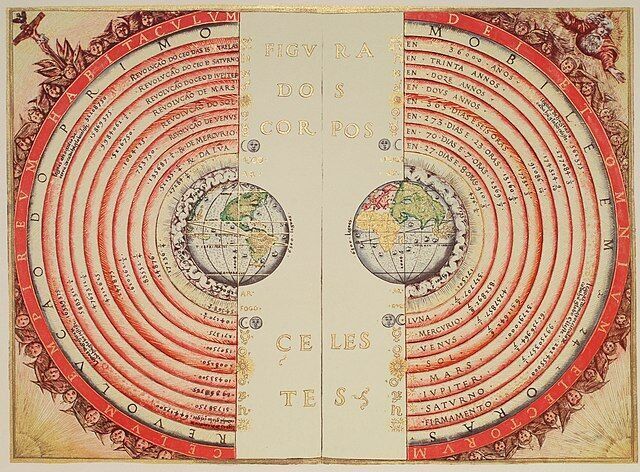
This is known as the geocentric theory,5 which dominated medieval conceptions of the universe, irrespective of popular beliefs at the time. This model was first significantly challenged by Nicolaus Copernicus (1473–1543), who introduced the heliocentric theory, positing the Sun at the centre of the cosmos. His ideas gained support from Galileo (1564–1642) and were embraced by successive generations of scholars and scientists, including Isaac Newton (1643–1727). The Earth’s sphericity was further corroborated by explorers such as Christopher Columbus (1451–1506) and Ferdinand Magellan (1480–1521).
The Flat Earth Myth and Its Origins
Medieval scholars largely adhered to the geocentric model, which placed a spherical Earth at the center of the universe. How, then, did the idea develop that people in the Middle Ages believed the Earth was flat? The myth of the flat Earth only emerged relatively recently, around 200 years ago. In 1824, Washington Irving (1783–1859), the writer and historian famous for Rip Van Winkle, published a biography of Christopher Columbus. In this work, Irving propagated the mistaken belief that Columbus was the first to prove the Earth’s roundness.6 His works gained great popularity, and along with them, the myth of a medieval belief in a flat Earth.
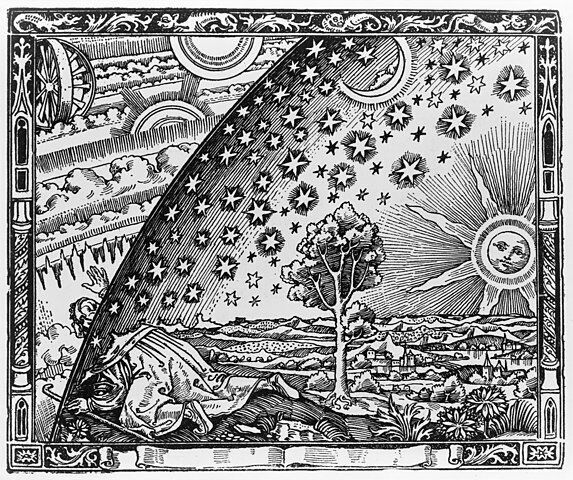
The main proponents of this myth were the scientists John William Draper (1811–1882) and Andrew Dickson White (1832–1918). Both asserted that science and religion, especially Christianity, were locked in a continuous conflict. In works like Draper’s History of the Conflict between Religion and Science (1874), they claimed that religion epitomised ignorance, using the medieval Church’s supposed endorsement of the flat Earth theory as an example. This narrative was unfortunately embraced by many later atheist scientists.7 However, respected historians such as Jeffrey Burton Russell8 and Lesley B. Cormack9 have convincingly disproven this myth.
Conclusion
A myth remains a myth, no matter who endorses it. At no point in history, including the Middle Ages, has the Christian Church taught that the Earth is flat. This misconception should not be perpetuated by atheists, evolutionists, or anyone else. Stephen Jay Gould (1941–2002), himself an evolutionist, wrote the following,
‘There never was a period of ‘flat earth darkness’ among scholars (regardless of how the public at large may have conceptualized our planet both then and now). Greek knowledge of sphericity never faded, and all major medieval scholars accepted the earth’s roundness as an established fact of cosmology’.10
The flat Earth myth in Christian history has no place in discussions between atheists and Christians, nor should it be used in the debate between the theory of evolution and the biblical account of creation. The vast majority of young Earth creationists understand that the Earth is spherical (or more precisely, a geoid), and that the universe spans billions of light-years. Biblical creationism and the flat Earth theory are separate matters and should not be conflated.
By the way, we recommend reading the articles:
- Axis of Evil – Could It Overturn the Big Bang Theory?
- Interactions Between Viruses and Human Organisms
- Defining the Human-Animal Divide
- Unicorns in the Bible – Myth or Reality?
- What is the Higgs Boson?
Footnotes:
- Contra Gentiles, ‘Czy w średniowieczu uważano, że Ziemia jest płaska?’, Contra Gentiles. Available at: https://contragentiles.pl/czytelnia/nauka-a-religia/trudne-przypadki-w-relacji-nauki-i-religii/czy-w-sredniowieczu-uwazano-ze-ziemia-jest-plaska/.
- Ibid.
- Sarfati, J. (2013) ‘The flat earth myth’, Creation, 35(3), pp. 20-23. Available at: https://creation.com/flat-earth-myth.
- Today we know that this realm is only apparent and abstract, but this concept is still used in astronomical observations and navigation.
- Contrary to the narrative of modern flat-earthers, geocentric theory does not say the Earth is flat at all.
- Contra Gentiles, ‘Czy w średniowieczu…’, op. cit.
- Sarfati, J., op. cit.
- Russell, J. B. (1991) Inventing the Flat Earth: Columbus & Modern Historians, New York: Praeger.
- Cormack, L. B. (2010) ‘O tym, że średniowieczni chrześcijanie nauczali, iż Ziemia jest płaska’, in: R. Numbers (ed.), Wyrok na Galileusza i inne mity o nauce i religii, trans. M. Romanek, Warszawa: Centrum Myśli Jana Pawła II, pp. 47-55.
- Gould, S. J. (1997) ‘The Late Birth of a Flat Earth’, in Dinosaur in a Haystack: Reflections in Natural History, New York: Three Rivers Press, pp. 38–50; cited in Sarfati, J., op. cit.
© Source of main image: Canva.

The portal EvolutionOfThinking.org, created by the Research and Education Institute, focuses on education and the dissemination of knowledge related to research on various aspects of human well-being.

