
Many people believe that rock layers take millions of years to form. This idea has been ingrained in society for years through media and educational materials, and is therefore often taken as a given. However, under certain conditions, rocks of all types can form much more quickly. In this article, four significant pieces of geological evidence will be presented suggesting that the rocks on Earth are relatively young, and that the planet’s age is closer to 6,000 years than to several billion.
1. The Rapid Rate of Erosion
Empirical measurements of current erosion rates indicate that rocks, claimed to be millions of years old, should not exist if exposed on the Earth’s surface. Secular geologists recognise that the erosion processes occurring today are so rapid that the continents should have already been eroded down to sea level.1 Recent studies show that outcrops—rocks visible above the ground—erode at an average rate of about 12 metres per million years.2 This suggests that the full erosion of most continents would occur in under 50 million years. If the continents are indeed very old, why do they remain above sea level? Their persistence, alongside the observed erosion rates, provides evidence for a younger Earth and reinforces the accuracy of the biblical account.
2. The Rapid Deposition of Shales and Limestones by Water Movement
Secular science has long argued that sedimentary rocks formed gradually over centuries, with the slow deposition of clay and limestone from standing water being cited as evidence of an ancient Earth.
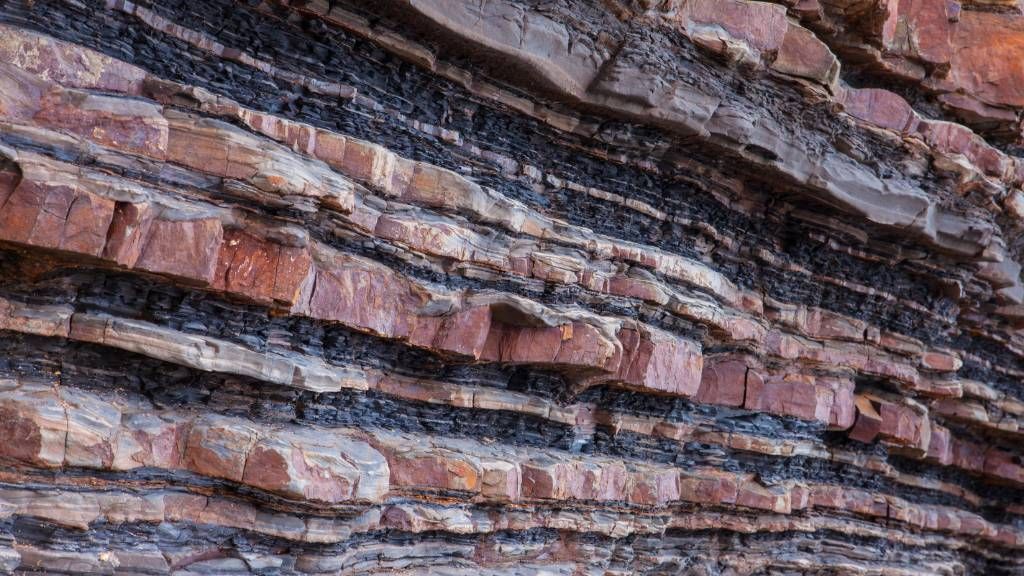
While it is true that we can observe clay settling from standing water today, the rocks we examine did not form in this way. Clay, the most abundant sediment on Earth, does not settle slowly from standing water to create rocks. Clay-rich rocks, such as shales and mudstones, often display fine laminations or thin layers, which can only form in environments with moving water. Recent empirical research suggests that laminated clays are deposited in energetic settings, driven by water movement.3 Finely laminated clays are infrequently formed today, as biological activity (bioturbation) typically disturbs these thin layers.
The same holds true for limestone layers. These carbonate rocks constitute 20-25% of all sedimentary layers on Earth’s continents, with some layers reaching thicknesses of over 900 metres.4 For many years, uniformitarians argued that thick layers of carbonate rocks formed in standing water over millions of years, but this has since been disproven.
Research in streambeds has shown that carbonate mud does not settle gradually; rather, it is rapidly deposited through the movement of waves and currents. Laboratory experiments indicate that water flowing at speeds of 25 to 50 centimetres per second creates ripples and laminated layers of carbonate mud, which closely resemble those found in carbonate rocks.5
The findings of these studies support the predictions of creationist geologists, who view mudstones, shales, and almost all sedimentary rocks as deposits that formed rapidly during the year-long Flood.6
3. Lack of Evidence for the Passage of Time Between Layers
When examining sedimentary rocks and the megasequences they form, we typically observe layers arranged in a way that resembles stacked pancakes, with each layer lying parallel to those above and below. These sedimentary layers show little evidence of the significant gaps in time that secular geologists propose. The boundaries between the layers often extend for tens, or even hundreds, of kilometres in all directions.
Secular scientists often attribute gaps of hundreds of thousands or even millions of years between parallel sedimentary units, such as the boundary between the Hermit Shale Formation and the overlying Coconino Sandstone in the Grand Canyon.7 Yet, the contact between these layers is remarkably flat in all directions, extending for tens of kilometres. Where are the gullies and uneven topography that would be expected from erosion over such long periods?
Similarly, the Redwall Limestone and the Tapeats Sandstone were deposited in an almost perfectly horizontal manner throughout the Grand Canyon. Furthermore, the Tapeats layer extends across much of North America, with its base remaining remarkably flat in almost every location. How is it possible for such flat surfaces to have persisted after such prolonged periods of erosion? The evidence suggests rapid scouring and erosion—possibly caused by tsunami-like waves sweeping across continents—followed almost immediately by the deposition of new sedimentary layers.
4. Cold Subducted Plates Deep in the Earth’s Mantle
One of the most convincing pieces of evidence for the catastrophic plate tectonics model, which includes uncontrolled subduction and rapid plate movement during the Flood, is seismic tomography imagery that reveals cold, subducted oceanic lithosphere deep within the Earth’s mantle. If these lithospheric plates were moving at the rate of just a few centimetres per year, as secular scientists propose, they would have been absorbed into the hot mantle long ago and would not display such significant density contrasts (indicating much lower temperatures) with the surrounding material. The low temperature of the lithospheric plates suggests that they moved rapidly only thousands of years ago.
Dr. Jake Hebert, a physicist, summarized the results of mantle tomography as follows:
‘An imaging process called seismic tomography has revealed a ring of dense rock at the bottom of the mantle. Since its location corresponds approximately to the perimeter of the Pacific Ocean, it appears to represent subducted ocean crust. Located inside this ring of cold rock is a blob of less-dense rock that appears to have been squeezed upward toward the crust. If one assumes that the density of the cold ring is comparable to that of the surrounding material, which is the most straightforward assumption, this ring is 3,000 to 4,000°C colder than the inner blob. This is completely unexpected in the conventional plate tectonic model since it can take about 100 million years for a slab to descend all the way to the base of the mantle. In that time, one would expect any such temperature differences to have evened out. However, in the catastrophic plate tectonics model, such a temperature difference is to be expected if the slab rapidly subducted into the mantle just a few thousand years ago.’8
These findings support the idea of uncontrolled subduction and rapid plate movement,9 which could only have resulted from a global catastrophe—a worldwide Flood—around 4,500 years ago.
Conclusion: The Earth Is Young
These four geological pieces of evidence suggest that the Earth is only thousands of years old, consistent with the account given in the Bible and its genealogies. There is no empirical evidence to contradict this. The case for an ancient Earth relies solely on biased interpretations based on unverifiable assumptions, such as the radioisotopic dating methods that secular science heavily depends on.10 In reality, rocks do not indicate an age of millions of years. We live on a young planet.
By the way, we recommend reading the articles:
- More Than One Genetic Code?
- Saturn’s Rings as Evidence of a Young Solar System
- The Flood in Native American Legends of the Grand Canyon
- The Phenomenon of Butterfly Wings
- Anxiety Disorders: What Guidance Does the Bible Offer?
- Does TRAPPIST-1 Harbor Extraterrestrial Life?
- The Existence of Plants Before the Sun: A Challenge to the Biblical Creation Account
Footnotes
- Blatt, H., Middleton, G. & Murray, R., Origin of Sedimentary Rocks, 2nd ed., Prentice-Hall, Englewood Cliffs, NJ, 1980.
- Portenga, E.W. & Bierman, P.R., ‘Understanding Earth’s eroding surface with 10Be’, GSA Today, 21(8), pp. 4-10, 2011.
- Schieber, J., Southard, J. & Thaisen, K., ‘Accretion of Mudstone Beds from Migrating Floccule Ripples’, Science, 318(5857), pp. 1760-1763, 2007.
- Boggs Jr., S., Principles of Sedimentology and Stratigraphy, 4th ed., Pearson/Prentice Hall, Upper Saddle River, NJ, pp. 159-167, 2006.
- Schieber, J. et al., ‘Experimental Deposition of Carbonate Mud from Moving Suspensions: Importance of Flocculation and Implications For Modern and Ancient Carbonate Deposition’, Journal of Sedimentary Research, 83(11), pp. 1026-1032, 2013.
- Snelling, A., Earth’s Catastrophic Past, vol. 2, Institute for Creation Research, Dallas, TX, pp. 493-499, 2009.
- Moshier, S. & Hill, C., ‘Missing Time: Gaps in the Rock Record’, in C. Hill et al. (eds.), The Grand Canyon, Monument to an Ancient Earth: Can Noah’s Flood Explain the Grand Canyon?, Kregel Publications, Grand Rapids, MI, pp. 99-107, 2016.
- Hebert, J., ‘The Flood, Catastrophic Plate Tectonics, and Earth History’, Acts & Facts, 46(8), pp. 11-13, 2017.
- Baumgardner, J.R., ‘Catastrophic Plate Tectonics: The Physics Behind the Genesis Flood’, in R.L. Ivey Jr. (ed.), Proceedings of the Fifth International Conference on Creationism, Creation Science Fellowship, Pittsburgh, PA, pp. 113-126, 2003.
- Cupps, V.R., Rethinking Radiometric Dating: Evidence for a Young Earth from a Nuclear Physicist, Institute for Creation Research, Dallas, TX, 2019.
Compiled from: T. Clarey, „Four geological evidences for young Earth”, Acts&Facts, Institute for Creation Research, June 2019, pp. 10-12.
© Source of main image: Canva.

The portal EvolutionOfThinking.org, created by the Research and Education Institute, focuses on education and the dissemination of knowledge related to research on various aspects of human well-being.

