
The TRAPPIST-1 system has captured the interest of scientists due to the discovery of seven planets orbiting a single star, a remarkable feat in planetary science. These planets are notably Earth-like in nature, which has sparked considerable excitement within the scientific community, particularly among those who theorise about the possibility of extraterrestrial life. Could this system be the key to uncovering life beyond our planet?
The TRAPPIST-1 Star
TRAPPIST-1 is found in the constellation Aquarius, roughly 40 light-years away from the Sun. As a small red dwarf star, it possesses only 8% of the Sun’s mass and has a diameter that is just 11% of that of our star. With a surface temperature around 2,550 Kelvin, it is considered relatively cool. Due to its faint emission of light, mostly in the infrared range, TRAPPIST-1 cannot be seen with the naked eye from Earth.1
The Discovery of Planets Around TRAPPIST-1
In 2015, astronomers from the University of Liège uncovered three planets orbiting the red dwarf star, which they designated as b, c, and d. The name TRAPPIST-12 comes from the Belgian telescope that contributed to the discovery, located at the La Silla Observatory in Chile. The planets were detected through the transit method, which involves observing the star’s periodic dimming as the planets pass in front of it.
In 2017, a collaborative effort by astronomers from around the world led to the identification of four more planets in the TRAPPIST-1 system, labelled e, f, g, and h. The focus was primarily on TRAPPIST-1e, f, and g, which are located in the star’s habitable zone—an area where conditions might allow for the presence of liquid water.3 NASA proposed that these planets fulfill the essential prerequisites for the emergence of life, but can this hypothesis be substantiated?
The Conditions Necessary for Life to Develop
For life to develop on a planet, certain conditions are universally recognised as essential. The planet must be positioned at the right distance from its star to ensure temperatures are conducive to life. Furthermore, it must be protected from harmful solar flares or intense stellar winds that could jeopardise its potential to sustain life.
For a planet to be habitable, its orbit should be nearly circular, ensuring stable conditions. It must also have the right chemical and thermodynamic characteristics to support liquid water. The host star should possess a suitable chemical composition to prevent the release of excessive ultraviolet radiation, which can be harmful to living organisms. According to David Coppedge, approximately twelve factors influence a planet’s ability to sustain life.4
TRAPPIST-1 as a Red Dwarf
A further complication is that around 80% of stars are cool red dwarfs, meaning their planets and habitable zones are positioned much closer to the star. This is also true for the TRAPPIST-1 system. The distance from TRAPPIST-1 to its farthest planet, TRAPPIST-1h, is six times smaller than the distance between Mercury and the Sun.
The close proximity of these planets to their star likely results in tidal locking, meaning one hemisphere is always exposed to the star, experiencing continuous daylight, while the other remains in permanent darkness.5 This causes extreme temperature variations between the day and night sides, making conditions unsuitable for life. A narrow zone of temperate conditions might exist along the terminator line, where constant twilight occurs.6, Despite this, the harsh environmental conditions would likely prevent the development of life.7
Is It Worth Searching for Life Around TRAPPIST-1?
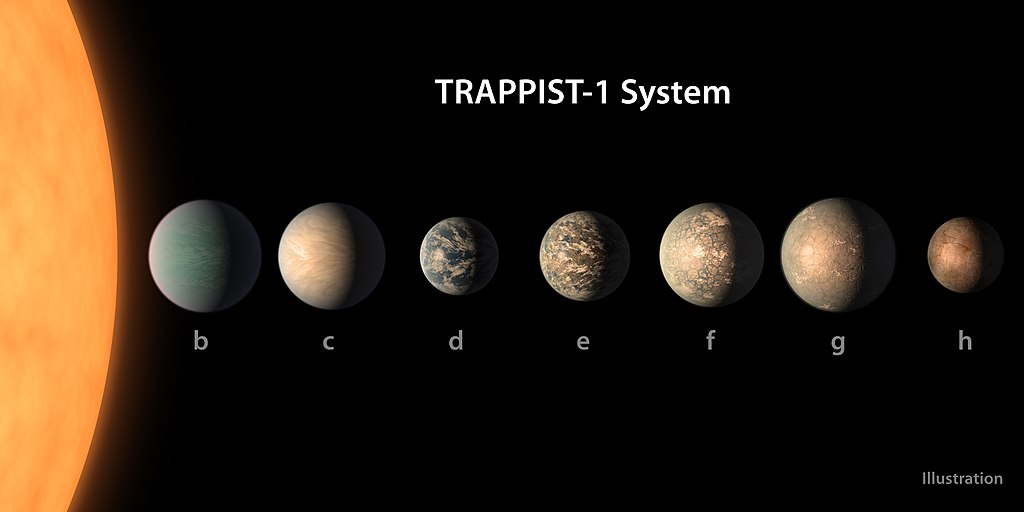
NASA has expressed a hopeful vision for the TRAPPIST-1 system, with artistic renderings depicting planets that feature oceans or areas full of vegetation (see Fig. 1). Another illustration presents the surface of planet f as having bodies of water. These images undoubtedly capture the interest of both scientists and those fascinated by the prospect of extraterrestrial life. Yet, they seem to contradict both scientific understanding and biblical perspectives.
No Chance for Life to Arise
Eric Wolf, an astrophysicist at the Laboratory for Atmospheric and Space Physics at the University of Colorado Boulder, carried out 3D climate simulations of the TRAPPIST-1 planets.8 His model suggested that the planets had oceans and atmospheres composed of nitrogen, carbon dioxide, and water vapour. Using data from planets d and f, Wolf extended his findings to estimate conditions on planets b and c (which are closer to the star) as well as g and h (which are farther away).
The findings revealed that on planets b, c, and d, the extreme temperatures and runaway greenhouse effect would cause water to evaporate into space, making it impossible for liquid water to persist. On planets f, g, and h, the frigid temperatures would lead to the condensation of carbon dioxide, causing it to accumulate on the surface. This would result in these planets being unable to support a stable atmosphere, with their surfaces entirely covered in snow and ice.
This leaves planet e, which appears to be the most optimally situated. Wolf, adopting an evolutionary perspective, assumed that stars like TRAPPIST-1, which are cold and burn slowly, would require around a billion years for their radiation to reach a stable state. During this period, planet e would undergo a similar process to planets b, c, and d, losing its water. For planet e to retain significant amounts of water today, it would have needed to begin with seven times the amount Earth currently has—an exceedingly unlikely scenario.9
Conclusion
Despite the optimism surrounding the TRAPPIST-1 system, shared by NASA, other space agencies, and proponents of extraterrestrial life, none of the planets in orbit around TRAPPIST-1 are suitable for sustaining life. The prospect of finding life on other planets remains deeply enticing. Evolutionists who subscribe to the concept of abiogenesis are reluctant to abandon this idea, as the potential discovery of intelligent life, especially life that which could have evolved similarly to humans, is particularly captivating.
The Bible teaches that God created the universe in its entirety and specifically designed Earth to support life.10 It is plausible that God may have created microscopic life forms on other planets. Since Genesis does not mention bacteria, such a discovery would not contradict biblical principles. While this possibility is unlikely, it cannot be ruled out entirely.
The Bible indicates that all of creation suffers due to the fall of Adam.11 If God were to create beings resembling humans, they would not be part of this particular creation (the universe or cosmos). This topic, however, is a subject for further exploration.
By the way, we recommend reading the articles:
- The Flood in Native American Legends of the Grand Canyon
- Viking Bones and Radiocarbon Dating
- Why Did Ancient Calendars Have Only 360 Days?
- Does the Big Bang Theory Exclude the Existence of God?
- Does the Bible Imply that the Earth is Flat?
Footnotes
- For the same reason, we cannot see even the nearest star, Proxima Centauri, with the naked eye.
- Acronym for TRAnsiting Planets and PlanetesImals Small Telescope.
- Grigg R., Ultracool Trappist-1 and its seven planets, Creation Ministries International, 3 March 2017, https://creation.com/seven-planets.
- Coppedge D., Extrasolar planets: a challenge to biblical cosmology?, Creation, 36 (3), 2014, pp. 42–44, https://creation.com/exoplanets.
- Similar to the Earth-Moon system, where the Moon always faces Earth with the same side.
- The terminator is the line separating the illuminated (daytime) side of a celestial body from its unlit (nighttime) side.
- Faulkner D.R., Discovery of 7 Earth-Sized Planets Orbiting Star TRAPPIST-1, Answers in Genesis, 25 February 2017, https://answersingenesis.org/astronomy/extrasolar-planets/7-earth-sized-planets-trappist-1/.
- Wolf E.T., Assessing the Habitability of the TRAPPIST-1 System Using a 3D Climate Model, 16 March 2017, https://arxiv.org/abs/1703.05815.
- Grigg R., Trappist planets not in habitable zone, Creation Ministries International, 11 April 2017, https://creation.com/trappist-planets-not-habitable-zone.
- The Bible, New King James Version, 1982, Isaiah 45:18.
- The Bible, New King James Version, 1982, Romans 8:22
© Source of main image: Canva.

The portal EvolutionOfThinking.org, created by the Research and Education Institute, focuses on education and the dissemination of knowledge related to research on various aspects of human well-being.

