
Is the fourth spatial dimension real? What do quantum physics and mathematics reveal about its existence?
In 2018, two physical experiments uncovered a previously unexplored aspect of our reality.1 Research teams from Europe and the USA aimed to determine if there is physical evidence supporting the existence of a fourth spatial dimension. In quantum physics, the quantum Hall effect typically occurs in two dimensions. However, American professor Oded Zilberberg’s calculations suggested that this phenomenon could also be observed in a four-dimensional system. To explore this, one team utilized rubidium atoms cooled to absolute zero, while the other experimented with a beam of photons. The results indicated that the Hall effect behaves as though a fourth spatial dimension were truly present.2,3
These discoveries were quite shocking for scientists worldwide.4 Until now, we have been accustomed to thinking in terms of three spatial dimensions and one temporal dimension. However, as early as the 18th century, mathematicians began to ask: what if there are more than three dimensions? Among the pioneers who introduced and developed the idea of four-dimensional space were Jean le Rond d’Alembert (1717-1783), Ludwig Schläfli (1814-1895), and Charles Howard Hinton (1853-1907). Later, physicists like Albert Einstein (1879-1955) also considered the fourth dimension, though Einstein identified it as time. Today, one of the leading mathematical theories is string theory, which posits not just four dimensions, but up to eleven, with seven of them being compactified.
The experiments outlined above, while not aimed at proving string theory, provided scientists with a glimpse of the fourth spatial dimension (also known as the fifth dimension if we count time as the fourth). However, we currently have no way to investigate the characteristics of this dimension, such as whether it is compactified or extended. The primary challenge is that we perceive reality through three spatial dimensions and one time dimension. As a result, the fourth spatial dimension remains a purely mathematical concept—for now, at least.5
Spatial Dimensions – The Basics
If we set aside the notion of compactified dimensions, we may instead consider the possibility of an extended fourth spatial dimension. Although, as previously noted, this dimension is beyond the capacity of human perception, it can be rigorously defined and analyzed through mathematical models.6 To begin with the fundamentals, how are spatial dimensions defined? Primarily, each additional dimension can be understood as a space in which an object may be positioned along a line that is perpendicular to the other existing dimensions. The overall number of dimensions is irrelevant in this context.
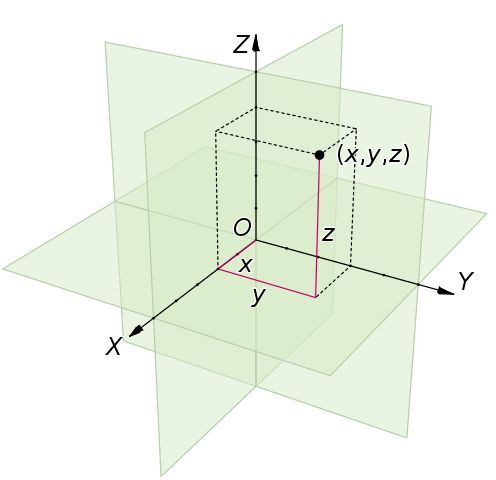
To describe a point on a two-dimensional plane, we use its x and y coordinates, which indicate its distance from a reference point where both x and y are zero. These coordinates correspond to the plane’s length and width. It is crucial to recognize that the lines where x equals 0 (while y does not) and y equals 0 (while x does not) are perpendicular, forming a 90° angle. The third dimension, height, is introduced through the z-coordinate, which is also perpendicular to the other two dimensions. If z equals 0, the point lies on the plane; if z has any other value, the point is positioned above or below the plane.
The Fourth Dimension – Position in Space
In light of the above, the fourth dimension must also be perpendicular to each of the preceding three dimensions. This introduces the concept of a theoretical hyperspace, defined by a line that intersects our three-dimensional space (our reality) at a 90° angle. Consequently, an additional coordinate is required, which may or may not be equal to zero. To simplify the process, we can replace the coordinates x, y, and z with labels that refer to specific points. For instance, for point A, they would be a1, a2, and a3. Therefore, its coordinate in the fourth dimension would be labeled as a4.
In our experiment, we will use the corner of a rectangular table as the reference point, with ball A as the object, and distances measured in centimetres. If the coordinates of ball A are a1=2, a2=0, a3=0, a4=0, this indicates that the ball is positioned 2 cm from one edge of the table. If they are a1=5, a2=7, a3=0, a4=0, it signifies that the ball is located near the centre of the table. However, if the coordinates are a1=6, a2=-5, a3=3, a4=0, the ball is hovering 3 cm above the surface of the table, but situated 5 cm away from the edge, rather than directly above the table.
Up to this point, the value of a4 has consistently been 0. However, what occurs if a4 takes a value other than 0, such as 1, 4, or -10? Where would the ball be located in that case? At this juncture, the limitations of our ability to perceive the fourth dimension start to become problematic. If the a4 value of the ball differs from 0, it would simply become invisible to us, though it would still exist. Nevertheless, should we adjust our position to align with the ball’s a4 coordinate, it is likely that we would see it again. Yet, in doing so, our entire familiar world would vanish from view until we return to a4=0.
The Fourth Dimension – Geometric Shapes
The fourth dimension can be represented not only through coordinates but also by employing geometric concepts, particularly geometric shapes. In one dimension, only a straight line is possible. In two dimensions, there are more possibilities, such as curves, squares, or circles on a plane. In three dimensions, the corresponding forms of the square and circle are the cube and sphere. These shapes also have equivalents in higher mathematical dimensions, where we refer to hypercubes and hyperspheres. In four dimensions, the equivalent of a cube is known as a tesseract, while the analogue of a sphere is the 3-sphere, also called a glome.7
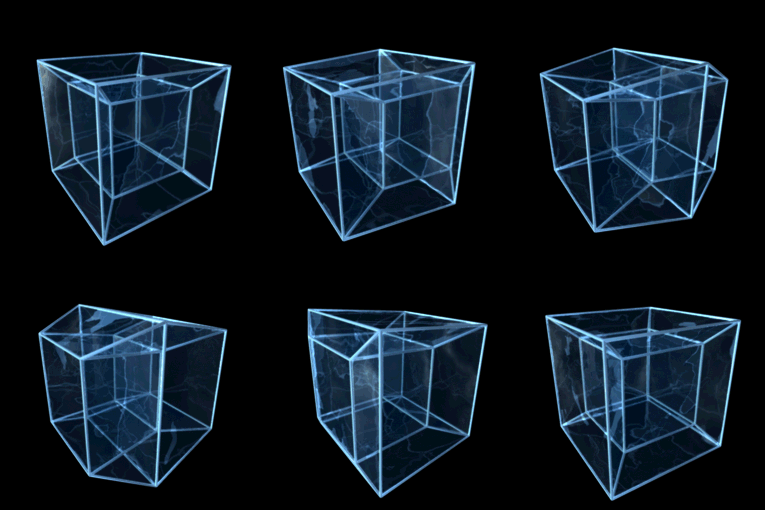
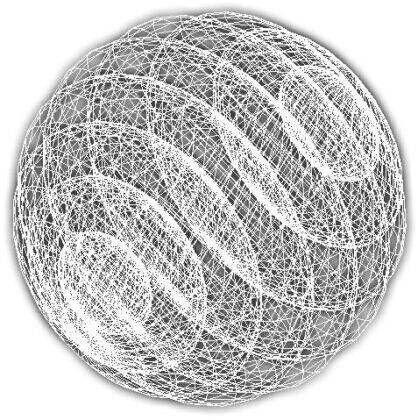
These shapes are extremely difficult for us to visualise, yet they each possess mathematical formulas for both surface area and volume. In the fourth dimension, a tesseract, for instance, has a four-dimensional volume and a three-dimensional surface area. Similarly, a 3-sphere has a volume and surface area one dimension higher than those of a three-dimensional sphere. The additional dimension thus enhances all these properties, and for shapes with edges (i.e., those other than a 3-sphere), this also entails an increased number of faces, edges, and vertices.8
The Shape of Our Universe
Let us extend the concept of four-dimensional hyperspace to the macro scale. Astrophysicists frequently liken the expansion of our three-dimensional universe to the inflation of a balloon.9 For many, this analogy can be perplexing. It is essential to emphasise that our three-dimensional universe is represented by the surface of the balloon, rather than its interior. The balloon analogy implies that the universe exists as a three-dimensional hypersurface on a four-dimensional cosmic hypersphere.10
This issue is intimately connected to the question of the universe’s shape and curvature. Current scientific data suggest that its critical density parameter, omega (Ω), is likely equal to 1. This would imply that the universe possesses zero curvature, is geometrically flat, and extends infinitely.11 The alternative is a universe with a closed geometry, such as a spherical one, with Ω equal to more than 1, or a universe with an open geometry shaped like a saddle with Ω equal to less than 1.
Journey Around the Universe
It appears highly improbable that such a physical value would be precisely equal to 1, extending indefinitely with an infinite number of zeros beyond the decimal point. More plausibly, there would be some deviation at a certain point in the decimal sequence. Should this deviation be upward—suggesting a density of matter sufficient to induce positive curvature—the universe would consequently adopt a closed geometry. In such a scenario, the entire universe would resemble a vast 3-sphere, with the observable universe constituting merely a small portion of its expansive three-dimensional hypersurface. Notably, data from the Planck satellite has hinted at the possibility that the universe may indeed possess a closed structure12 (which triggered a cosmological crisis).
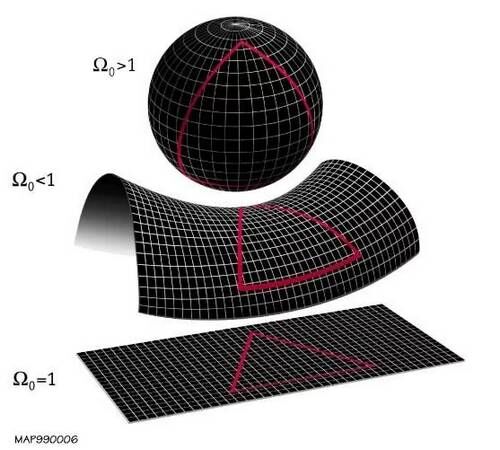
Thus, if we were to travel in a perfectly straight line in any direction within the universe, our path would curve within the fourth dimension. A useful analogy lies directly beneath our feet: when we walk in a straight line on Earth, without deviating to the left or right, we curve only in the third dimension due to the curvature of the planet’s surface. In time, we would ultimately return to the point where we began.14
A Four-Dimensional Interior of the Universe?
If this were the case, our cosmic hypersphere would possess not only a three-dimensional hypersurface but also a four-dimensional hyper-interior. This inner dimension could harbour deeper mysteries concerning the nature of our universe, potentially offering resolutions to some of the enduring challenges and paradoxes in modern cosmology. Furthermore, four-dimensional space would need to extend beyond the boundaries of our universe, outward into the unknown. The question remains: where might this extended space ultimately lead us?
Further exploration of the fourth dimension will be addressed in Part 2.
By the way, we recommend reading the articles:
- The Fourth Dimension – Part 2: Exploring the Intersection of Science and Spirituality
- Exploring the Origins of Religion
- What Happened to the Waters Above the Firmament?
- Human Races: A Scientific Perspective
- What is the Higgs Boson?
- Does the Bible Imply that the Earth is Flat?
Footnotes
- Mandelbaum, R.F. (2018) ‘Two experiments show fourth spatial dimension effect’, Gizmodo, 4 January. Available at: https://gizmodo.com/two-experiments-show-fourth-spatial-dimension-effect-1821739488.
- Lohse, M., Schweizer, C., Price, H.M., Zilberberg, O. and Bloch, I. (2018) ‘Exploring 4D quantum Hall physics with a 2D topological charge pump’, Nature, 553(7686), pp. 55–58. Available at: https://www.nature.com/articles/nature25000.
- Zilberberg, O., Huang, S., Guglielmon, J., Wang, M., Chen, K.P., Kraus, Y.E. and Rechtsman, M.C. (2018) ‘Photonic topological boundary pumping as a probe of 4D quantum Hall physics’, Nature, 553(7686), pp. 59–62. Available at: https://www.nature.com/articles/nature25011
- Stando, A. (2018) ‘Istnieje czwarty wymiar. Odkrycie szokuje naukowców z całego globu’, WP Tech, 10 January. Available at: https://tech.wp.pl/istnieje-czwarty-wymiar-odkrycie-szokuje-naukowcow-z-calego-globu,6207807597328001a.
- Kajfosz, J. (2010) U wrót przestrzeni. Warszawa: Oficyna Wydawnicza Vocatio, pp. 19–20.
- Ibid.
- Elwes, R. (2011) ‘Exotic spheres, or why 4-dimensional space is a crazy place’, Plus, 12 January. Available at: https://plus.maths.org/content/richard-elwes.
- Kajfosz, J. (2010) U wrót przestrzeni. Warszawa: Oficyna Wydawnicza Vocatio, pp. 21–23, 29–31.
- OpenStax (n.d.) ‘The Big Bang’, University Physics Volume 3. Available at: https://openstax.org/books/university-physics-volume-3/pages/11-6-the-big-bang.
- GeekWeek (2020) ‘Wszechświat jest 4-wymiarową hiper-kulą o brzegu 3-wymiarowej sfery ekspandującej’, GeekWeek, 30 November. Available at: https://geekweek.interia.pl/astronomia/news-wszechswiat-jest-4-wymiarowa-hiper-kula-o-brzegu-3-wymiarowe,nId,5546829.
- Sutter, P. (2016) ‘The Universe Is Flat — Now What?’, Space.com, 7 December. Available at: https://www.space.com/34928-the-universe-is-flat-now-what.html.
- Di Valentino, E., Melchiorri, A. and Silk, J. (2019) ‘Planck evidence for a closed Universe and a possible crisis for cosmology’, Nature Astronomy, 4, pp. 196–203. Available at: https://www.nature.com/articles/s41550-019-0906-9.
- Not counting, of course, the fact that the Earth is not a perfect sphere, but a geoid, whose polar diameter is 42 km smaller than the equatorial diameter.
- Sagan, C. (n.d.) Universe, YouTube. Available at: https://www.youtube.com/watch?v=3WL_vtu4r1w.
© Source of main image: Canva.

The portal EvolutionOfThinking.org, created by the Research and Education Institute, focuses on education and the dissemination of knowledge related to research on various aspects of human well-being.

