
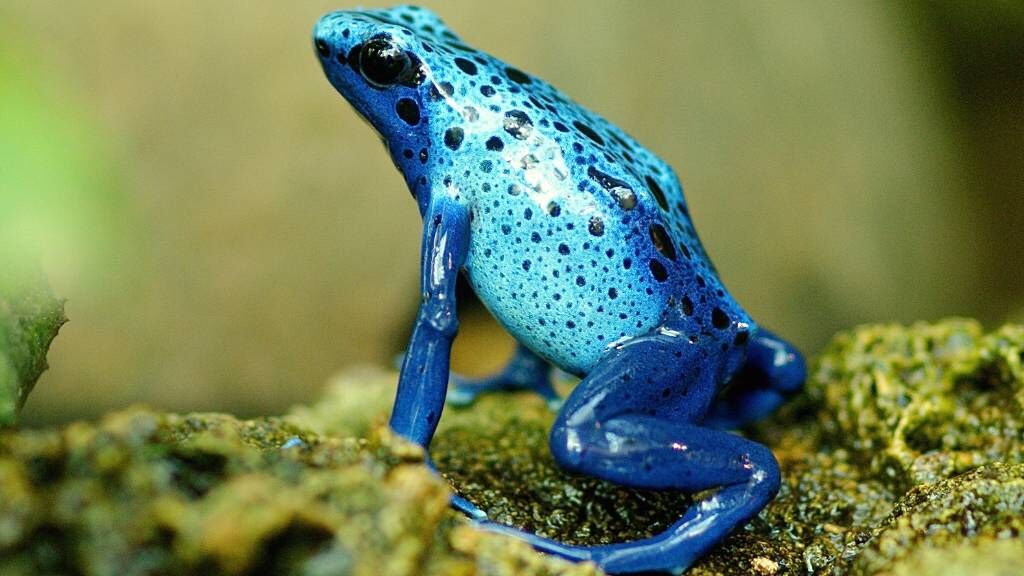
Poison dart frogs, native to Central and South America, are both beautiful and deadly. They secrete toxic alkaloids through their skin, and their vibrant coloration serves as a warning to potential predators. Each frog contains enough toxins in its skin to kill up to ten people.1 Research has uncovered how these amphibians manage to survive without succumbing to their own lethal poison.
Did Frogs Evolve Resistance to Their Toxins?
Scientists, drawing on Charles Darwin’s theory of evolution, believe that nature gradually “selects” beneficial traits, allowing one species to evolve into another over time. Can this theory, however, fully explain the emergence of poison dart frogs? Could such creatures have formed through random processes?
What came first: the frog’s toxin or its resistance to that toxin? If nature “chose” to create the toxin first, how did the frog survive the initial exposure? This sequence of events seems implausible.
One might then conclude that the frog first developed a resistance to the toxin, and only later did it evolve the complex biochemical mechanisms required to produce the toxin. In this way, the toxin could evolve without endangering the frog.
However, the issue is that the frog’s toxin is not a simple “substance.” To produce such a toxin in a laboratory, chemists must follow a precise, 24-step process.2 Natural, random processes could never have devised such a detailed and complex procedure.
Furthermore, this idea encounters two significant challenges.
Issue One: The Limitations of Natural Processes
Natural processes lack the foresight to anticipate future needs. Nature could not have foreseen that, at some distant point in the future, a toxin would become essential for the frog’s self-defense. Nor could it have predicted the need to begin developing such a toxin in advance.
Issue Two: The Biochemical Mechanism of the Frog’s Toxin
The frog’s toxin functions by binding to a specific protein module located on the outer surfaces of nerve and muscle cells. It targets a module containing 1,836 amino acids, blocking the transmission of critical signals. This disruption causes muscle cells to freeze, ultimately leading to cardiac arrest.
When scientists replaced amino acid 1584 (asparagine), which is present in most animals, with the amino acid found in poison dart frogs at this position (threonine), the toxin lost its effectiveness. Rats with the frog’s version of this protein survived exposure to the toxin without issue.3
What, then, are the chances that such an amino acid substitution, in this exact location, could have been “selected” by natural processes for frogs before any of them began producing their toxin?
Created as a Whole
Believing in the random precision of nature in arranging amino acids within frogs’ bodies is, in effect, to accept the occurrence of a miraculous event. It demands as much faith as the belief that the God of the Bible created each animal in a single act, rather than through a gradual, step-by-step process. Only an intelligent Creator could foresee the needs of His creatures and provide them with the necessary means to fulfill those needs.
By the way, we recommend reading the articles:
- What Does the Bible Say About a Healthy Diet and Nutrition?
- Does the Bible Justify Slavery?
- Which Came First: The Flood or the Pyramids?
- The Tower of Babel – Extra-Biblical Narratives
- Eugenics and Its Consequences
Footnotes
- Yirka, B., 2017. Why poison dart frogs don’t poison themselves. PhysOrg, [online] 5 September. Available at: https://phys.org/news/2017-09-poison-dart-frogs-themselves.html.
- Logan, M.M., et al., 2016. Asymmetric synthesis of batrachotoxin: Enantiomeric toxins show functional divergence against NaV. Science, 354(6314), pp. 865-869.
- Wang, S.-Y. and Wang, G.K., 2017. Single rat muscle Na+ channel mutation confers batrachotoxin autoresistance found in poison-dart frog Phyllobates terribilis. Proceedings of the National Academy of Sciences, 114(39), pp. 10491-10496.
Compiled from: B. Thomas, „Why don’t poison dart frogs poison themselves?”, Acts&Facts, Institute for Creation Research, November 2017, p. 20.
© Source of main image: Canva.

The portal EvolutionOfThinking.org, created by the Research and Education Institute, focuses on education and the dissemination of knowledge related to research on various aspects of human well-being.

