
Mohenjo-Daro is an ancient city renowned for its remarkable urban planning, designed from the ground up. How did the people of antiquity possess such advanced knowledge of city design?
The Indus Valley in South Asia was home to a civilization that still fascinates us today. Known as the Harappan or Indus Valley Civilization, it is thought to have existed from 3300 to 1300 B.C., with its peak period between 2600 and 1900 B.C.1 It is therefore regarded as one of the oldest civilizations, existing alongside those of Mesopotamia, Egypt, Crete, China, and Peru (Caral-Supe).
What Was Mohenjo-Daro?
The Indus Valley civilization left behind the remains of many ancient cities, with Harappa and Mohenjo-Daro being the most renowned archaeological sites. The ruins of Harappa, located in Pakistan’s Punjab province, were first described as early as the 1840s.2 However, it was not until the 1920s that excavation work produced significant results. Archaeologists not only uncovered much of Harappa but also discovered extensive ruins in the Sindh province, including Mohenjo-Daro.
These discoveries caused a sensation, particularly as Mohenjo-Daro proved to be larger than Harappa. Archaeologists estimate that Harappa housed approximately 23,000 inhabitants,3 while Mohenjo-Daro may have had up to 40,0004. It is believed that the city was established around 2500 B.C., roughly the same time the Egyptians were constructing the Great Pyramid of Giza.5 In these ruins, archaeologists discovered numerous ceramics, tools, and toys, but very few artifacts that could be definitively identified as having a religious function. Additionally, they found no structures that could be unquestionably classified as a temple or palace, suggesting that the inhabitants may not have practiced a centralized religion.
Mohenjo-Daro – A City Planned from the Ground Up
Mohenjo-Daro covered about 250 hectares6 and was built with bricks of uniform size. The city was divided into two sections: the Citadel and the Lower City. In the Citadel, archaeologists uncovered several notable sites, including the Chief’s House, the Great Granary, and the Assembly Hall. However, one of the most famous discoveries is the Great Bath, found in 1926. This site consists of a series of rooms and bathrooms surrounding a small pool measuring 14.5 by 7 meters, with a maximum depth of 2.4 meters. The pool was supplied with water from a brick-lined well.7
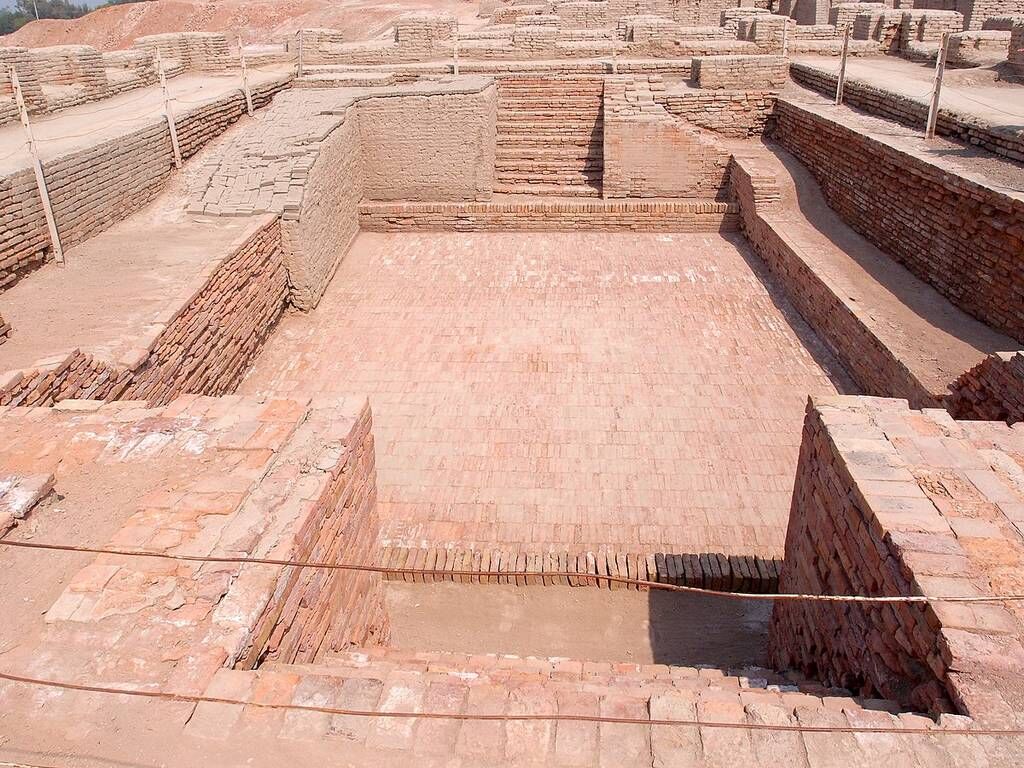
This pool was just one part of the extensive water infrastructure that spanned the ancient city. Mohenjo-Daro boasted at least 700 public wells, approximately one for every three houses, a remarkably high ratio. Additionally, most houses had at least one private well.8 The entire city was also linked by an advanced sewage system that efficiently disposed of waste. Scientists believe this may be the world’s first such system, and the innovative solutions developed in this ancient city are still used by the inhabitants of South Asia today.9
The Genius of Ancient People
This confirms that both Mohenjo-Daro and other Indus Valley cities were thoughtfully designed from the ground up. Mohenjo-Daro, in particular, remains a remarkable example of urban planning. To construct the city in this manner, the ancient inhabitants had to carefully plan its entire layout, including the walls, streets, houses, public buildings, administrative structures, and the complex water supply and sewage systems.
Archaeologists believe that Mohenjo-Daro emerged around the same time as the pyramids of Giza. It was also during this period that the cities of Caral and Aspero, part of Peru’s Norte Chico civilization—the oldest known civilization in the Americas—were established.10 This raises several important questions. First, why did ancient people choose to build highly developed civilizations on three different continents simultaneously, around 2500 B.C.? Second, how did these ancient people possess advanced knowledge of urban planning, enabling them to create masterpieces like Mohenjo-Daro?
Advanced Urban Planning in Antiquity – Evidence Supporting the Bible?
Ancient humans were not as primitive as they may seem to us today. The earliest known civilizations reveal a remarkably high level of knowledge in city planning and the construction of monumental structures, such as the pyramids.11 This aligns with the biblical account of the city of Babel. Genesis 11:3-4 (NKJV) mentions the baking of bricks and the construction of a city with a tower that would reach the heavens. The words of the people on the plain of Shinar, saying, “Come, let us build ourselves a city,” suggest that Babel was a planned city, much like Mohenjo-Daro.
The Bible also states that before the flood, Cain, who killed his brother Abel, built the first city in honor of his son, Enoch.12 The builders of Babel must have inherited this knowledge through Noah and his sons, passed down from previous generations who lived before the flood. Similarly, the builders of Mohenjo-Daro and other ancient cities likely inherited this knowledge. Therefore, only the biblical narrative aligns with the sudden emergence of advanced civilizations in Africa, Asia, and the Americas around 4,500 years ago.
By the way, we recommend reading the articles:
- The Laws of Logic and the Existence of God
- Does the Bible Justify Slavery?
- Social Darwinism and Its Impact on Society
- Defining the Human-Animal Divide
- Earth’s Axial Precession in Ancient Thought
Footnotes
- Decline of the Indus River Valley Civilization (c. 3300-1300 BCE), Available at: https://www.science.smith.edu/climatelit/decline-of-the-indus-river-valley-civilization-c-3300-1300-bce/.
- Masson’s Observations at Harappa, Available at: https://www.harappa.com/har/masson0.html.
- Indus Civilization Discoveries at Harappa, National Geographic, Available at: https://www.nationalgeographic.com/adventure/article/130425-indus-civilization-discoveries-harappa-archaeology-science.
- Mohenjo-Daro and Harappa: History, Facts & Tourism, Available at: https://www.zameen.com/blog/mohenjodaro-harappa-history-facts-tourism.html.
- Handwerk, B., Pyramids at Giza, National Geographic, Available at: https://www.nationalgeographic.com/history/article/giza-pyramids.
- Bahn, P.G., 2006. Archeologia – Przewodnik. Warszawa: Wydawnictwo Arkady, p. 338.
- Singh, U., 2008. A History of Ancient and Early Medieval India: From the Stone Age to the 12th Century. Pearson Education, pp. 149-150.
- Singh, U., 2008. A History of Ancient and Early Medieval India: From the Stone Age to the 12th Century. Pearson Education, p. 151.
- Mughal, M.A.Z., 2011. Mohenjo-daro’s Sewers, in World History Encyclopedia. Santa Barbara, CA: ABC-CLIO, pp. 121-122. Available at: https://dro.dur.ac.uk/11022/1/11022.pdf?DDD5+twxg95+cqjd36.
- Hirst, K.K., 2019. The Norte Chico Civilization of South America, ThoughtCo. Available at: https://www.thoughtco.com/caral-earliest-civilization-in-new-world-172680.
- Landis, D., 2019. Ancient Man and Intelligence: Were People Originally Dumb Brutes or Brilliant?, Answers in Genesis. Available at: https://answersingenesis.org/human-evolution/brilliant-or-dumb-brutes/.
- The Bible, New King James Version, 1982, Genesis 4:17.
© Source of main image: Canva.

The portal EvolutionOfThinking.org, created by the Research and Education Institute, focuses on education and the dissemination of knowledge related to research on various aspects of human well-being.

