
Researchers are continually uncovering new insights into the sophisticated bioengineering found in organisms. This complexity is closely associated with the idea of irreducible complexity, which asserts that all parts of a system must be present and work in unison for the mechanism to function. Ants and their behaviours serve as an excellent example of this concept.
Ants ‘Chirp’ Their Way to Survival
For many years, it has been well established within the scientific community that ants communicate through touch and the release of chemical substances known as pheromones. These pheromones enable ants to leave chemical trails that other members of the colony can follow. Additionally, pheromones play a crucial role in identifying an ant’s origin, including its nest and social status within the colony.
At one point, scientists uncovered an additional layer of complexity in the communication systems of ant colonies. They discovered that ants also use sound (stridulation) to communicate, and that this acoustic system plays a crucial role in the colony’s survival.1
Researchers investigated the European ant species Myrmica rubra, which produces sounds through a stridulatory organ located on the dorsal side of the fourth abdominal segment. This organ works in conjunction with a spine (plectrum) that extends from the posterior edge of the second petiole segment (postpetiole). As the ant moves its abdomen, these two parts rub together, producing a series of chirping sounds.2
Other ants are able to detect and interpret these signals, prompting a variety of complex social behaviours. Acoustic signals are not used in isolation; rather, they are combined with pheromones and processed together through sophisticated internal mechanisms.
The integration of these different communication and sensory systems serves as a clear example of irreducible complexity—an ‘all-or-nothing’ arrangement. Without any one of these components, the entire colony would be doomed within a single generation.
Ants Never Cause Traffic Jams
While humans have not yet devised ideal traffic management systems, ants have long since mastered the art of efficient movement and hardly ever experience ‘traffic jams’.
Audrey Dussutour, an entomologist from the University of Sydney, told Wired Science:
‘They never get stuck in traffic. We should use their rules. I’ve been working with ants for eight years, and have never seen a traffic jam.’3
Dr. Dussutour’s earlier research showed that when ants move along broad paths with several lanes, they arrange themselves in a way that maximises efficiency.3 Dr. Dussutour and her collaborators later found that even when ants navigate single-lane paths, such as those on lianas or small branches, they also employ strategies that optimise movement.4
To prevent ‘overcrowding’ on a narrow path, ants leaving the nest yield to those returning with heavy loads. Furthermore, ants returning without heavy loads do not attempt to overtake slower, laden ants; instead, they slow down. Why do they do this? Researchers have provided an explanation: ‘The insects could waste up to 64 s [seconds] on a 300 cm bridge. However, by slowing down and following an unimpeded cargo-carrying ant, the empty-handed foragers would only be delayed by 32 s, returning faster than if they’d muscled past’. Also, ‘unladen returning ants avoided outbound foragers by moving to the side.’4
Without these algorithms, ants would be hindered by head-on collisions, which would disrupt the efficient delivery of food to the nest and ultimately threaten the colony’s survival.
This illustrates the concept of irreducible complexity. If ants were to lack the algorithms currently integrated with pheromones, tactile sensory input, muscle systems, and motor control, their survival would be impossible. Furthermore, there is no evidence to suggest that ants have the ability to learn new behavioural patterns.
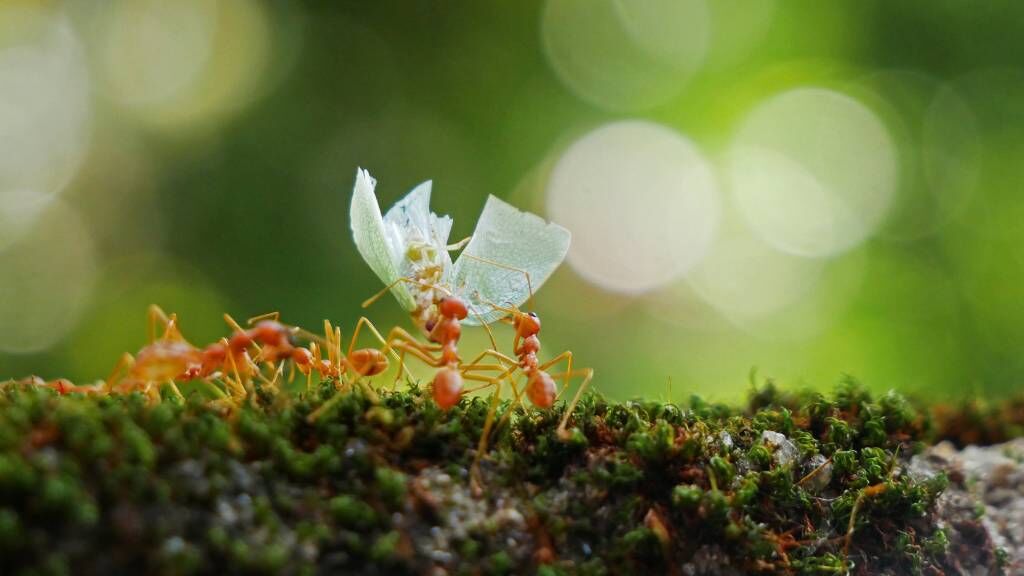
Ants Know Each Others Nutritional Needs
Ants, as social creatures, demonstrate an extraordinary ability to collaborate in meeting the nutritional requirements of their entire colony. The structure within the nest does not simplify the management of nutrition; rather, it evolves in line with the colony’s growth and developmental stages, while also being shaped by various environmental factors. Despite these complexities, ants consistently manage to meet the specific nutritional needs of the colony.
A study published in Current Biology revealed that the amount of food delivered to the colony is precisely aligned with the nutritional requirements of its members.5 Mature worker ants primarily require carbohydrates, while larvae need significantly higher levels of protein to support proper development. The methods used to collect and distribute food are specifically adapted to meet the distinct nutritional needs of each group within the colony.
How do foraging ants assess the type and quantity of food to bring back to the nest? How has their foraging strategy developed to precisely accommodate the colony’s shifting nutritional demands? If the mechanisms behind these behaviours had not functioned perfectly from the start, the colony would not be able to survive.
Conclusion
The extraordinary abilities of ants are difficult to account for through the concept of natural selection alone. No one has yet provided a plausible explanation for how the complex mechanisms and algorithms within these creatures evolved gradually over millions of years. The concept of irreducible complexity appears to fit more naturally within a biblical framework.
By the way, we recommend reading the articles:
- The Origin of Music and Singing
- The Existence of Plants Before the Sun: A Challenge to the Biblical Creation Account
- The Formation of the Solar System: What Do We Really Know?
- Speech – A Unique Human Ability
- Which Came First: The Flood or the Pyramids?
Footnotes
- Casacci, L. P. et al. (2013) ‘Ant Pupae Employ Acoustics to Communicate Social Status in Their Colony’s Hierarchy’, Current Biology. Published online before print, 7 February.
- Barbero, F. et al. (2012) ‘Myrmica Ants and Their Butterfly Parasites with Special Focus on the Acoustic Communication’, Psyche, 2012.
- Keim, B. (2009) ‘Taking Traffic Control Lessons—From Ants’, WIRED Science. Posted on wired.com, 3 February.
- Dussutour, A. et al. (2009) ‘Priority rules govern the organization of traffic on foraging trails under crowding conditions in the leaf-cutting ant Atta colombica‘, The Journal of Experimental Biology, 212, pp. 499–505.
- Dussutour, A. and S. J. Simpson (2009) ‘Communal Nutrition in Ants’, Current Biology, 19(9), pp. 740–744.
Compiled from: J. P. Tomkins, ‘Talking’ ants are evidence for creation’, published on icr.org on February 22, 2013; B. Thomas, ‘Ant algorithms argue against evolutionary origins’, published on icr.org on February 17, 2009; J. P. Tomkins, ‘Communal nutrition in ants: strong evidence for creation’, published on icr.org on July 8, 2009.
© Source of main image: Canva.

The portal EvolutionOfThinking.org, created by the Research and Education Institute, focuses on education and the dissemination of knowledge related to research on various aspects of human well-being.

