
The most significant discovery in biblical archaeology was the uncovering of the manuscripts of the Holy Scriptures at Qumran in 1947 and the subsequent years.
Qumran is situated near the northern part of the Dead Sea. The Old Testament references six cities located within the Judean Desert,1 one of which could have been Khirbet Qumran. Originally, this area housed an Israelite desert fortress, which was likely abandoned during the reign of the last Judean king, Zedekiah. Subsequent archaeological studies have revealed that the site was inhabited from the 2nd century BCE until 68 CE, with a brief gap following an earthquake in 31 CE.

The Essenes’ Complex
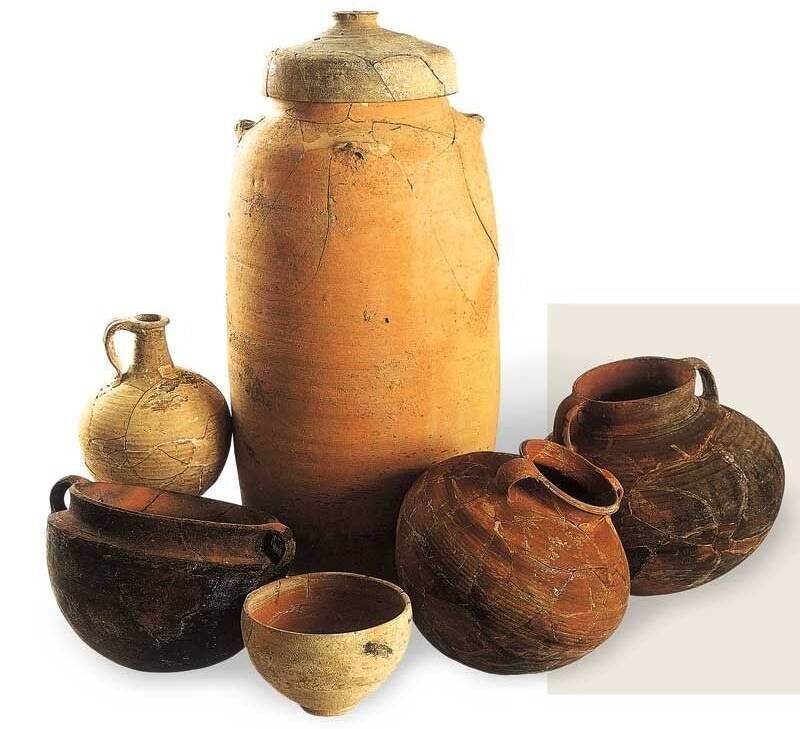
The residential complex excavated near the caves, where jars containing biblical manuscripts were discovered, is attributed to the Essenes, an ascetic Jewish community that existed from around 200 BCE to 70 CE. This community used the site for living, working, studying, and worshipping, with their primary activity being the transcription of the Holy Scriptures.
The complex was accessed through a gate, which featured a two-storey tower and was flanked by two smaller entrances. Inside, a large kitchen with five hearths was found, alongside a refectory adjoining a smaller room where clay vessels, such as vases, platters, plates, pitchers, and cups, were uncovered. Archaeologists also unearthed a pottery workshop and a long assembly hall, likely serving as a scriptorium, as evidenced by the presence of a writing desk and several inkwells. Water was supplied via an aqueduct and stored in seven cisterns.

Ancient Jewish historians, including Josephus Flavius and Philo of Alexandria, documented the Essenes in their writings. According to their accounts, the Essene community consisted of approximately 4,000 members, dispersed across Palestine and living in monastic communes. In 68 CE, as the Roman army advanced to suppress the Jewish rebellion, the Essenes concealed their scrolls in the remote caves, where they remained undisturbed until their rediscovery in the mid-20th century.
The Significance of the Scrolls
Several of the scrolls, such as the Damascus Document, outline the regulations governing the Qumran community and present theological principles that diverged significantly from mainstream Judaism. Another notable text, The Rule of War, offers an apocalyptic depiction of the events leading up to the end of the world.
In 1947, a young Bedouin shepherd named Muhammad adh-Dhib serendipitously discovered biblical manuscripts in one of the caves near the Dead Sea. While the trajectory by which these manuscripts ultimately reached Professor W.F. Albright is complex, it is beyond a shadow of a doubt that their examination yielded a remarkable find. The scrolls were determined to be approximately 1,000 years older than the previously known manuscripts. Among the biblical texts, one holds particular significance: a complete scroll of the Book of Isaiah, measuring 7.34 metres in length and 26 centimetres in height.

This discovery, however, was not an isolated occurrence. In addition to Cave 1, where the Isaiah Scroll was found, several other caves were subsequently explored. The oldest manuscript dates to the 3rd century BCE, while the most recent dates to the 2nd century CE. By the early 1960s, texts from Caves 1, 2, 3, and 5–10 had been published. A well-preserved Psalms scroll from Cave 11 was released in 1965, and in 1971, an Aramaic targum (paraphrased translation) of the Book of Job was made available. The scrolls discovered in Wadi Murabba’at were published in 1961. Of the 35,000 fragments uncovered in Cave 4, along with manuscripts from other locations, only biblical commentaries, phylacteries (scrolls containing specific biblical texts used in prayer), and targums were published between 1968 and 1977. In 1977, Yigael Yadin published the 8.5-metre-long Temple Scroll, which had been seized in Bethlehem during the Six-Day War of 1967 but was later acquired from its owners. The text includes religious laws, lists of offerings, and detailed instructions regarding the construction of the future temple.2
The Scope of the Findings and Textual integrity of the Bible
The Qumran scrolls include texts from every book of the Old Testament, with the exception of the Book of Esther. Several books were found in multiple copies; for example, Psalms is found in 30 manuscripts, Deuteronomy in 25, Isaiah in 19, and both Genesis and Exodus in 15 manuscripts each. In total, 179 biblical manuscripts were discovered.
A detailed examination of the biblical manuscripts from Qumran reveals that the Masoretic Text—the basis of all printed Hebrew Bibles—can be traced back to no later than the early Christian era. This discovery challenged the assumptions of many scholars who had previously maintained that the original text of the Hebrew Bible underwent substantial revisions during the Talmudic and Masoretic periods (2nd–10th centuries CE). The publication of the Qumran manuscripts was eagerly awaited by scholars seeking to compare them with the Masoretic Text. As Randall Price observed, ‘Those anticipating that the scrolls would reveal radical alterations to the biblical text were disappointed, as their contents affirmed the reliability and stability of the Old Testament that we have in modern translations.3‘
The comparison of the Isaiah Scroll from the Dead Sea with its Masoretic counterpart, which is 1,000 years younger, showed only minimal differences. These differences were limited to alternate spellings of the same word or variations in word order within sentences. It is worth noting that even in ancient times, there were multiple spelling conventions for certain words.
Conclusion
Overall, the Dead Sea Scrolls offer significant evidence that the biblical texts, despite being hand-copied over more than a millennium, have remained remarkably consistent. The content originally revealed is preserved in its entirety to the present day, a continuity that enhances our confidence in the reliability of the biblical tradition and, by extension, in the Creator of the world.
By the way, we recommend reading the articles:
- Science vs. Religion: Which Side Holds the Truth?
- The Concept of the Supreme God in Ancient Religions
- Is the Biblical Age of the Universe Plausible?
- Eugenics and Its Consequences
- Social Darwinism and Its Impact on Society
Footnotes
- The Bible, New King James Version, 1982, Joshua 15:61-62.
- Millard, A., 1994. Skarby z czasów biblijnych. R.A.F. Scriba, Racibórz, p. 162.
- Price, R., 1996. Secrets of the Dead Sea Scrolls. Ben Publishing, Eugene, p. 146.
© Main photo: Dead Sea. Author: Bernard Koziróg.

The portal EvolutionOfThinking.org, created by the Research and Education Institute, focuses on education and the dissemination of knowledge related to research on various aspects of human well-being.

