
Without fire, civilisation as we know it would not exist. Among all the planets we are aware of, fire can ignite only on Earth. What does this reveal about our planet?
Fire is not easy to define in simple terms. The PWN Encyclopedia describes it as the totality of phenomena accompanying certain strongly exothermic chemical reactions, primarily combustion.1 Combustion, in turn, is a physicochemical reaction in which energy is released through the rapid oxidation of a combustible material.2 This process produces a visible flame that emits both light and heat. While we can see the flame and feel its warmth, it is important to be cautious and avoid direct contact with the combustion zone, which is the flame itself. In addition to light and heat, fire also generates sounds, such as hissing.
The science of fire
To create fire, three elements are needed:
- fuel (a combustible material),
- an oxidizer (most often oxygen),
- heat.
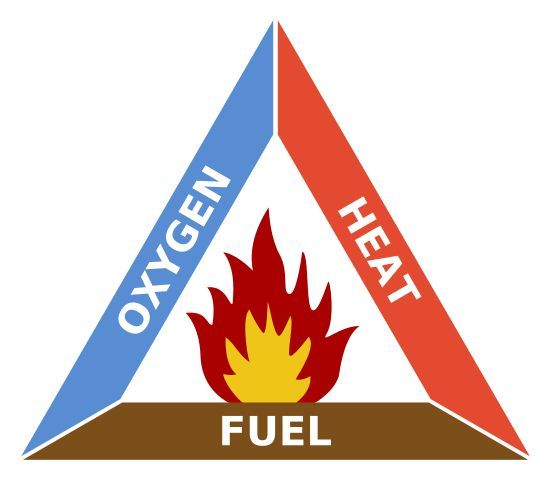
This is known as the combustion triangle or, in some cases, the combustion tetrahedron.3 Fire occurs when these three elements interact in a combustion reaction. In most combustion processes, three primary elements are involved: hydrogen (atomic number 1), carbon (atomic number 6), and oxygen (atomic number 8). Hydrogen and carbon serve as fuels, while oxygen acts as the oxidiser. The chemical reaction governing combustion can be represented as follows:
- in the case of burning hydrogen alone: 2H2 + O2 → 2H2O + heat
- in the case of burning hydrocarbons, e.g., methane: CH4 + 2O2 → CO2 + 2H2O + heat
In other words, hydrogen or hydrocarbons react with oxygen, producing water vapour, carbon dioxide, and thermal energy.4
Fire as a condition for technological development
Oxygen is not the only oxidiser; chlorine, for example, can also serve this function. However, oxygen is so abundant in the Earth’s atmosphere, making up around 21% of its composition, that fire can occur. Simultaneously, its concentration is insufficient for fire to burn uncontrollably. Fire is also not an explosive phenomenon due to the relative stability of carbon and oxygen, which makes it easier for humans to control.5
For this reason, fire has played a fundamental role in human civilisation. Modern research suggests that humans have controlled fire for at least several hundred thousand years. Combustion has enabled heating, even with a simple bonfire, as well as lighting through torches, oil lamps, and candles. It has also been essential to various industries, with metallurgy being the earliest, as it involves the processing of metals using fire.
Combustion is also used to generate mechanical energy, which powers modern machines, including cars. It was also essential to the development of energy production, as the first power plants were coal-fired. All fossil fuels, and even some renewable ones like biomass, contain hydrocarbons.
Earth as a unique place for scientific and technological development
Let us consider a scenario in which fire did not exist, where the properties of carbon and oxygen were slightly different, preventing combustion. Without fire, there would be no means of generating heat. Metallurgy and smelting would never have developed, and modern industry would not have emerged. There would be no cars, no fossil fuel power plants, and no industrial infrastructure as we know it. In short, without fire, the scientific and technological advancements that shape our world today, including the very devices on which this article was written, would not exist.
We owe all of this to fire, a phenomenon that does not exist on any other known planet.6 No planet or moon in the Solar System other than Earth contains free oxygen in sufficient amounts to sustain combustion. Only traces are detected in some places, such as Jupiter’s moon Europa. Had we originated on another planet, like Mars, or on a moon, we would not have been able to create fire or develop a technological civilisation.
Fire – a coincidence or design?
Are we simply fortunate that the very elements we are made of and depend on for survival also create a phenomenon that allows us to understand the world and build a technological civilisation? This is what evolutionists argue. Yet, if millions of years of plant and animal evolution had taken place, they could have occurred entirely without fire. The same applies to humans, who, at best, might have remained at a Neolithic level of development, as without fire, they would never have reached the Bronze Age.
The phenomenon of fire is yet another example showing that nothing in existence came about by mere chance. The cosmological constants and the physical and chemical properties of elements not only make life possible but also allow us to expand our understanding of the Universe, develop civilisation, and even achieve space travel.7 Likewise, the fact that the Moon’s disk appears the same size as the Sun’s, making solar eclipses possible and leading to the discovery of helium, cannot be dismissed as coincidence.8 The same applies to fire. These are just two examples, and there are certainly more.
Is it possible that both the Universe and humanity were created by design? This is the only rational conclusion, as stated in the Holy Scriptures.9
By the way, we recommend reading the articles:
- Radiohalos and the Geological Age of the Earth
- Does the Bible Explain the Ice Age?
- Reevaluating the Concept of Evolutionary Time
- Ota Benga – The Man Who Became a Zoo Exhibi
- What is ‘The Overview Effect’?
- Who Were the Neanderthals?
- Geological Evidence for a Young Earth
Footnotes
- See Encyklopedia PWN, available at: https://encyklopedia.pwn.pl/haslo/ogien;3950211
- See Encyklopedia PWN, available at: https://encyklopedia.pwn.pl/haslo/spalanie;3978003.html
- See Zintegrowana Platforma Edukacyjna, available at: https://zpe.gov.pl/a/zagrozenie-pozarem/D160vnI1p
- See Greelane, available at: https://www.greelane.com/pl/nauka-tech-math/nauka/definition-of-combustion-reaction-604937/
- Gonzalez, G. & Richards, J.W., The Privileged Planet: Why Our Place in the Cosmos is Designed for Discovery, Fundacja En Arche, Warsaw, 2021, p. 346; see also Denton, M.J., Nature’s Destiny: How the Laws of Biology Reveal Purpose in the Universe, New York, 1998, p. 117.
- Conrad, A., ‘Does fire exist anywhere else besides on our planet?’, Astronomy, 30 May 2016, available at: https://astronomy.com/magazine/ask-astro/2016/05/is-there-fire
- Gonzalez, G. & Richards, J.W., The Privileged Planet: Why Our Place in the Cosmos is Designed for Discovery, Fundacja En Arche, Warsaw, pp. 116-118, 2021.
- Gonzalez, G. & Richards, J.W., The Privileged Planet: Why Our Place in the Cosmos is Designed for Discovery, Fundacja En Arche, Warsaw, pp. 44-49, 2021.
The Bible, New King James Version, 1982, Isaiah 37:16.
© Source of main image: Canva.

The portal EvolutionOfThinking.org, created by the Research and Education Institute, focuses on education and the dissemination of knowledge related to research on various aspects of human well-being.

