
Radiohalos present a significant challenge for evolutionists who propose that the Earth is billions of years old, as they cannot explain the origin of polonium radiohalos. In contrast, creationist scientists view them as evidence supporting the biblical account of the Earth’s creation.
Evolutionists claim to have all the evidence needed to support the assertion that the Earth is 4.6 billion years old. Their main argument is based on radiometric dating, which relies on the fact that some isotopes are unstable, emitting ionising radiation (alpha, beta, or gamma) and transforming into stable isotopes. By measuring the ratio of the daughter isotope to the parent isotope, geologists estimate the age of a particular rock.
Each isotope decays at a different rate, and this rate is measured by its half-life, which is the time it takes for half of the parent isotope to decay. For example, the half-life of carbon-14 decaying into carbon-12 is about 5,740 years, while the half-life of rubidium-87 decaying into strontium-87 is approximately 48.6 billion years.
What Are Radiohalos and How Do They Form?
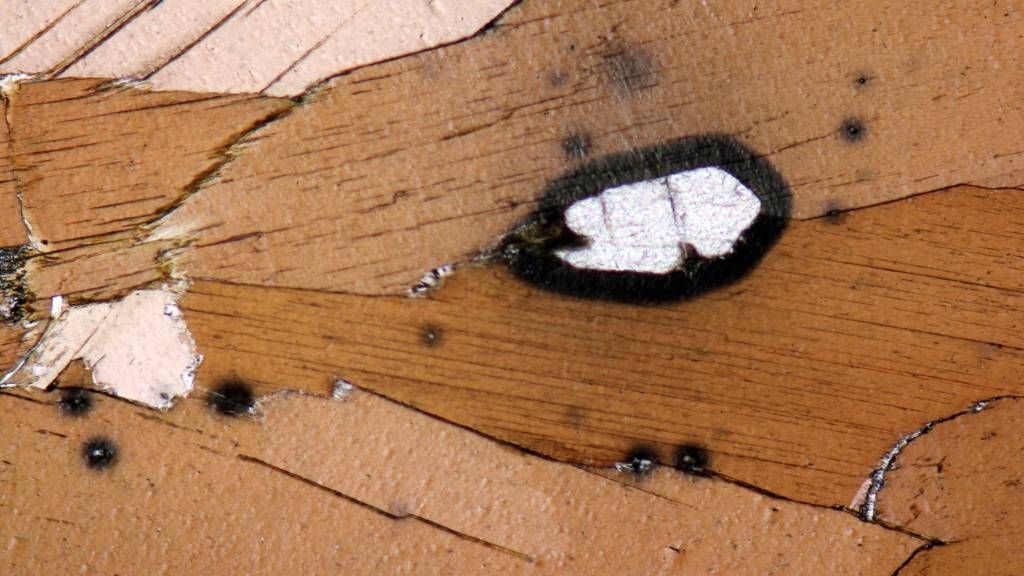
Radioactive decay behaves in a peculiar way in crystalline rocks, especially igneous and metamorphic rocks like granite. It results in microscopic rings of dark, ‘burned’ rock, known as radioactive halos or radiohalos.1 These are of little interest to supporters of evolutionary theory, but they intrigue scientists who advocate for biblical creation.
How do radiohalos form? Granite contains specks of biotite, a black mineral that holds fragments of a small crystal called zircon. Zircon is zirconium silicate (ZrSiO₄). Zirconium2 itself is not radioactive, but its atoms are similar in size and electrical charge to uranium-238 atoms. As a result, uranium-238 atoms can become trapped inside zircon crystals during their formation.
Radioactive Decay of Uranium-238
Unlike zirconium, uranium-238 is a radioactive and highly unstable isotope, which means it eventually decays. The half-life of uranium-238 is 4.5 billion years, but this decay is just the start of a lengthy series of radioactive transformations. Uranium-238 decays into thorium-234, which then turns into protactinium-234, and further into uranium-234. Uranium-234 continues to decay in the uranium decay chain, passing through stages such as thorium-230, radium-226, radon-222, and polonium-218, releasing alpha radiation (helium atoms) in the process. Polonium remains unstable, and its decay follows several pathways, emitting both alpha and beta radiation (electrons). Eventually, all the material transforms into lead-206, a stable isotope.
In the decay chain from uranium-238 to lead-206, eight radioactive decay processes are responsible for the formation of radiohalos in zircon crystals. As a result, radiohalos typically consist of eight concentric rings, each corresponding to a specific decay process. For example, the last three rings are produced by the decay of polonium-218, polonium-214, and polonium-210. Unlike uranium-238, all three polonium isotopes have very short half-lives: 3.1 minutes for polonium-218, 164 microseconds for polonium-214, and 138 days for polonium-210.3
Polonium Radiohalos
The problem is that not all radiohalos contain eight rings; many have only three, two, or even a single ring. Each of these corresponds to one of the polonium isotopes mentioned earlier, which have already decayed due to their rapid instability. However, there is also no uranium-238 in these ‘incomplete’ radiohalos. Where has the uranium isotope gone? Uranium-238 is the only natural source of polonium in its unstable forms—polonium-218, polonium-214, and polonium-210. The absence of uranium-238 in these radiohalos raises questions about their formation.
Solving the Mystery of Polonium Radiohalos
Biotite consists of microscopic flat layers (or ‘sheets’) separated by very narrow gaps. Radiohalos intersect these layers. It is important to note that polonium radiohalos are always found near uranium radiohalos (which have eight rings), with their centres lying within the same layer. Therefore, the most reasonable explanation for the origin of polonium radiohalos is that the source of the radioactive polonium atoms, which form the ‘incomplete’ radiohalos, is uranium-238 from the nearby ‘complete’ radiohalos.
This, however, raises another question: how did polonium suddenly ‘emigrate’ from zirconium silicate crystals containing uranium-238? Under current conditions, it is impossible for polonium atoms to simply leave zirconium silicate and move elsewhere. We are dealing with hundreds of millions of atoms that not only relocated but did so at an extraordinarily rapid pace, given the very short half-life of polonium, especially polonium-214.4
One possibility is that it was not polonium-218 that migrated from the zircon crystal, but its predecessor, radon-222. However, radon-222 also has a short half-life of 3.8 days. Additionally, there is no extra ring corresponding to radon-222 in polonium radiohalos. What is the reason behind this?
The Role of Water
The key to solving the mystery of polonium radiohalos lies in the fact that water can enter the gaps within biotite. As water passed through these gaps, it likely washed radon-222 out of the zircon crystals, where it decayed into polonium-218. However, radon does not bond with other molecules, meaning its remnants would have been washed out of the biotite. In contrast, polonium atoms readily bond with elements such as chlorine or sulfur (found in, for example, mineral water). By bonding with these elements to form polonium chloride or polonium sulfide, polonium atoms remained within the biotite, where they continued to decay and form radiohalos.
Furthermore, for radon-222 to be washed out of zircon crystals, the water must have been heated. It also needed to be hot enough to destroy the original rubidium and polonium radiohalos. Only after the water cooled and all rubidium had transformed into polonium could the polonium radiohalos form again, as we observe today.5

How Many Atoms Are Needed to Form a Radiohalo?
It is also important to understand how many atoms are needed to produce a visible radiohalo. For a single ring of a radiohalo to appear dark, at least 500 million alpha particles (helium atoms) must be emitted. In other words, to form a ring caused by the decay of polonium-218, more than 500 million alpha particles must be emitted from the decay of over 500 million radon-222 atoms.
At the current rate of uranium-238 decay, the production of radon-222 would take approximately 100 million years.6 Both radon-222 and polonium isotopes decay much faster than uranium-238. Therefore, radon atoms must have accumulated in large quantities outside the zircon crystal (containing uranium-238). Given the present rate of uranium-238 decay, this is not possible today. What, then, made this possible?
Radiohalos and Their Geological ‘Bias’
Another intriguing mystery arises. Both uranium and polonium radiohalos are found almost exclusively in Paleozoic and Mesozoic rocks, while they are very rare in Cenozoic rocks. These conclusions were drawn by the RATE research team, which studied radiohalos.
The scientists analysed 3,485 samples of Paleozoic and Mesozoic rocks (excluding metamorphic rocks) and 400 samples of Cenozoic rocks. They found 29,000 radiohalos in the former, compared to only 11 in the latter. This difference is of extreme significance. Furthermore, Precambrian rocks contained far fewer radiohalos (2,326 radiohalos from 1,510 samples) than Paleozoic and Mesozoic rocks.7
Summary and Conclusions
Let us summarize all the findings so far:
- Polonium radiohalos containing only one, two, or three rings must have formed due to radon and polonium atoms that left zircon crystals containing uranium-238. Considering the decay rate of radon and polonium, this process had to occur at an extremely rapid pace in order for polonium radiohalos to form.
- For this to happen, water at sufficiently high temperatures must have washed out the radon, which subsequently transformed into polonium. Once the water and granite cooled, the decaying polonium could freely form radiohalos.
- However, for visible radiohalos to appear from polonium, over 500 million alpha particles were needed. Uranium-238, however, cannot supply such quantities within just a few days due to its 4.5 billion year life span.
- Radiohalos were found primarily in Paleozoic and Mesozoic rocks. There are far fewer in Precambrian rocks, and almost none in Cenozoic rocks. These differences are very significant.
Based on the above findings, three surprising conclusions can be drawn:
- The granite rock must have been flooded with very hot water, which, upon flowing through the gaps in the biotite, was able to wash radon out of the zircon crystals. Considering that polonium radiohalos are found worldwide, the event that affected those ancient rocks must have had a global scale.
- An even more surprising conclusion is that uranium-238 must have had a completely different half-life than it does today. To provide enough alpha particles to form polonium radiohalos within just a few days, uranium must have decayed at a rate billions of times faster than it does now. This is entirely inconsistent with the principle of geological uniformitarianism, which states that the half-lives of isotopes have always remained constant.
- The near-total absence of radiohalos in Cenozoic rocks suggests that these rocks were not exposed to hot waters, unlike the Paleozoic and Mesozoic rocks.
Evidence of a Global Flood and a Young Earth
The first conclusion provides direct evidence for a global flood. Modern biblical creation science offers mechanisms that explain the formation of distinct polonium radiohalos. The water that washed radon-222 out of zircon crystals must have been heated by magma rising from the ocean floor during the flood.
The second conclusion serves as evidence that the Earth does not have to be 4.6 billion years old, as evolutionists claim. If the half-life of radioactive decay were much shorter than it is today, radioactive isotopes would no longer be a reliable method for measuring the age of our planet. This is a very radical conclusion, which also provokes questions about the cosmological nature of the biblical flood.
Finally, the third conclusion suggests that the global flood primarily accounts for the formation of Mesozoic and Paleozoic rocks, while Cenozoic rocks formed shortly after the flood or during its later stages, when floodwaters were no longer as hot as before.
Conclusion
There is no doubt that evolutionists will continue to use radiometric dating to try to prove the Earth’s age as billions of years. However, the existence of polonium radiohalos shows that these methods cannot be relied upon. The research findings align with the creationist view that the Earth is only a few thousand years old, as stated in the Bible.
By the way, we recommend reading the articles:
- Mohenjo-Daro – Advanced Urban Planning in Antiquity?
- Can a “Toxic” Frog Poison Itself?
- Who Created God?
- The Formation of the Solar System: What Do We Really Know?
- The Feasibility of Radiocarbon Dating in Dinosaur Fossils
Footnotes
- Snelling, A.A., 2012. Radiohalos–Mysterious Bullet Holes in Rocks. Answers in Genesis, 1 April.
- Both the element zirconium (Zr) and the mineral zircon share the same nam
- Snelling, A.A., 2012. Radiohalos–The Mysterious Vanishing Bullets. Answers in Genesis, 1 July.
- Ibid.
- Snelling, A.A., 2012. Radiohalos–Solving the Mystery of the Missing Bullets. Answers in Genesis, 1 October.
- Snelling, A.A., Radiohalos. Creation.
- Cupps, V.R., 2018. Radiohalos: Nature’s Tiny Mysteries. Acts & Facts, 47(7), July, pp. 11–13. Available at: https://www.icr.org/i/pdf/af/af1807.pdf.
© Source of main image: Canva.

The portal EvolutionOfThinking.org, created by the Research and Education Institute, focuses on education and the dissemination of knowledge related to research on various aspects of human well-being.

