
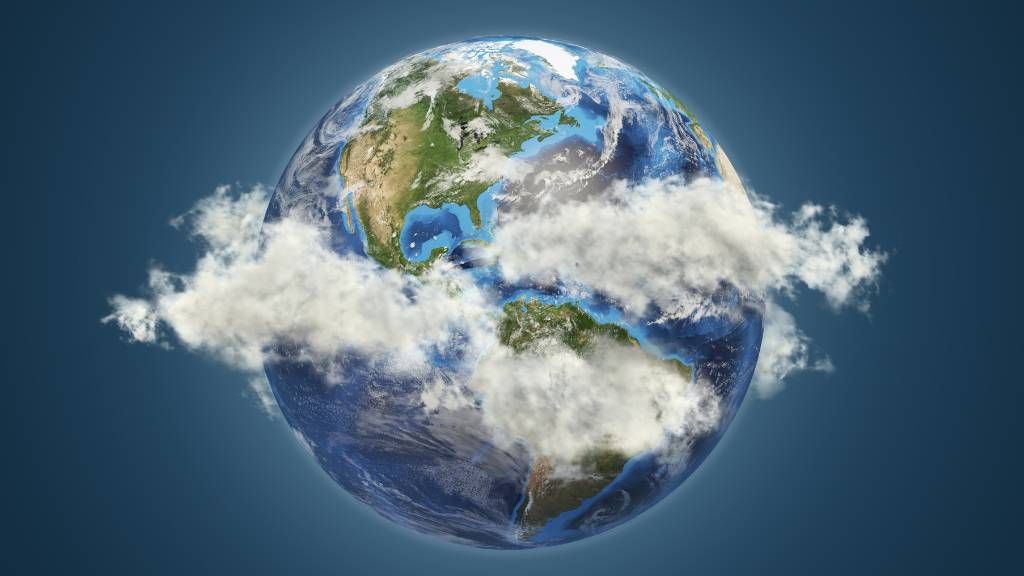
When looking at a world map or a globe, one might notice that the shapes of some continents appear to fit together. Could this mean they were once part of a single supercontinent? What do both science and the Bible say about this?
The coastline of the continents
When examining a map, one can see that the shapes of Africa and South America align almost perfectly. The eastern region of Brazil, where the city of Recife is located, appears to correspond with what is now the Gulf of Guinea. Similarly, the area of Angola in Africa closely matches the part of Brazil where Rio de Janeiro is situated. A comparable fit can also be observed between Europe and North America, as well as between Australia and Antarctica.
Moreover, geologists have identified identical rock formations and geomorphological structures on different continents that align in shape. The same fossils have also been discovered in these locations.
Could this mean that the Americas were once connected to Europe and Africa? Were other continents also once part of a single landmass?
The supercontinent of Pangaea
Through studies of coastlines and the distribution of specific fossils, including Glossopteris seed ferns, scientists such as Eduard Suess (1831–1914) were able to reconstruct today’s continents into larger landmasses and, ultimately, a single supercontinent.1 Alfred Wegener (1880–1930), a German geophysicist and the originator of the theory of continental drift, introduced this concept in his 1912 work Die Entstehung der Kontinente (The Origin of Continents), referring to the ancient landmass as Urkontinent. He later coined the term Pangaea, which appeared in a subsequent edition of his second work, Die Entstehung der Kontinente und Ozeane (The Origin of Continents and Oceans). Over time, Pangaea became the established name for this ancient supercontinent.
Wegener’s theory was initially met with scepticism, as he did not offer a convincing explanation for the mechanism behind continental drift. This led to criticism from other scientists, particularly George Gaylord Simpson.2
In the 1950s and 1960s, new evidence emerged supporting Wegener’s hypothesis. This included the discovery of the tectonically active Mid-Atlantic Ridge and subduction zones.3 The former contributes to the expansion of the ocean floor, while the latter, such as those off the coast of the Andes, causes oceanic crust to sink beneath higher tectonic plates, accompanied by Benioff zones of increased volcanic activity. These discoveries provided scientists with an explanation for continental drift. Today, plate tectonics, continental drift, and the supercontinent Pangaea are widely accepted scientific theories.
What does the Bible say?
The Bible also addresses the concept of an ancient supercontinent. In Genesis 1:9–10, it states:
‘Then God said, “Let the waters under the heavens be gathered together into one place, and let the dry land appear”; and it was so. And God called the dry land Earth, and the gathering together of the waters He called Seas. And God saw that it was good.’
God commanded the waters covering the Earth to gather in one place, implying the existence of a single great ocean. Genesis 1:9 also indicates that this allowed dry land to appear as a single landmass.4 This interpretation is supported by the Hebrew word yabbashah, meaning ‘dry land,’ which is used in the singular rather than the plural form.
In 1859, the French creationist geographer Antonio Snider-Pellegrini (1802–1885) referenced these verses. In his work La Création et ses mystères dévoilés (The Creation and Its Mysteries Revealed), he noted that the coastlines of Africa and South America appeared to match.5 He also identified identical plant fossils in Europe and North America. However, his theory did not gain recognition, possibly because Charles Darwin’s On the Origin of Species was published that same year.6 It was only with Wegener’s 1912 theory of continental drift that the idea received more serious consideration.
Two different interpretations
The current rate of continental drift is only a few centimetres per year. Based on this, secular scientists estimate that the Americas began separating from Europe and Africa around 180 to 250 million years ago. This view aligns with evolutionary theory but contradicts the biblical account, which describes a supercontinent created by God 6,000 years ago. Could there have been a time in Earth’s history when tectonic plates moved much faster than they do today?
Catastrophic plate tectonics
At least two scientific findings indicate that the breakup of the supercontinent Pangaea and the formation of the Atlantic Ocean floor occurred rapidly. The first concerns the magnetic properties of the rocks along the Mid-Atlantic Ridge. These rocks are arranged in alternating bands, magnetised in opposite directions due to Earth’s geomagnetic reversals. If the ridge had formed slowly over time, the rocks beneath its floor would exhibit a consistent magnetic pattern. However, drilling at 15 locations along the ridge, reaching depths of up to 500 metres below the ocean floor, revealed that below a certain point, these magnetic bands collapse.7 The deeper rocks show magnetic disorder, which could only have resulted from a rapid, catastrophic formation of the ridge.8
The second piece of evidence concerns sediment layers at the bottoms of ocean trenches, such as those along the Andes off the coasts of Peru and Chile. If subduction had been slow, these layers would have been compressed and folded. However, studies of the area have shown that they remain smooth and flat, with no significant deformation.9 This suggests that subduction initially occurred rapidly before later slowing down.
The catastrophic model offers a stronger explanation for this evidence than the gradual formation of the Atlantic Ocean floor. In 1993, geophysicist and creationist John Baumgardner developed a three-dimensional computer model of plate tectonics, showing that very rapid tectonic plate movement is possible.10 This model, despite allowing for catastrophic plate tectonics, is still recognised as one of the most credible in the scientific community.11
Evidence of a global flood
The scientific evidence presented, along with plate tectonics modelling, is consistent with the biblical account of the ancient supercontinent and the global flood. According to the creationist interpretation, God first created a single supercontinent, now known as Pangaea, ad subsequently sent a flood that altered the Earth’s surface.
The flood was not just rainfall but primarily water erupting violently from beneath the earth.12 These geological processes likely caused the waters to break through the surface, destroying the Earth’s crust, breaking it into smaller fragments, and triggering plate tectonics and continental drift. As a result, the single supercontinent, Pangaea, was replaced by the separate continents seen today.
By the way, we recommend reading the articles:
- Did Dragons Exist in the Middle Ages?
- Plants and Mathematics – What Do They Have in Common?
- Sauropods from the Middle Ages – A Fairy Tale or Reality?
- The Flood in Native American Legends of the Grand Canyon
- The Five Wonders of Atheism – The Origin of the Universe
- Why Are There Seven Days in a Week?
- The Laws of Logic and the Existence of God
Footnotes
- McLoughlin, S., ‘The breakup history of Gondwana and its impact on pre-Cenozoic floristic provincialism’, Australian Journal of Botany, 49(3), pp. 271–300, 2001.
- Simpson, G.G., ‘Mammals and the Nature of Continents’, American Journal of Science, 241(1), pp. 1–31, 1943, available at: http://people.wku.edu/charles.smith/biogeog/SIMP943A.htm
- Dietz, R.S., ‘Continent and Ocean Basin Evolution by Spreading of the Sea Floor’, Nature, 190(4779), pp. 854–857, 1961.
- Snelling, A.A., ‘Noah’s Lost World’, Answers in Genesis, April 1, 2014, available at: https://answersingenesis.org/geology/plate-tectonics/noahs-lost-world/
- Snider-Pellegrini, A., Le Création et ses Mystères Dévoilés, Franck and Dentu, Paris, 1859.
- Mitchell, E., ‘Smithsonian’s Account of Tectonic History Short-Sighted’, Answers in Genesis, May 26, 2012, available at: https://answersingenesis.org/geology/plate-tectonics/smithsonian-tectonic-history-short-sighted/
- Hall, J.M. & Robinson, P.T., ‘Deep crustal drilling in the North Atlantic Ocean’, Science, 204, pp. 573–576, 1979, available at: https://www.science.org/doi/10.1126/science.204.4393.573
- Snelling, A.A., ‘A Catastrophic Breakup’, Answers in Genesis, March 20, 2007, available at: https://answersingenesis.org/geology/plate-tectonics/a-catastrophic-breakup/
- Scholl, D.W. et al., ‘Peru-Chile trench sediments and seafloor spreading’, Geological Society of America Bulletin, 81, pp. 1339–1360, 1970, available at: https://pubs.geoscienceworld.org/gsa/gsabulletin/article-abstract/81/5/1339/6837/Peru-Chile-Trench-Sediments-and-Sea-Floor?redirectedFrom=fulltext
- Snelling, A.A., ‘A Catastrophic Breakup’, Answers in Genesis, March 20, 2007, op. cit.
- Beard, J., ‘How a supercontinent went to pieces’, New Scientist, January 16, 1993, available at: https://www.newscientist.com/article/mg13718563-400-technology-how-a-supercontinent-went-to-pieces/
- The Bible, New King James Version, 1982, Genesis 7:11.
© Source of main image: Canva.

The portal EvolutionOfThinking.org, created by the Research and Education Institute, focuses on education and the dissemination of knowledge related to research on various aspects of human well-being.

