
In a previous article about the Welsh dragon, a piece of medieval artwork was discussed that appears to suggest ancestors had some awareness of dinosaurs long before palaeontology emerged. This, of course, contradicts the common evolutionary view that humans and dinosaurs never lived at the same time.
Sauropods from Carlisle
Carlisle Cathedral, a historic church in northern England, features numerous medieval carvings. At the centre of its floor lies the tomb of Bishop Richard Bell, decorated with brass engravings that depict animals strikingly similar to sauropods.1 A wall plaque states that Richard Bell was appointed bishop in 1478 and passed away in 1496.
Could a medieval artist have carved depictions of dinosaurs, or other animals that once lived in medieval Europe, without any knowledge of them?
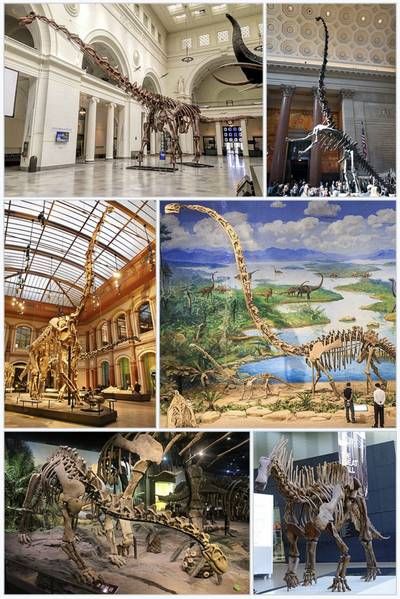
Thomas Quine, Richard Mortel, Zhangzhugang, Morosaurus millenii,
Sainterx. License: CC BY-SA 4.0.
Accurately Reflected Features
The carvings on Bishop Bell’s tomb depict various animals, including a dog, bird, fish, and eel, with precise attention to their forms. Some are more difficult to identify, yet none appear to be fictional.
Among these carvings are two similar-looking dinosaurs with long tails and legs that extend straight down, unlike the sprawled limbs of modern crocodiles. Their long necks intertwine in a pose that suggests interaction. They resemble sauropods with high-set hips rather than those with elevated shoulders.2 While the head and neck regions have been worn down by centuries of foot traffic, the rest of their bodies remain clearly visible.
One of the sauropods has a tail with a spiked club at the tip. Researchers first identified club-like tails in sauropods in 1989 based on Shunosaurus fossils found in China.3 A 2009 report later documented the discovery of another rare sauropod, Spinophorosaurus, in the Republic of Niger, Africa, which also had a spiked club-like tail.4 Both fossils featured two pairs of spikes.
The sauropod carved on Bishop Bell’s tomb also has four spikes on its tail. How did a 15th-century artist know such details? Both sauropods are part of the overall artwork, show signs of wear from 500 years of foot traffic, and the tomb has been documented and described for centuries.5 It seems unlikely that the artist created imaginary creatures that happened to resemble sauropods so precisely. Too many features correspond to those of a Spinophorosaurus-type sauropod: long, flexible necks, arched backs with high-set hips, legs extending straight down from the body, forward-facing knees, backward-facing elbows, long, flexible tails, and tail spikes forming a club-like shape.
Vance Nelson, author of Dire Dragons, which documents depictions of dinosaurs from around the world, claims that if the spiked tail of the Carlisle sauropod were straightened, one pair of spikes would point upward and the other backward, exactly as indicated by discovered fossils.6
What Happened to the Medieval Sauropods?
If the artist who decorated Bishop Bell’s tomb had seen living sauropods, heard descriptions of them, or observed drawings, it would not be surprising that he carved their images. However, this would imply that dinosaurs existed in medieval England or nearby. If so, what became of them?
Dinosaurs inhabited swampy regions, many of which were drained by the people of Europe, leading to a decline in their numbers. Others may have been killed by humans who viewed them as a threat.
Conclusion
If the medieval artist was directly or indirectly familiar with sauropods, it raises the question of whether the secular view of dinosaurs is truly reliable.
By the way, we recommend reading the articles:
- Volcanoes and Their Role in the Ice Age
- The Quipu: Knotted Strings That Testify to Ancient Intelligence
- Durupinar – Has Noah’s Ark Been Found?
- Where Did Snake Venom Come From?
- Lost Paradise – Did It Actually Exist?
- Do Tardigrades Disprove Evolution?
- Can Scientists Prove That the Universe Cannot Be Eternal?
Footnotes
- Bell, P., ‘Bishop Bell’s brass behemoths!’, Creation, 25(4), pp. 40-44, 2003.
- Brachiosaurs had high-set shoulders, while diplodocids and others had high-set hips.
- Dong, Z., Peng, G. & Huang, D., ‘The Discovery of the Bony Tail Club of Sauropods’, Vertebrata PalAsiatica, 27(3), pp. 219-224, 1989.
- Remes, K. et al., ‘A New Basal Sauropod Dinosaur from the Middle Jurassic of Niger and the Early Evolution of Sauropoda’, PLOS ONE, 4(9), e6924, 2009.
- The brass on Bishop Bell’s tomb was described long ago, for example in: Eley, C.K., The Cathedral Church of Carlisle, Riverside Press, Edinburgh, UK, p. 53, 1900.
- Nelson, V., Dire Dragons, 3rd ed., Untold Secrets of Planet Earth Publishing Co., Red Deer, AB, p. 74, 2011.
Based on: B. Thomas, “Did medieval artists see real dinosaurs?”, Acts & Facts, Institute for Creation Research, July 2018, pp. 16-17.
© Source of main image: leonardo.ai.

The portal EvolutionOfThinking.org, created by the Research and Education Institute, focuses on education and the dissemination of knowledge related to research on various aspects of human well-being.

