
The intricate knotted script of quipu stands as a remarkable achievement of ancient civilizations. Could it, however, resemble something we recognize today?
The Andean civilization stands out as one of the most fascinating in history. Their ability to construct cities in some of the world’s driest regions is truly impressive. Of these civilizations, the Incas are the most famous, establishing a state in the 12th century that expanded into a vast empire before being conquered by Spanish conquistadors in the 16th century.
The Inca Empire was a highly efficient absolute monarchy. Despite not knowing the wheel, their state was covered by a network of paved roads used by state messengers (known as tambo). Another astounding feature of the Andean civilization is that it did not develop a traditional form of writing—or at least not as we know it in Western civilization. Instead, the Incas used a knotted script known as quipu.
What Is the Knotted Script of Quipu?
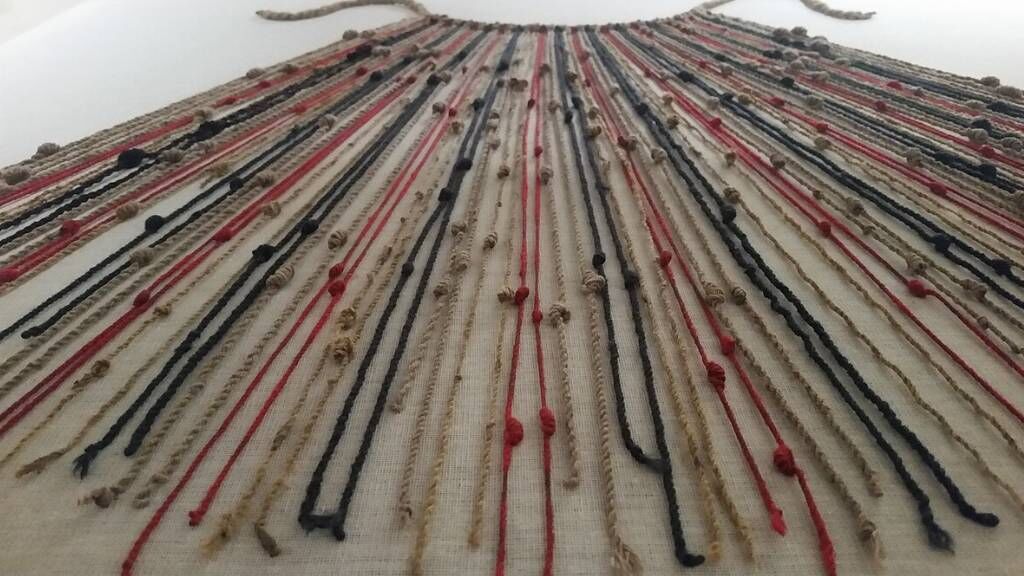
Quipu is a knotted script used by the cultures of the Andean civilization, including the Incas. Among other ancient civilizations, this is a unique system of transmitting information. The Spanish noted that the Incas recorded information by making knots. Research into deciphering quipu has been ongoing for years, as the art of creating and reading knots has been largely forgotten by many Andean Indians.
In the 1920s, anthropologist Leland Locke discovered that some knots represent digits. When arranged in a specific order, they form numbers in the decimal system. Some knots have binary characteristics; for example, a knot twisted in one direction means ‘paid’, while twisted in the opposite direction means ‘unpaid’. Significant progress in this field has been made by Gary Urton, an anthropologist at Harvard University, and Spanish economics student Manny Medrano, who found that quipu knots contain crucial accounting information, such as the names of debtors and the amounts they owed.1
Factors like the color of the cord, the direction of the knot, and even the animal material used to make the cords carried meaning. This means that reading the knots required not only the sense of sight but also touch. Sabine Hyland, an ethnographer from the University of St. Andrews, has had the opportunity to analyze extremely complex sets of knots, suspecting that they might also convey historical events. She discovered 95 different knot combinations that could correspond to syllabic writing. Could quipu be a syllabary?2
How Old Is Quipu?
The knotted script of quipu is an extraordinary invention. However, the Inca civilization was not the first to use this form of writing. In ancient times, it was also used by peoples in China, Tibet, Korea, Japan, Taiwan, and even Hawaii.3 Over time, these regions adopted conventional pictographic or syllabic writing systems. Knotted writing primarily survived in South America, but the Incas were not the first Andean civilization to use it.
Today, the Norte Chico culture (also called the Caral-Supe culture) is considered the oldest civilization in South America. Scientists believe the first cities of this culture were established around 3500 BCE, and the civilization flourished in the 3rd millennium BCE. Thus, Norte Chico belongs to the oldest civilizations in the world, alongside Mesopotamia and Egypt. In the Caral site, archaeologists discovered the oldest known example of the knotted script of quipu.4 This suggests that quipu has been used by Andean inhabitants since the dawn of human civilization.
Humans Have Always Been Intelligent and Curious About the World
Scientists are still intrigued by the fact that ancient civilizations around the world emerged roughly at the same time—around 3000 BCE. However, civilization is not just about impressive structures like pyramids but also about writing. It is believed that before this time, people organized themselves into small farming communities over several thousand years. Then, about 5,000 years ago, ancient peoples suddenly began creating complex societies of interconnected cities, building pyramids, temples, and royal palaces, and managing these societies using written scripts. This is true for Mesopotamia, Egypt, the Indus Valley, and the Norte Chico civilization.
Did humans change so much 5,000 years ago that they suddenly began forming hierarchical states? It seems more plausible that humans have always been beings that seek to build communities and explore their surroundings. The Bible contains a story about the city of Babel and a tower that reached to the heavens. The builders of the city and the tower wanted to ‘make a name for themselves’ so they would not be scattered over the face of the earth.5 In other words, they sought to create a unified community. However, God wanted humans to populate the entire planet, so they were dispersed to build communities wherever they went.
It is also possible that after dispersing, people traveled not only by land but also by sea. It is worth noting that knotted writing emerged in communities around the Pacific Ocean, such as in China and the Andes. Is this merely a coincidence, or is there a historical connection? Some researchers, like Charles H. Hapgood and James I. Nienhuis,6 suggest that a civilization of ‘Sea Kings’ existed before Egypt. Such a civilization might have spread ideas like pyramids or knotted writing across great distances within a single historical period.
The Knotted Script of Quipu and DNA
Moreover, the knotted script is evidence not only of the intelligence of ancient people but also indirectly of a higher intelligence. Quipu resembles DNA in our cells. Just as quipu consists of appropriately entangled strings, DNA is a set of intricately twisted strands. Both are collections of encoded information used to create structures larger than themselves.
Encoding and utilizing information require great intelligence.7 DNA strands are so complex that scientists are still discovering new ways in which they function. This means that, contrary to the narrative of evolutionists, DNA could not have come about on it own—it must have been designed. Thus, the existence of DNA is evidence of an intelligent Creator, just as quipu knots testify to the high intelligence of ancient humans.
By the way, we recommend reading the articles:
- Ants: Complex Creatures
- More Than One Genetic Code?
- Intelligent Design or Just an Illusion of Design?
- Is the Biblical Age of the Universe Plausible?
- What is the Higgs Boson?
Footnotes
- Cossins D., We thought the Incas couldn’t write. These knots change everything, NewScientist, August 26, 2018, https://www.newscientist.com/article/mg23931972-600-we-thought-the-incas-couldnt-write-these-knots-change-everything/
- Ibid.
- Ancient Chinese Version of Quipu – Tradition Of Tying Knots Dates Back To Antiquity, MessageToEagle, https://www.messagetoeagle.com/ancient-chinese-version-quipu-tradition-tying-knots-dates-back-antiquity/
- Mann C.C., Unraveling Khipu’s Secrets, Science, 309(5737), August 12, 2005, pp. 1008–1009, https://www.science.org/doi/abs/10.1126/science.309.5737.1008
- The Bible, New King James Version, 1982, Genesis 11:1–9.
- See Nienhuis J.I., Tajemnice epoki lodowcowej, Wyd. Amber, Warsaw 2009.
- Catchpool D., Unravelling the knotty khipu code, Creation, 27(3), June 2005, pp. 40–41, https://creation.com/unravelling-the-knotty-khipu-code
© Source of main image: Canva.

The portal EvolutionOfThinking.org, created by the Research and Education Institute, focuses on education and the dissemination of knowledge related to research on various aspects of human well-being.

