
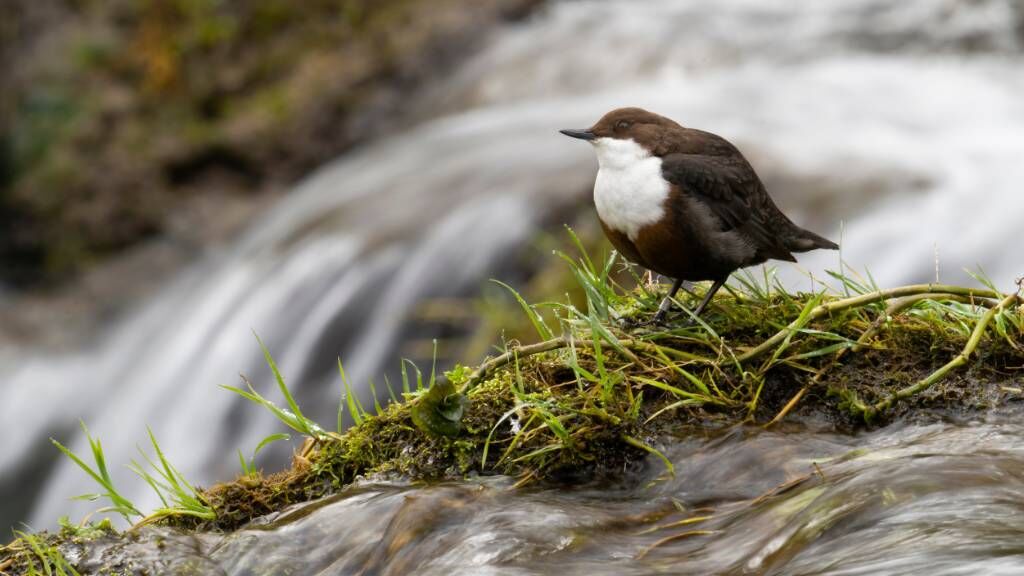
The white-throated dipper, the national bird of Norway, presents a rather unassuming appearance, characterised by its stocky body, rounded form, short wings, and upturned tail. Despite this, its behaviour is anything but conventional.
A “Water” Bird
The white-throated dipper is exceptionally adapted for underwater foraging—a behavioural trait that presents a challenge for evolutionary explanations. Unlike ducks, which typically forage on the water’s surface, the dipper engages in diving, paddling, and even walking and flying underwater to locate its food, demonstrating remarkable dexterity in its aquatic activities. It remains the only songbird capable of diving and swimming with such efficiency.
This behaviour cannot be attributed to random actions acquired through trial and error, as a single mistake would likely suffice to impede subsequent reproduction. This is akin to other species that purposefully and effectively exploit their specialised anatomical and physiological traits for adaptive advantage.1
The white-throated dipper is a year-round resident throughout Norway,2 where it thrives in the country’s abundant fast-flowing freshwater habitats. These environments are primarily fed by the runoff from melting mountain snow, which cascades into the sea via waterfalls, streams, rocky crevices, and other drainage channels. In these aquatic settings, the dipper engages in foraging by diving into the water and “walking” along the stream beds to hunt a variety of prey, including underwater insect larvae, small freshwater molluscs, shrimp, fish, and amphibians.
Underwater Acrobatics
The dipper enters the water by wading and subsequently dives, submerging with a modest splash. Its dense bones serve as ballast, aiding its descent. Once submerged, the bird exhibits a flight-like motion, displaying remarkable agility. It is capable of moving along stream beds against the current, anchoring itself to rocks with its robust claws while vigorously “paddling” with its powerful wings.
The dipper is capable of descending to depths of up to 1.5 metres, as its rounded wings impede premature surfacing. It can remain submerged for up to 30 seconds, a feat made possible by its specialised respiratory adaptations, including membranous flaps that seal its nostrils and prevent water from entering the airways. Moreover, it can hold its breath for longer durations than other songbirds of similar size, owing to a higher concentration of haemoglobin in its blood.
Conclusion
Can an unprogrammed, undirected process of trial and error account for the complex adaptations and behaviours exhibited by the dipper? It cannot. Any failure in this context would result in drowning, and a dead bird could not develop such specialised underwater survival skills. Like all living organisms, the dipper required a providential and purposeful design to enable these remarkable abilities.3
God equipped this bird with specially designed anatomy, abilities, and strength so it could meet its needs by gathering food amidst the wealth of fresh waters.
By the way, we recommend reading the articles:
- Blue Eyes – Mutation or Common Genetic Variant?
- Why Are There Seven Days in a Week?
- Evidence for the Resurrection of Christ
- The Origin of Viruses: Three Possible Variants
- Does the Bible Imply that the Earth is Flat?
Footnotes
- Johnson, J.J.S., 2018. Withstanding Winter Weather. Acts & Facts, 47(7), p. 21.
- Daly, S., 2018. White-throated Dipper (Cinclus cinclus) in Germany. Focusing on Wildlife, 5 June. Available at: https://focusingonwildlife.com.
- Johnson, J.J.S., 2010. Survival of the Fitted: God’s Providential Programming. Acts & Facts, 39(10), pp. 17-18.
Compiled from: J.J.S. Johnson, „The bird that walks and flies under water”, Acts&Facts, Institute for Creation Research, June 2020, p. 21.
© Source of main image: Canva.

The portal EvolutionOfThinking.org, created by the Research and Education Institute, focuses on education and the dissemination of knowledge related to research on various aspects of human well-being.

