
For centuries, the Hittites were known solely through mentions in the Old Testament, which led many scholars to question their historical existence. However, subsequent archaeological discoveries have thoroughly disproven this scepticism, affirming the accuracy of these biblical references.
The Hittites were an ancient Indo-European group that lived in Anatolia and the Levant, which is now known as Turkey and Syria. In the 17th century BCE, they created an empire with its capital located at Hattusa (currently known as Boğazkale in central Turkey). As time passed, the Hittite Empire grew, emerging as a powerful force that challenged both Egypt and Mesopotamia. The strength of the Hittites is evidenced by King Mursilis I’s conquest of Babylon in 1595 BCE.1 The Hittite language was written using the cuneiform script, which was adapted from the Semitic script of the Mesopotamian peoples for a language that was entirely distinct from theirs. The Hittite Empire collapsed in the 12th century BCE, but independent Hittite states continued to exist until the 8th century BCE.
The Hittites Only in Scripture – A Reason to Criticize the Bible?
For many years, the Hittites were largely forgotten, until the 19th century. The only significant reference to them came from the Bible, where the Hebrew term hiti appears 48 times.2 These mentions include Abraham’s purchase of land from a Hittite to bury his wife, Sarah (Gen 23:7-20), the mention of Bathsheba’s husband, Uriah, a Hittite (2 Sam 11:3), and King Solomon’s trade dealings with the Hittites (2 Chr 1:17).
The 1861 edition of the Encyclopaedia Britannica contained just eight lines on the Hittites, summarising only the information provided by the Bible. For a long time, no archaeological discoveries or historical records beyond the biblical accounts confirmed the existence of the Hittites.3 As a result, sceptics criticised the Bible for presenting what they considered to be “imaginary” tales.4
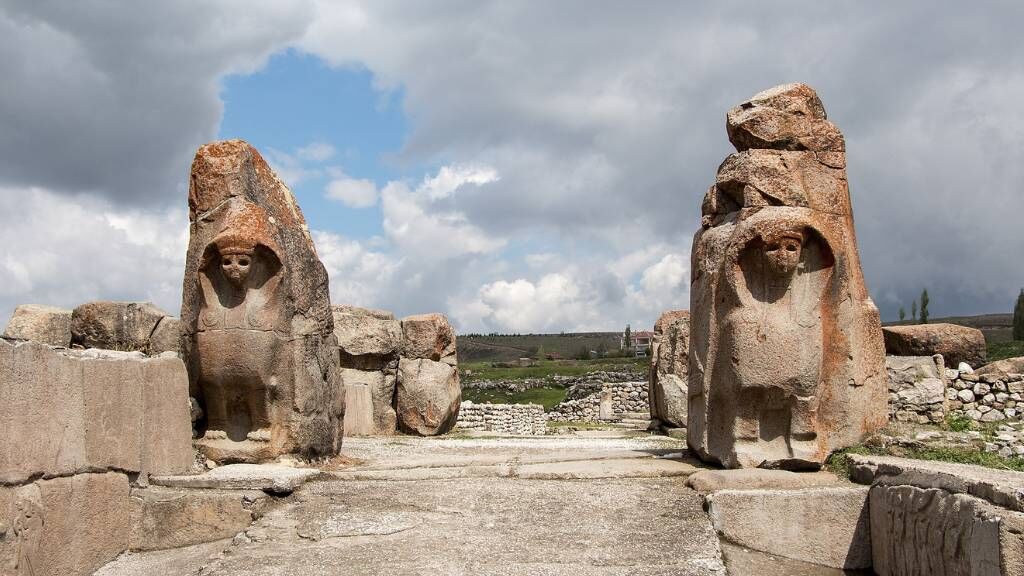
Archaeological Discoveries of the Hittites
However, this situation proved to be temporary. In the 19th century, several travellers to the Ottoman Empire encountered artifacts inscribed with hieroglyphs that were neither Egyptian nor cuneiform, suggesting an unknown origin. In 1812, the Swiss traveller Johann Burckhardt identified traces of such inscriptions in the city of Hamat, although he was unable to conduct a thorough examination. In 1839, the French archaeologist Charles Texier discovered previously unknown ruins near Boğazköy (modern-day Boğazkale).5 In the 1870s, Protestant missionary William Wright and Oxford scholar Professor Archibald Henry Sayce independently identified these ruins as the remnants of the Hittite civilisation.6 Subsequent research on cuneiform tablets discovered at the site confirmed that the ruins were indeed those of Hattusa, the capital of the Hittite Empire.
The Amarna Letters proved invaluable in advancing knowledge about the Hittites. Scholars identified the name of the most powerful Hittite king, Suppiluliuma I. Among the letters were cuneiform inscriptions, which had previously resisted decipherment, and were suspected to be written in the Hittite language.7 In 1915, Czech scholar Bedřich Hrozný succeeded in deciphering them. In the 1940s, German archaeologist Helmut Theodor Bossert uncovered a Hittite counterpart to the Rosetta Stone in Karatepe,8 which enabled scholars to decipher the hieroglyphs. These inscriptions, however, were found to encode the Luwian language rather than Hittite.9
Another intriguing aspect is the striking similarity between the treaties of the Hittites and those found in the Pentateuch. The Hittite imperial treaties followed a seven-part structure, closely resembling the Sinai covenant described in Exodus 20-31, which had vanished by the 14th century BCE. This similarity, also observed in ancient cities such as Mari and Tell Leilan, supports the argument that the Pentateuch was written in the second millennium BCE, rather than the first, as suggested by liberal Bible scholars.10
Conclusion
Today, our understanding of the Hittite Empire is nearly as extensive as our knowledge of ancient Egypt or Mesopotamia.11 Until the 19th century, however, the Hittite state was entirely unknown to those who did not consult the Bible, the sole source that mentioned the Hittites. Many scholars interpreted this as evidence of the Bible’s untrustworthiness.12 The subsequent discovery of the ruins of the Hittite Empire, along with references to it in the writings of other ancient civilisations, served to confirm the historical reliability of the Bible.
By the way, we recommend reading the articles:
- The Platypus: An Evolutionary Enigma
- The Potential Impact of Extraterrestrial Beings on Religious Systems
- Did Kangaroos Evolve in Australia?
- The Tower of Babel – Extra-Biblical Narratives
- What is the Higgs Boson?
Footnotes
- Palla, A., 2002. Sekrety Biblii. Betezda, pp. 90-95.
- Blue Letter Bible, 2023. Lexicon entry for H2850. Available at: https://www.blueletterbible.org/lexicon/h2850/kjv/wlc/0-1/.
- Encyclopaedia Britannica, 1861. Vol. XI, 8th edition. Cited in Down, D., 2009. The Hittites – Second Time Round. Journal of Creation, 23(1), pp. 50-55.
- Palla, A., 2002. Op. cit.
- Koziróg, B., 2022. Kim byli Hetyci?. Znaki Czasu, 4 May. Available at: https://znakiczasu.pl/kim-byli-hetyci/.
- Palla, A., 2002. Op. cit.
- Koziróg, B., 2022. Op. cit.
- Palla, A., 2002. Op. cit.
- Omniglot, 2023. Luwian Writing System. Available at: https://www.omniglot.com/writing/luwian.htm.
- Kitchen, K.A., 1995. The Patriarchal Age: Myth or History? Biblical Archaeology Review, Mar-April, p. 52. Cited in Palla, A., 2002. Op. cit.
- Palla, A., 2002. Op. cit.
- Halley, K., 2017. Archaeology Supports the Bible. Creation Ministries International, 28 January. Available at: https://creation.com/archaeology-supports-the-bible.
© Source of main image: Wikimedia Commons. Author: Klaus-Peter Simon. License: CC BY 3.0.

The portal EvolutionOfThinking.org, created by the Research and Education Institute, focuses on education and the dissemination of knowledge related to research on various aspects of human well-being.

