
What is the source of the genetic code? Evolutionary biologists claim that it emerged naturally, but they do not present any significant proof to back this assertion. A more likely explanation is that the genetic code was intentionally created.
Evolutionary theory maintains that the universe consists solely of matter and energy, with no higher intelligence involved in its formation. According to this view, life did not require a creator but emerged naturally through a process known as abiogenesis or spontaneous generation. The theory of abiogenesis suggests that, under specific conditions, simple chemicals formed DNA chains, lipids, and other fundamental components, which subsequently organised into the first bacterial cell.
There is, however, no scientific evidence to support this claim. Furthermore, when examining DNA and the cell in which these chains are housed, it becomes evident that they could not have arisen spontaneously. In addition to matter and energy, DNA contains another critical element essential for the functioning of the entire cellular machinery. This element is information, which constitutes an immaterial phenomenon.1
The Genetic Code: Information in DNA
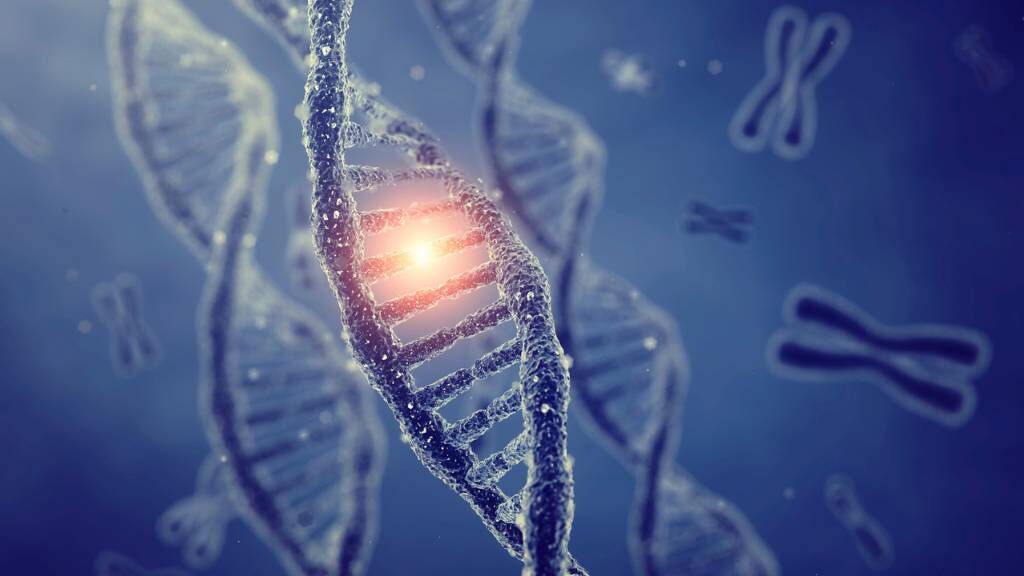
Where is data stored in DNA? Deoxyribonucleic acid (DNA) has a double helix structure, featuring a backbone made up of alternating deoxyribose sugars and phosphates. The two complementary strands of the helix are united by nucleotides, each featuring a nitrogenous base. DNA consists of four nitrogenous bases: adenine (A), cytosine (C), guanine (G), and thymine (T), which is replaced by uracil (U) in messenger RNA (mRNA). Adenine specifically pairs with thymine (or uracil), whereas cytosine pairs with guanine.
These four nitrogenous bases make up the entire DNA code. Thus, we are dealing with a code consisting of four symbols. For comparison, modern digital devices use a binary code consisting of only two symbols (bits): 0 and 1. It is not an exaggeration to say that the cell, with its DNA code, is a biological machine with “informational” characteristics. Moreover, it is far more efficient than our computers.2
The Genetic Code in Action
Only a small fraction of the DNA sequence—approximately 3%—is involved in coding for the cell’s proteins, yet this remains the most widely recognised function of the molecule. When a new protein is required, the DNA code is transcribed into a messenger RNA (mRNA) sequence. This process is facilitated by an enzyme known as RNA polymerase. The resulting mRNA sequence consists of triplets of nitrogenous bases, known as codons. Each codon corresponds to a specific amino acid that is necessary for protein synthesis. For example, the codon UCA codes for serine, while ACG codes for threonine.3
There are a total of 64 codons, 61 of which encode specific amino acids (with some amino acids being encoded by multiple codons). For protein peptides to form, the codons in mRNA must be translated into specific amino acids by the ribosome and transfer RNA (tRNA). The remaining three codons are known as stop codons, which signal the termination of the translation process.
The Genetic Code and Linguistics
These represent only the foundational principles regarding the role of DNA within the cell, yet we already observe terminology that is clearly derived from linguistics, such as “code,” “transcription,”4, and “translation5“… Moreover, when applying the semiotic triangle articulated by Ogden and Richards, it becomes apparent that the components of this model have analogous counterparts within genetics. The semiotic triangle consists of three key elements: the sign (code), the interpretation (thought), and the referent (object). In the context of DNA and cellular processes, these elements correspond as follows:
- The code (containing signs) is the DNA, mRNA, and their nitrogenous bases (A, C, G, and T/U),
- The interpreter (receiver) is the cell, specifically its decoding mechanisms,
- The objects are the specific amino acids that form peptide (protein) chains.6
Interestingly, the context in which a codon is situated plays a significant role. Research has demonstrated that some codons can encode distinct amino acids depending on their location within the genome. For example, the AUA codon, when present in DNA that encodes proteins in the cell nucleus, specifies isoleucine. However, in the mitochondria of vertebrates, AUA codes for methionine instead. Thus, while the sign itself remains constant, the contextual environment in which it is positioned alters its interpretation, as does the cell’s corresponding interpretive mechanism.7
The Arbitrary Nature of the DNA Code
This suggests that codons and their respective nitrogenous bases function as arbitrary units. While they remain subject to the material principles of physics and chemistry, the nitrogenous bases themselves do not possess an intrinsic chemical relationship with the amino acids they encode. Instead, their role is determined solely by the system in which information is encoded and subsequently decoded. For instance, the UGG codon, which encodes tryptophan, could equally encode lysine or any other amino acid, depending on the context of the encoding system.
Thus, DNA functions as a repository of information for the cell, directing the synthesis of specific substances. This presents a fundamental challenge for evolutionists, as they are unable to explain the origin of both the code that conveys information about amino acids and the cellular mechanisms that interpret this code. In contrast, for scientists who adhere to the biblical account of creation by an omniscient God, the origin of the DNA code and its interpretive mechanisms poses no such difficulty.
Conclusion
DNA functions as the encoded blueprint for cellular activity. The cell’s complex mechanisms decode this genetic information, enabling the synthesis of specific proteins necessary for cellular development. Notably, only approximately 3% of the DNA sequence directly contributes to this process. Historically, evolutionary biologists have characterised the remaining DNA as “junk DNA.” However, recent research has increasingly demonstrated that this non-coding DNA performs a variety of essential functions, including the regulation of protein synthesis within the cell.8
The complexity of cellular machinery, including genetic programming, presents a significant challenge to evolutionary theorists, particularly those who reject the notion of a Creator. It was the remarkable intricacy of the DNA code and the cellular mechanisms that decode it that ultimately led Antony Flew, an atheist philosopher, to revise his position and accept the existence of a Creator.9 Flew contended that no natural process could have plausibly led to the spontaneous emergence of both DNA and the highly specialised mechanisms required for its accurate interpretation. Moreover, genetic information, although encoded in material form, is inherently an immaterial phenomenon, comparable to intelligence. This observation strongly suggests that the DNA code is the product of intelligent design.
By the way, we recommend reading the articles:
- The Hittites and the Credibility of the Bible
- Can a “Toxic” Frog Poison Itself?
- Scientists and Philosophers Who Found Faith in God
- What Happened to the Waters Above the Firmament?
- Social Darwinism and Its Impact on Society
Footnotes
- Smith, C., 2010. Lost in Translation. Creation Ministries International, 6 May. Available at: https://creation.com/genetic-code-intelligence.
- Riddle, M., 2010. Information – Evidence for a Creator?. Answers in Genesis, 24 June. Available at: https://answersingenesis.org/genetics/information-theory/information-evidence-for-a-creator/.
- Similarly, in digital machines, a string of eight characters (bits) 01010111 forms a single “codon” (byte) that encodes (and returns) the letter W.
- In linguistics, transcription is the transcription of words from one character system to another character system according to their phonetic values. For example, the Ukrainian name Андрій will be transcribed in the Latin alphabet as Andriy.
- Translation in linguistics is otherwise known as translation from one language to another.
- Is DNA coded information?, 2012. Creation Ministries International, 2 February. Available at: https://creation.com/dna-language-information.
- Ibid.
- Ham, K., 2021. The Days of ‘Junk DNA’ Are Over. Answers in Genesis, 21 October. Available at: https://answersingenesis.org/genetics/days-junk-dna-over/.
- Flew, A. and Varghese, R.A., 2007. There Is a God: How the World’s Most Notorious Atheist Changed His Mind. HarperCollins e-books.
© Source of main image: Canva.

The portal EvolutionOfThinking.org, created by the Research and Education Institute, focuses on education and the dissemination of knowledge related to research on various aspects of human well-being.

