
Environmental protection is a current yet sometimes controversial topic. What can the Bible teach us about caring for the Earth?
The Earth’s population has exceeded 8 billion and continues to grow, although at a slower rate. Unfortunately, as the number of people increases and access to modern advancements such as industry, cars, and electronics becomes more widespread, the planet suffers greater environmental damage through emissions and waste. When God created the natural world and humanity, He did not intend for us to harm the Earth. What has come of the home that God made for us?
Climate change
It is widely recognised that, over the past century, the Earth’s climate has become increasingly warmer. Between 1925 and 2023, the average global temperature has risen by more than 1°C. While this may seem like a minor increase, a higher global temperature results in more heat energy being trapped in the atmosphere. This energy is eventually released in the form of more severe weather events. Even more troubling is the fact that scientists predict there is a 66% chance that we will surpass the 1.5°C threshold by 2027, which could have disastrous effects on our climate.1
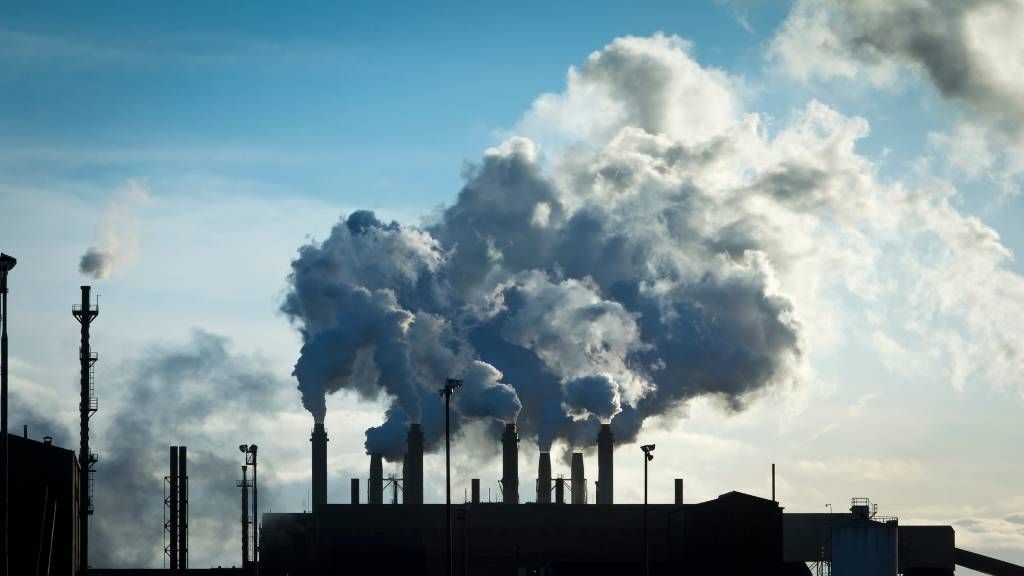
Despite the views of sceptics who dispute the current scientific understanding of global warming, the vast majority of scientists agree that human activity is its main cause.2 Greenhouse gases emitted by factories, cars, airplanes, and industrial agriculture play a significant role, as well as the widespread destruction of forests, which act as carbon sinks by absorbing carbon dioxide and releasing oxygen.
Environmental pollution
Deforestation also has a significant impact on local ecosystems. Trees are vital in filtering air3 and water4 and absorbing toxic chemicals. In urban areas, where pollution levels are high, trees are especially important. One of the most pressing environmental issues is smog, a dense, toxic fog5 that frequently envelops large industrial cities like Krakow, particularly during the winter. Smog forms when emissions from combustion rise to around 40 metres. According to the European Environment Agency, smog contributes to the premature deaths of 45,000 to 50,000 people in Poland every year.6
Another major environmental challenge, both locally and globally, is the pollution of water and soil. This is primarily caused by industrial and municipal wastewater, illegal landfills, and a variety of other sources. These pollutants alter the chemical, physical, and biological properties of water and soil to such an extent that they become unfit for use. Images from the Global South, depicting people living on vast landfills, are well-known. One of the largest such sites is located in Bantar Gebang, near Jakarta, Indonesia’s capital, where as many as 18,000 people live.7 At the same time, the Great Pacific Garbage Patch, which is five times the size of Poland, is responsible for the deaths of at least 1.1 million animals each year.8
Exploitative economy vs. green misanthropy
In other words, the Earth is in trouble. It is understandable that world leaders have proposed various plans and agreements, such as the Paris Agreement in 2015. Unfortunately, these efforts often fail due to a lack of political commitment and insufficient public motivation to protect both local and global environments. Much of the resistance to change comes from powerful industrial, oil, and gas corporations, for whom activities like deforestation, resource extraction, and the production of new technologies are simply standard business practices that generate substantial profits. These corporations, therefore, tend to oppose any efforts to impose restrictions.9
On the other hand, non-governmental environmental organisations, such as Greenpeace and WWF, have been key players in advocating for change. While their goals are generally commendable, some of their tactics have been controversial. For example, in 2014, Greenpeace placed an eco-friendly message in Peru’s Nazca Park, an action for which the organisation later apologised.10 Similarly, WWF has faced accusations of funding paramilitary groups in some Global South countries, groups that have been involved in the massacres of indigenous peoples in protected areas.11
Such actions demonstrate a misanthropic attitude, a profound disregard for humanity, that can be found within certain parts of the environmental movement. A subset of deep ecology, which champions biocentrism over anthropocentrism, asserts that nature is of greater value than human beings. The most well-known organisation within this movement is ‘Earth First!’.12 Other radical groups, such as the Voluntary Human Extinction Movement (VHEMT), argue that humanity must ultimately cease to exist in order for the biosphere to endure.13
Was the Earth truly meant for humans?
Is humanity deserving of extinction for its role in destroying the Earth? This is a dangerous idea, one that could lead to genocides far more devastating than those carried out by Stalin and Hitler. The roots of this belief can be traced to radical evolutionism, which suggests that nature emerged independently through abiogenesis, a theory that remains unproven by science. According to this perspective, nature is almost sacred, and humans, as products of evolution, now violate this sanctity with their actions.14
However, when considering the idea of sanctity, it is worth turning to the Bible. When God created Adam and Eve, He gave them clear instructions. ‘God blessed them and said to them, “Be fruitful and increase in number; fill the earth and subdue it. Rule over the fish in the sea and the birds”’ (Gen 1:28). The command to subdue the Earth has often been used as a justification for the unregulated exploitation of nature by humanity. In reality, however, God does not call for a harsh dominion over the Earth, but rather for its responsible care and stewardship.15

Earth and humanity according to the Bible
According to the Bible, God created nature as a gift for humanity, and Christians are called to care for it in return. Adam was given the task of tending the Garden of Eden (Gen 2:15), a responsibility that should extend to the whole of the Earth. God also warns against the destruction of nature. In the Book of Revelation, it is stated: ‘The nations were angry, and your wrath has come, the time […] for destroying those who destroy the earth’ (Rev 11:18). Thus, we bear a significant responsibility for the Earth, our home.
We must also bear in mind that the same God who gave us the Earth as a dwelling place has the power to take it away. The descriptions of the seven final plagues in Revelation 16, along with other events leading to Christ’s Second Coming in Revelation 19, suggest that the Earth will be desolated. However, God will take His saints to heaven for a time (Rev 14:1–3; 20:4–6). The same God who will temporarily remove the Earth from us will, in due course, restore it completely. In its renewed, paradisiacal state, the Earth will once again become our home, inherited by those whose sins God has forgiven through Christ and who have learned to live in full harmony with His will (Rev 21:1–8).
Our responsibility for God’s creation
Therefore, even today, in keeping with God’s will, it is important to learn how to care for our home, both the Earth we currently inhabit and the one to come. There are many ways to do this. These include adopting a vegetarian diet, recycling, reducing daily consumption, purchasing natural products, conserving water and electricity, and opting for public transport or bicycles over cars, particularly if living in a city. Limiting air travel, which significantly contributes to greenhouse gas emissions, is another important step. Other actions include cleaning up local neighbourhoods, planting trees, or even supporting tree planting initiatives around the world through subscriptions. Ultimately, the Earth is our shared home, created for us by God. Whether we like it or not, it is our duty to care for it.
By the way, we recommend reading the articles:
- Abiogenesis: Could Life Have Arisen from Non-Living Matter
- Is World War III Imminent? Part 1: History, the Present, and Future Predictions
- Is World War III Imminent? Part 2: Great Hope in the Face of Destruction
- Chinese Pictograms and the Story of Genesis
- Do UFOs Exist? – Part 1: Reported Sightings
- Do UFOs Exist? – Part 2: The Forces Behind the Phenomenon
Footnotes
- McGrath, M. 2023. ‘Global warming set to break key 1.5C limit for first time’, BBC News, 17 May. Available at: https://www.bbc.com/news/science-environment-65602293.
- Lynas, M. et al. 2021. ‘Greater than 99% consensus on human-caused climate change in the peer-reviewed scientific literature’, Environmental Research Letters, 16(11). Available at: https://iopscience.iop.org/article/10.1088/1748-9326/ac2966.
- Weeden, M. 2023. ‘How Trees Clean the Air’, One Tree Planted, 22 June. Available at: https://onetreeplanted.org/blogs/stories/how-trees-clean-air.
- Weeden, M. 2023. ‘How Trees Clean the Water’, One Tree Planted, 5 June. Available at: https://onetreeplanted.org/blogs/stories/trees-clean-water.
- The word “smog” is a combination of two English words: smoke and fog.
- Kleczkowski, P. 2020. Smog w Polsce. Przyczyny, skutki, przeciwdziałanie. Warsaw.
- Kwong, L. 2019. ‘Living in Landfills: Poverty in the Developing World’, The Borgen Project, 26 July. Available at: https://borgenproject.org/living-in-landfills-poverty-in-the-developing-world/.
- Wielka Pacyficzna Plama Śmieci. 2022. Włącz Oszczędzanie, 25 October. Available at: https://wlaczoszczedzanie.pl/wielka-pacyficzna-plama-smieci/.
- Timperley, J. 2020. ‘Who is really to blame for climate change?’, BBC Future, 19 June. Available at: https://www.bbc.com/future/article/20200618-climate-change-who-is-to-blame-and-why-does-it-matter.
- McGrath, M. 2014. ‘Greenpeace sorry for Nazca lines stunt in Peru’, BBC News, 11 December. Available at: https://www.bbc.com/news/science-environment-30422994.
- Warren, T. and Baker, K.J.M. 2019. ‘WWF Funds Guards Who Have Tortured and Killed People’, BuzzFeed News, 4 March. Available at: https://www.buzzfeednews.com/article/tomwarren/wwf-world-wide-fund-nature-parks-torture-death.
- Bevington, D. n.d. ‘Earth First!’, Encyclopaedia Britannica. Available at: https://www.britannica.com/topic/Earth-First.
- Jarvis, S. 1994. ‘Live long and die out: Stephen Jarvis encounters the Voluntary Human Extinction Movement’, Independent, 23 April. Available at: https://www.independent.co.uk/life-style/live-long-and-die-out-stephen-jarvis-encounters-the-voluntary-human-extinction-movement-1372200.html.
- Wieland, C. 2001. ‘Fouling the nest’, Creation, 24(1), pp. 10-17. Available at: https://creation.com/fouling-the-nest.
- Wieland, C. and Sarfati, J. 2002. ‘Earth Day: Is Christianity to blame for environment problems?’, Creation Ministries International, 20 March. Available at: https://creation.com/earth-day-is-christianity-to-blame-for-environment-problems.
© Source of main image: Canva.

The portal EvolutionOfThinking.org, created by the Research and Education Institute, focuses on education and the dissemination of knowledge related to research on various aspects of human well-being.

