
This is the story of a man who became a living exhibit at the Bronx Zoo in New York in 1906. Who was Ota Benga, where did he come from, and how did this come to happen? Most importantly, what motivated those who decided to display him as an exhibit?
Benga’s Early Life and First Journey to America
Ota Benga was a Congolese Pygmy, born around 1883 in the Congo. He was a member of the Mbuti tribe and at the time, the region in which he lived had recently become the private property of King Leopold II of Belgium in the early 20th century. Ota had a wife and two children, who were attacked and killed along with his entire village by the colony’s security forces, the Force Publique. Ota survived as he was away hunting, but he was later captured and sold into slavery to the Baschilele tribe.1
In 1904, Samuel Phillips Verner, an explorer, anthropologist, and missionary from South Carolina, took an interest in Ota Benga. Verner was tasked with bringing several Pygmies and other Africans to the United States for the World’s Fair in St. Louis. He bought Ota Benga and others before travelling with them to America, and the two became friends.
Although Samuel P. Verner rescued Ota Benga from those who had killed his family and destroyed his village, his primary aim was to acquire suitable ‘specimens’ for an exhibition. Verner was instructed to gather eighteen people, but ultimately managed to bring only five, including Ota.2 At the World’s Fair in St. Louis, Ota was displayed alongside other Pygmies from the Batwa tribe as one of the ‘savages’.
Benga’s Second Journey to America – New York
After the exhibition, Verner took Ota back to Africa, where he remarried. Unfortunately, his wife died from a snake bite. With his tribe destroyed, he was unable to find a home. Other Africans distanced themselves from him due to his association with white people. In response, Verner decided to bring him back to America. In 1906, the two travelled to New York.
However, Verner soon ran out of money and had to leave Ota in New York while he travelled to the southern states. Ota Benga temporarily stayed at the American Museum of Natural History, where he lived and was free to move around. The silence of the museum, however, felt strange to him, and he began to show signs of longing for the wilds of Africa. His unpredictable behaviour led Verner and museum curator Henry Bumpus to search for another place for him.3
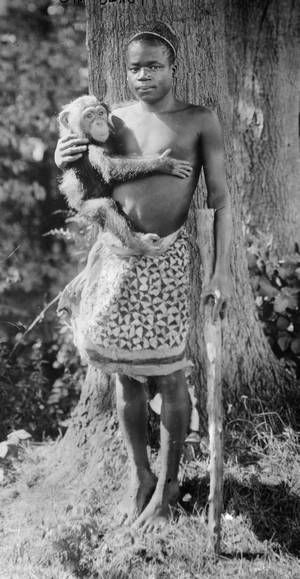
Ota Benga at the New York Zoo
Verner brought Ota Benga to the New York Zoo, where the zoo director, William Hornaday, took him in. Ota Benga was free to move about the grounds and occasionally helped clean the animal exhibits. He began spending more time in the Monkey House, where he cared for one of Verner’s chimpanzees and an orangutan named Dohong. It remains uncertain whether Hornaday actually ‘employed’ him, as he claimed, since there is no evidence that Ota received any payment.4
The zoo director, noticing that visitors were more interested in Ota than the animals, encouraged him to hang his hammock in the Monkey House cage. He was also given a bow and arrows, which he used to shoot at a target. On 8 September 1906, the zoo director placed a sign in front of the exhibit with information about Ota and his origins. In this way, Ota Benga became part of the New York Zoo exhibit, to the delight of visitors.5
Evolutionary Motives
Why were William Hornaday’s intentions? Since the publication of Charles Darwin’s The Descent of Man, scientists have been interested in finding the missing link between apes and humans among contemporary peoples. They believed that Africans, in particular, could represent this link, as Darwin’s theory suggested that human evolution began in Africa.6
William Hornaday was a strong supporter of Darwinism, scientific racism, and eugenics. Madison Grant, who was head of the New York Zoological Society at the time, shared these views and encouraged Hornaday to place Ota in the exhibit alongside an orangutan, chimpanzee, and parrot. They presented him as the ‘missing link’ between ape and man, even suggesting he was closer to apes than to white humans.7
Ten years later, the aforementioned Madison Grant wrote the pseudoscientific book The Passing of the Great Race, in which he examined the history of the Nordic race in Europe. It was one of the works that influenced Adolf Hitler’s Nazi ideology.8 In the 1920s and 1930s, Grant also led the American Eugenics Society and was behind a series of legislative actions, including the prohibition of interracial marriages.
Protests Against Ota Benga’s Zoo Imprisonment
Ota Benga became a major attraction in New York. The day after the exhibit opened, newspapers, including The New York Times, reported on him, attracting many people to the zoo to view Ota. Almost everyone was eager to see the ‘intermediate link’ between ape and man.
However, protests arose quickly, particularly from local African American churches. For many preachers, both black and white, displaying an African in a zoo was seen as degrading to black people, especially Pygmies, reducing them to the role of the ‘missing link’ in the theory of evolution. Reverend R.S. MacArthur, a white pastor from Calvary Baptist Church, stated: ‘The person responsible for this exhibit is degrading himself just as much as he is degrading this African man.’9
William Hornaday and Madison Grant defended their actions by stating that their intention was to create an ‘ethnological’ exhibit. However, facing significant opposition, they suspended the exhibit on the afternoon of Monday, September 10. Ota Benga was freed from the cage and allowed to move around the zoo for the remainder of his time there.
How Ota Benga himself assessed his situation remains unknown, as he left no records. However, the public’s interest in the ‘savage’ from Africa continued. Over the next week, the crowds became increasingly unbearable for him. The New York Times of September 18, 1906, reported that on Sunday, September 16, up to 40,000 people came to see him. They mocked him, pulling his limbs, poking his ribs, and tripping him. He retaliated by injuring several people with his bow.10
A Tragic End
Under these circumstances, Hornaday and Grant decided to release Ota Benga from the zoo. For several years, he lived in an orphanage on the eastern end of Long Island.11 In 1910, he was sent to Lynchburg, Virginia, where he lived among African Americans. He studied at a local Baptist seminary and was baptised there.12
However, Ota Benga did not complete his education and later attempted various jobs, including working in a tobacco factory. Certain events, combined with his longing for Africa— to which he could not return due to the cost of a ticket and the war— led him into deep depression. In March 1916, Ota Benga took his own life by shooting himself in the chest with a revolver.
It is notable that William Hornaday, an evolutionist and racist, upon hearing of the suicide, almost mockingly stated that Ota ‘tried to prove to his benefactors that he had no ability to learn’ and that ‘he preferred to commit suicide rather than earn a living’.13
A Painful Lesson
The tragic story above should serve as a reminder of how easily a human being can be degraded due to flawed views on humanity. Ota Benga was not a ‘missing link’ between ape and man. He was a human being and should have been treated as such. The Bible states that every human being, regardless of skin colour, descends from a single human couple. Had this been remembered, perhaps such tragedies would not have occurred.
By the way, we recommend reading the articles:
- The Platypus: An Evolutionary Enigma
- Blue Eyes – Mutation or Common Genetic Variant?
- The Hittites and the Credibility of the Bible
- A Bird That Walks Underwater
- What is the Source of the Genetic Code?
Footnotes
- Keller, M., 2006. The Scandal at the Zoo. The New York Times, 6 August. Available at: https://www.nytimes.com/2006/08/06/nyregion/thecity/06zoo.html.
- Bergman, J., 2000. Ota Benga: The pygmy put on display in a zoo. Creation Ministries International, Journal of Creation, 14(1), pp. 81–90. Available at: https://creation.com/ota-benga-the-pygmy-put-on-display-in-a-zoo.
- Keller, M., op. cit.
- Keller, M., op. cit.
- Keller, M., op. cit.
- Gearan, A., 1992. African Was Shown as a Darwinian ‘Specimen’: Racism: Book tells of events that led to suicide of Congolese Pygmy who was exhibited at 1904 World’s Fair and at Bronx Zoo as proof of man’s relation to apes. Los Angeles Times, 29 November. Available at: https://www.latimes.com/archives/la-xpm-1992-11-29-mn-2734-story.html.
- Howe, C., 2015. EXCLUSIVE: Caged with an orangutan and put on display in New York: How 23-year-old pygmy Ota Benga was taken from the Congo, billed as ‘the missing link’ and humiliated before thousands. Mail Online, 2 June. Available at: https://www.dailymail.co.uk/news/article-3107714/Caged-orangutan-display-New-York-Zoological-Gardens-104-pound-23-year-old-Ota-Benga-taken-Congo-billed-missing-link-humiliated-thousands.html.
- Bates, G., 2020. Bronx Zoo apologizes for putting a man in a monkey house. Creation Ministries International, 6 August. Available at: https://creation.com/bronx-zoo-apologizes.
- Keller, M., op. cit.
- Bergman, J., 1993. Ota Benga. Answers in Genesis, 1 December. Available at: https://answersingenesis.org/charles-darwin/racism/ota-benga/.
- Keller, M., op. cit.
- Ham, K., 2019. Darwin’s Garden. In: One Race, One Blood. Master Books. Available at: https://answersingenesis.org/charles-darwin/racism/darwins-garden/.
- Bergman, J., Ota Benga: The pygmy…, op. cit.
© Source: Wikimedia Commons. Author: Unknown; however, image credit is given to The South Carolina Library, University of South Carolina, Columbia, S.C. in The Pygmy in the Zoo. License: public domain.

The portal EvolutionOfThinking.org, created by the Research and Education Institute, focuses on education and the dissemination of knowledge related to research on various aspects of human well-being.

