
Göbekli Tepe disrupts established frameworks in history, archaeology, and paleontology, prompting critical questions about humanity’s past. It invites us to reconsider: What is the genuine story of human civilization?
Situated in southeastern Turkey, approximately 15 kilometres from the city of Şanlıurfa, lies Göbekli Tepe, a site that appears to challenge established historical paradigms. These ruins date back to the Pre-Pottery Neolithic period and comprise a series of oval stone structures. Within these enclosures stand upright megalithic stones. Although known since the 1960s, the significance of the site was only revealed through archaeological excavations conducted between 1994 and 1995. Göbekli Tepe features four principal oval structures, yet geomagnetic surveys have indicated the presence of up to twenty similar formations in the surrounding area.
The most significant enigma facing researchers is the age of this complex. Radiocarbon dating1 suggests that Göbekli Tepe was constructed around 12,000 years ago, approximately 10,000 BCE, near the conclusion of the last Ice Age.2 Additionally, evidence indicates that the site was not permanently occupied, implying that its primary purpose was of a religious nature. This positions Göbekli Tepe as the oldest known religious structure in existence.
Who Were the Builders of Göbekli Tepe?
This revelation is profoundly unsettling for scientists, as it was previously held that the region was exclusively populated by primitive hunter-gatherer cultures around 12,000 years ago. The question arises: how did these hunter-gatherers, lacking any prior experience in constructing such megalithic structures, come to the decision to erect a substantial sanctuary? Notably, this occurred approximately 6,000 to 7,000 years before the advent of writing and the rise of recognized ancient civilizations, such as the Sumerians, as well as the construction of Stonehenge, during a period when agriculture and pottery had yet to be developed.

Photo 1. The position of Göbekli Tepe in Turkey. © Source: Wikimedia Commons. Author: beytullah eles. License: CC BY-SA 4.0.
The megaliths themselves, shaped like the letter T, pose another great puzzle. Some of these stones are three times the height of a human, weighing between 7 and 10 tons3, with some even weighing up to 16 tons.4 The megaliths seem to represent human figures, each embellished with carvings or reliefs depicting a variety of animals, particularly snakes and foxes. The processes of constructing, carving, and transporting these megaliths would have necessitated considerable knowledge, expertise, and motivation. Consequently, the identity of the builders of Göbekli Tepe remains a mystery.
Chronological Mysteries
As previously noted, scientists have dated Göbekli Tepe to approximately 12,000 years ago. It is believed that the complex was in use for roughly 3,000 years before its eventual abandonment.5 How do we reconcile the construction of this sanctuary 12,000 years ago with its abandonment around 9,000 years ago—during which it was purposefully buried—while no further permanent structures appear to have been built until the emergence of the first known civilizations around 3,000 BCE? It seems implausible that these societies did not create any notable architecture between 7,000 and 3,000 BCE. This raises significant questions regarding the accuracy of our chronological narrative of human history.6
The mysteries of Göbekli Tepe do not conclude here. Among the array of megaliths, Column 27, situated within the oval structure marked “C,” stands out as particularly captivating. This column is adorned with a carving of an enigmatic four-legged reptile, distinguished by its sharp teeth and crocodile-like appearance. Klaus Schmidt, the archaeologist credited with the rediscovery of Göbekli Tepe in 1994, described this creature as a “predator,” suggesting it may have functioned as a mythical guardian of the sanctuary. Interestingly, this would be the sole mythical representation at Göbekli Tepe, as all other carvings portray actual animals.7
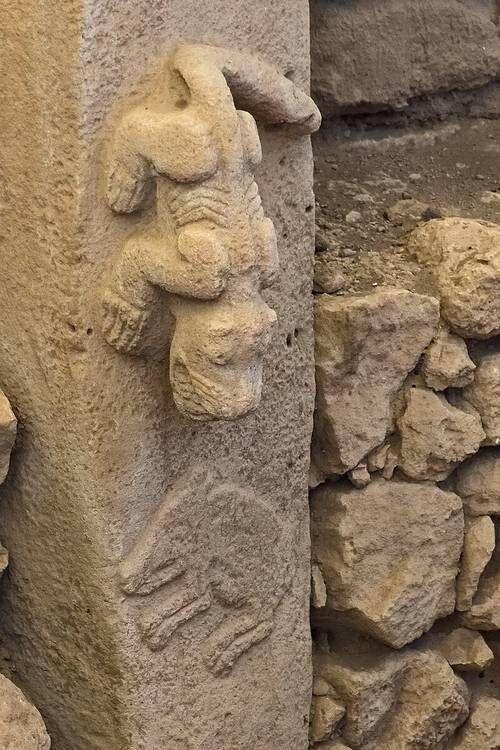
Interestingly, the carving closely resembles genuine quadrupedal reptiles documented in the fossil record. For example, reptiles from the suborder Proterosuchia may serve as pertinent examples.8 The issue at hand is that these reptiles are believed to have existed and subsequently gone extinct during the early Triassic period, approximately 250 million years ago. Is it conceivable that the builders of Göbekli Tepe had knowledge of these extinct reptiles? If so, how might they have acquired such information?
A Revised History of Humanity
The most straightforward explanation is that they must have observed these animals firsthand. Is it conceivable that these reptiles inhabited what is now Turkey just a few thousand years ago? This possibility cannot be ignored when one considers the inconsistencies in the dating of rocks and fossils. The American Paleochronology Group has found that dinosaur bones, which are typically dated to tens or even hundreds of millions of years old, contain significant levels of carbon-14, suggesting a more recent date of between 22,000 and 39,000 years ago.9 This indicates significant discrepancies in the chronology of our planet.
These observations, coupled with the decision of ancient peoples to construct such a megalithic sanctuary, lead to several conclusions. Firstly, humans have consistently exhibited profound spiritual and religious needs throughout history. Secondly, these ancient individuals must have possessed remarkable intelligence and physical capabilities, enabling them to erect megalithic structures without the aid of modern equipment. Finally, the entire chronology of Earth’s and humanity’s history necessitates substantial revision; specifically, it should be significantly condensed.
Göbekli Tepe and the History of the World According to Genesis
Proper interpretation of Göbekli Tepe may lend support to the historical accounts presented in the Book of Genesis, particularly in light of its proximity to the traditionally accepted location of Noah’s Ark on Mount Cudi.10 Moreover, it could be located near the original city of Babel, which may not be identical to the ruins of Babylon in Lower Mesopotamia as we know them. Researchers such as Anne Habermehl11, Ken Griffith, and Darrel K.12 White point to historical and archaeological data suggesting that the original city of Babel was located in Upper Mesopotamia, within the Pre-Pottery Neolithic A (PPNA) area.
Göbekli Tepe is located only a few dozen kilometres from the sites identified by researchers as the original, yet undiscovered city of Babel. As the oldest known religious sanctuary in the world, it substantiates the credibility of the historical narrative outlined in the Book of Genesis.
By the way, we recommend reading the articles:
- Does the Big Bang Theory Exclude the Existence of God?
- The Origin of Viruses: Three Possible Variants
- The Fourth Dimension – Part 2: Exploring the Intersection of Science and Spirituality
- Self-Transcendence – The Forgotten Human Need
- What Happened to the Waters Above the Firmament?
Footnote:
- Sanders, L. & Carter, R. (2011) How does Göbekli Tepe fit with biblical history? Creation Ministries International. Available at: https://creation.com/gobekli-tepe.
- Scham, S. (2008) The World’s First Temple. Archaeology, 16(6), Nov/Dec. Available at: https://archive.archaeology.org/0811/abstracts/turkey.html.
- Curry, A. (2008) Gobekli Tepe: The World’s First Temple? Smithsonian Magazine. Available at: https://www.smithsonianmag.com/history/gobekli-tepe-the-worlds-first-temple-83613665/.
- Smith, D.B. (2014) Overturning Expectations About Ancient Man. Answers in Genesis. Available at: https://answersingenesis.org/archaeology/ancient-technology/overturning-expectations-about-ancient-man/.
- Roget, S. (2021) This Archaeological Site Is Rewriting Our Entire Understanding of Human History. Ranker. Available at: https://www.ranker.com/list/facts-about-gobekli-tepe-turkish-archaeological-site/stephanroget.
- Sanders, L. & Carter, R., How does Göbekli Tepe fit with biblical history?, op. cit.
- Smith, D.B., Overturning Expectations About Ancient Man, op. cit.
- Ibid.
- Holloway, A. (2018) Did Humans Walk the Earth with Dinosaurs? Triceratops Horn Dated to 33,500 Years. Ancient Origins. Available at: https://www.ancient-origins.net/news-evolution-human-origins/humans-walk-earth-dinosaurs-triceratops-horn-dated-33500-020159.
- Lewis, J.P. (1984) Noah and the Flood: In Jewish, Christian, and Muslim Tradition. The Biblical Archaeologist, Dec., p. 237.
- Habermehl, A. (2011) Where in the World Is the Tower of Babel? Answers Research Journal, 4, pp. 25-53. Available at: https://answersresearchjournal.org/where-is-the-tower-of-babel/.
- Griffith, K. & White, D.K. (2021) An Upper Mesopotamian location for Babel. Journal of Creation, 35(2), Aug., pp. 69-79. Available at: https://creation.com/babel-upper-mesopotamia.
© Source of main image: Wikimedia Commons. Author: Cobija. License: CC BY-SA 4.0.

The portal EvolutionOfThinking.org, created by the Research and Education Institute, focuses on education and the dissemination of knowledge related to research on various aspects of human well-being.

