
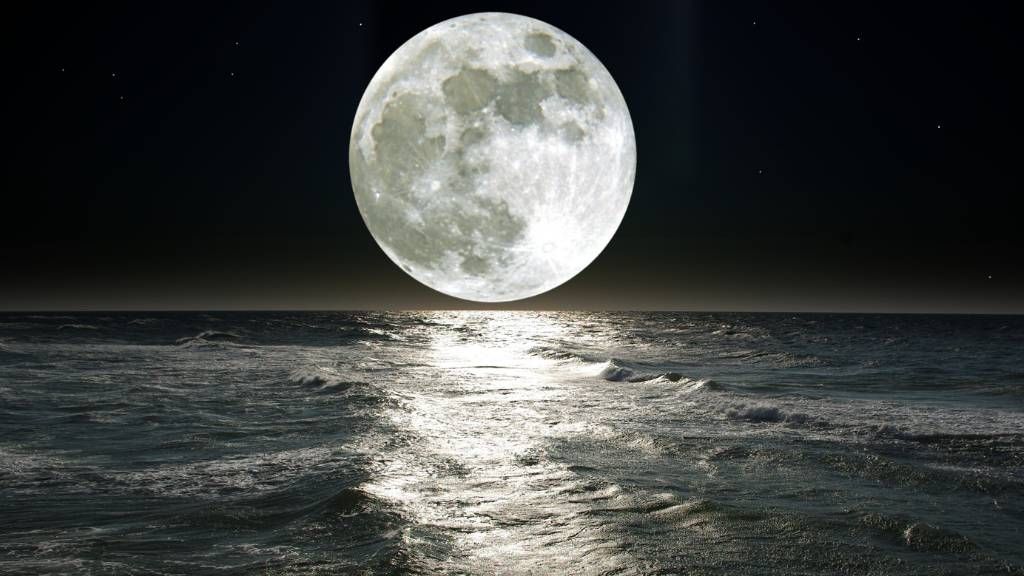
The Moon stands as one of the most remarkable celestial phenomena available to human observation. Its striking appearance and unique position in our sky set it apart from any other planetary-mass object we can observe. Beyond its visual appeal, the Moon serves vital functions for both our planet and human civilisation. These facts invite deeper reflection on what they might reveal about the universe we inhabit.
General features of the Moon
The Moon is a unique celestial body, serving as Earth’s only natural satellite. It lies at an average distance of 384,400 kilometres from our planet, drawing as close as roughly 360,000 kilometres at perigee and reaching up to 405,000 kilometres at apogee. Its synodic orbit around the Earth lasts approximately 29.5 days. The Moon’s phases form the basis for the concept of the month.1
The Moon has had and continues to have enormous cultural significance for humans. In the Bible, it is mentioned as the ‘lesser light’ that God created to rule the night.2 In nearly all ancient cultures, the Moon carried symbolic meaning and was commonly linked to water and femininity. Early lunar calendars were based on the Moon’s movement and its visible phases. The most widely recognised lunar calendar in use today is the Islamic calendar.
The size of the Moon
The Moon’s size is particularly noteworthy, as its diameter is around 3,475 kilometres. In the entire solar system, only four moons are larger: Jupiter’s Ganymede, Callisto and Io, and Saturn’s Titan.3 What sets our Moon apart is that it is the only moon of such scale orbiting a rocky inner planet. Mars has just two small, asteroid-like moons, while Mercury and Venus have none at all.
The size of the Moon in relation to the Earth is also quite striking. Its diameter is more than 27 percent of Earth’s, the highest ratio of any moon to its planet in the solar system. For comparison, Triton, Neptune’s largest moon, has a diameter just 5.5 percent that of its planet.
The Moon’s orbital plane
Another distinctive feature of the Moon is the inclination of its orbital plane in respect to the Earth. Other moons in the solar system generally fall into one of two categories: they either orbit close to the equator of their planet, as is the case with most inner moons, or they follow paths tilted at various irregular angles, typical of outer moons.
The Moon’s orbit, however, aligns more closely with Earth’s path around the Sun than with Earth’s equator. Its inclination to the ecliptic is slightly over 5 degrees, whereas Earth’s axial tilt relative to the ecliptic is approximately 23.4 degrees. No other moon of comparable size exhibits an orbital inclination of this kind.4
How does the Moon affect the tides?
Due to its size and orbit, the Moon has a significant effect on natural phenomena on Earth. Most importantly, without the Moon, we would not have tides in their current form. Tides help cleanse coastlines and play a vital role in coastal ecosystems. The life cycles of many animals are closely tied to this rhythm, and species such as crabs and sea urchins that live in the intertidal zone are dependant on the regular rise and fall of the sea. Tides are also crucial for habitats such as mangrove forests.
The Moon as a stabiliser of Earth’s orbital axis
An even more significant feature of the Moon is its role in stabilising Earth’s axial tilt. Other planets in the solar system exert a slight gravitational influence on Earth, gradually altering the tilt of the planet’s axis over time. The Moon’s size, mass, and orbital inclination contribute to the stabilisation of this process. Earth’s current axial tilt is approximately 23.4 degrees and is slowly decreasing, though over long timescales it oscillates between 22.1 and 24.5 degrees.5
Imagine a world without the Moon. Earth’s axial tilt would be far more unstable, with changes occurring much more rapidly. The tilt could swing to extreme values, ranging from 0 to 90 degrees. If it dropped close to 0 degrees, seasonal variation would disappear or become significantly weaker. On the other hand, if the tilt approached 90 degrees, seasonal changes would become extreme, potentially threatening the survival of life on Earth. The Moon plays a crucial role in maintaining the stability of Earth’s axial tilt.6
Solar eclipses
The Moon is also remarkable for another important reason. It is approximately 400 times smaller than the Sun, yet also about 400 times closer to Earth.7 This unusual alignment results in the Moon and the Sun appearing nearly equal in size from Earth’s perspective, making total solar eclipses occasionally possible.
If the Moon were smaller or farther away, eclipses would be only partial, or at most annular. If it were larger or closer, total eclipses would be more frequent but would block significantly more light, and annular eclipses would not occur at all. Instead, we are able to witness striking total eclipses during which the Sun’s corona becomes visible, glowing around the silhouette of the Moon.
The Moon in scientific research
The Moon has long held considerable importance for scientific inquiry. It was through observing the Moon’s movement around the Earth that Isaac Newton developed his theory of gravity. This breakthrough enabled him to account for the forces responsible for the motion of the planets around the Sun and of moons orbiting their respective planets, a question that had not been fully resolved by Kepler despite his formulation of the three laws of planetary motion.8
In 1868, French astronomer Jules Janssen observed a solar eclipse in India using a prism. While examining the light from the Sun’s chromosphere, he identified a dark spectral line9 in the yellow region of the spectrum. At first, he believed it indicated the presence of sodium, but the line did not correspond to any known element. The substance was later identified and named ‘helium’ by subsequent researchers.10
In 1919, British astronomer Arthur Eddington and his team photographed a total solar eclipse, capturing images of stars from the Hyades cluster near the Sun and Moon. They noted small discrepancies between the recorded positions of the stars and their known locations. Subsequent analysis revealed that the Sun’s gravity bends the light from distant stars. This provided the first experimental confirmation of Albert Einstein’s general theory of relativity concerning the curvature of spacetime caused by gravity.11
Chance or design?
The Moon appears to serve as an exceptional instrument for astronomical and astrophysical observation. Would the scientific discoveries mentioned above have been possible without it? Perhaps they would have emerged eventually, though likely at a later stage and without the same observational clarity. It is clear, however, that the Moon has played a meaningful role in enabling many of these breakthroughs.
When we take into account various factors, such as the Moon’s size and unusual orbit, its stabilising influence on Earth through tides and axial tilt, the occurrence of total solar eclipses, and its other notable features, it is worth asking whether the Moon truly came into existence by chance. Can all of this reasonably be attributed to coincidence?
A number of contemporary scholars and scientists regard the Moon as evidence that the universe is not the product of random processes but reflects intentional design by God.12 This ‘lesser light’, as described in the Bible, not only governs the night but also contributes significantly to the preservation of life on Earth and has aided profoundly in the advancement of scientific knowledge. It is difficult to argue that this is merely the result of chance.
By the way, we recommend reading the articles:
- The Texas Mystery Spider
- Panpsychism and the Origin of Human Consciousness
- The Evolutionary Roots of Racism
- Did Noah’s Flood Cover the Himalayas?
- True Femininity
Footnotes
- In Ukrainian, the word місяць (misjac’) means both ‘month’ and ‘Moon.’
- The Bible, New King James Version, 1982, Genesis 1:16–18.
- NASA, By the Numbers – Earth’s Moon, https://solarsystem.nasa.gov/moons/earths-moon/by-the-numbers/.
- D. R. Faulkner, ‘No Ordinary Moon’, Answers Magazine, 2017, 34(5): 71–75, https://answersingenesis.org/astronomy/moon/no-ordinary-moon/.
- K. Syty, Milankovitch Cycles, AstroNET – Polish Astronomical Portal, March 20, 2020, https://astronet.pl/autorskie/cykle-milankovicia/.
- D. R. Faulkner, ‘A Perfect Partner’, Answers Magazine, 2014, 18(1), https://answersingenesis.org/astronomy/moon/a-perfect-partner/.
- Ibid.
- J. E. Faller, Gravity, Encyclopaedia Britannica, https://www.britannica.com/science/gravity-physics/Newtons-law-of-gravity.
- Each such spectral line shows a fragment of the electromagnetic wavelength absorbed by a chemical element present in the source of that light.
- M. Williams, Who Discovered Helium?, Universe Today, March 14, 2016, https://www.universetoday.com/53563/who-discovered-helium/.
- E. Landau, A Total Solar Eclipse 100 Years Ago Proved Einstein’s General Relativity, Smithsonian Magazine, May 24, 2019, https://www.smithsonianmag.com/science-nature/total-solar-eclipse-100-years-ago-proved-einsteins-general-relativity-180972278/.
- Some of these ideas were featured in the documentary The Privileged Planet, dir. Lad Allen, USA, 2004.
© Source of main image: Canva.

The portal EvolutionOfThinking.org, created by the Research and Education Institute, focuses on education and the dissemination of knowledge related to research on various aspects of human well-being.

