
What will become of the universe in billions of years, and should this be a cause for concern? Insights from both science and the Bible provide perspective.
Humans are naturally curious, not only understanding the concept of the future but also seeking to know it in order to determine what awaits the universe. These predictions may be based on scientific theories or religious prophecies. Will the universe eventually come to an end, and if so, how?
The end of the Earth, Sun, and universe?
The fate of the Sun and Earth is a subject of scientific study. Researchers estimate that in approximately five billion years, the Sun will enter the red giant phase. A few billion years later, it will shed its outer layers, leaving behind only a white dwarf. However, life on Earth is expected to vanish much earlier—within roughly one billion years—due to the Sun’s gradual increase in temperature, which rises by 1% every 100 million years. In other words, within a billion years, the Sun’s heat will render Earth uninhabitable.1
Conditions are not anticipated to improve beyond that point. In about four billion years, our galaxy is predicted to collide with the Andromeda Galaxy, partially overlapping with the Sun’s transformation into a red giant.2 The fate of the universe also seems sealed, as it will eventually ‘die’ in one way or another. Several hypotheses exist regarding this:3
The Big Freeze
The Big Freeze hypothesis, also called the heat death of the universe, suggests that the universe will keep expanding at an ever-increasing rate, pushing all objects farther apart. In time, it will cool to the point of reaching maximum thermal equilibrium (entropy), leaving no energy and no motion.
The Big Rip
In the Big Rip model, as in the previous scenario, the universe continues expanding, with its expansion accelerating over time. Eventually, it will reach a point where galaxies, stars, planets, and even matter itself are torn apart. Robert Caldwell suggests this could happen in as little as 22 billion years.4
The Big Crunch
The Big Crunch is the opposite of the Big Freeze and the Big Rip. This hypothesis suggests that if the universe’s average mass density and overall gravitational pull exceed the force of its expansion, that expansion will slow over time. Eventually, the universe will contract, collapsing into an extremely dense point—the reverse of the Big Bang.
The Big Slurp
The Big Slurp is considered the most unsettling scenario, as it is not confined to the distant future but could theoretically occur at any time. If the Higgs boson has a certain mass, it would suggest that the vacuum of our universe is not entirely stable but metastable—known as a false vacuum. There also exists a more stable vacuum state with lower energy, referred to as the true vacuum. According to the Big Slurp hypothesis, if a universe in a true vacuum were to collide with ours, it would trigger the collapse of our universe. At that point, all protons would disintegrate, and we would disappear with them.
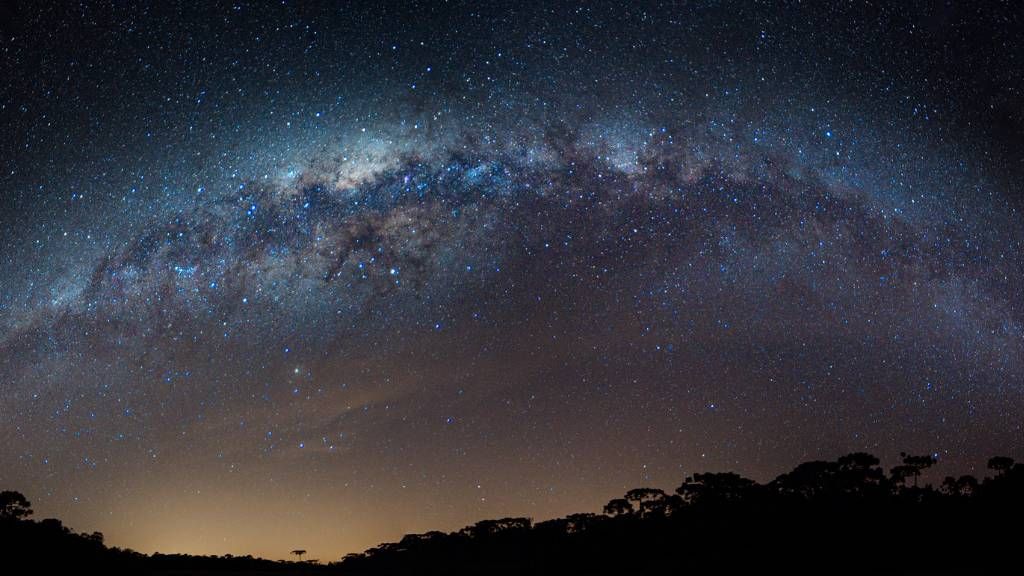
Should we be afraid?
This does not present a particularly optimistic perspective, does it? Fortunately, most of these scenarios would not take place for billions, or even trillions, of years. Humanity tends to think in terms of decades and centuries, rarely considering timescales of thousands of years. Even tens of thousands of years already feel beyond comprehension. The further into the future we look, the more abstract such numbers become. Millions, tens of millions, or hundreds of millions of years? Life on Earth is expected to persist for around a billion years. There is little reason, then, to concern ourselves with events that may or may not occur billions of years from now.
What about the frightening possibility of the Big Slurp, which could, in theory, happen at any moment? Unfortunately, there is no way to know whether a ‘hostile’ universe exists nearby, waiting to destroy us. However, how can we find reassurance that nothing will ultimately threaten us? That confidence comes from the Bible, which presents God, in the person of Jesus Christ, as the one who oversees the fate of the universe and will not allow it to be destroyed by chance. As stated in Hebrews:
‘Who being the brightness of His glory and the express image of His person, and upholding all things by the word of His power, when He had by Himself purged our sins, sat down at the right hand of the Majesty on high.’ (Hebrews 1:3)
Christ upholds the existence of the entire universe, as well as each of us, by the word of His power. Considering that the Earth, the Sun, and the universe may continue for billions of years, it is clear that everything has been created with extraordinary stability, preventing it from collapsing within decades, centuries, or even thousands of years. We can therefore be at peace, knowing that the fate of the universe is in the hands of the Creator and Redeemer Himself.
The fate of the universe and our fate according to the Bible
This does not mean that our universe will not ultimately be destroyed. It will, in fact, come to an end. The same Bible that speaks of God’s power in sustaining the universe also declares:
‘But the day of the Lord will come as a thief in the night, in which the heavens will pass away with a great noise, and the elements will melt with fervent heat; both the earth and the works that are in it will be burned up. […] Nevertheless we, according to His promise, look for new heavens and a new earth in which righteousness dwells.’ (2 Peter 3:10,13)
On one hand, our world—and even the universe (‘the heavens’)—will be destroyed. However, this destruction will be controlled, as God has promised to protect His children in Jesus Christ. On the other hand, the same promise declares that God will create a new heaven and a new earth for His children, where they will live with Him for eternity. In this new creation, righteousness will dwell, meaning that only those who are righteous will inherit it.5
The truth is that we are all God’s children, though few of us realise it. We have all made many mistakes in our lives.6 However, God is patient, and His love for us is immeasurable. He proved this by giving His Son, Jesus Christ, to die on the cross for us, though we deserve eternal death and condemnation.7 This great love calls us to come to Him, confess our mistakes, and allow Him to transform our hearts to reflect the purity of Christ. It is the only way to survive the destruction of the present universe and enter a new one, filled with righteousness, in the eternal presence of our God and Saviour.
By the way, we recommend reading the articles:
- The Evolutionary Roots of Racism
- Did Noah’s Flood Cover the Himalayas?
- What is the Source of the Genetic Code?
- The Babylonian Exile – A Historically Confirmed Biblical Prophecy
- King Nebuchadnezzar’s Dream: How History Validates the Bible
Footnotes
- Hurley, S. 2015. The future of the sun. Explaining Science. Available at: https://explainingscience.org/2015/04/12/the-future-of-the-sun/.
- NASA. 2012. NASA’s Hubble shows Milky Way is destined for head-on collision. NASA. Available at: https://www.nasa.gov/mission_pages/hubble/science/milky-way-collide.html.
- Trosper, J. 2018. Four ways that our universe might end, according to science. Futurism. Available at: https://futurism.com/four-ways-the-universe-could-end.
- Caldwell, R. R. 2003. Phantom energy and cosmic doomsday. Available at: https://arxiv.org/pdf/astro-ph/0302506.pdf.
- The Bible, New King James Version, 1982, 1 Corinthians 6:9-11; Galatians 5:19-23.
- The Bible, New King James Version, 1982, Romans 5:12.
- The Bible, New King James Version, 1982, John 3:16-17.
© Source of main image: Canva.

The portal EvolutionOfThinking.org, created by the Research and Education Institute, focuses on education and the dissemination of knowledge related to research on various aspects of human well-being.

