
Is the Bible merely a collection of myths? Here, we explore a biblical prophecy whose accuracy is echoed in historical records.
To skeptics, the Bible might appear as a set of exaggerated tales revered as sacred. However, one particular account invites a closer look due to its striking historical parallels. Between 605 and 562 B.C., the powerful King Nebuchadnezzar II ruled Babylon. The Book of Daniel describes how one of his young captives, Daniel, entered his service after Nebuchadnezzar’s forces captured Jerusalem in 587-586 B.C.
King Nebuchadnezzar was deeply troubled by a mysterious dream. The dream had terrified him, yet he found himself unable to recall its details. Frustrated and resolute, he decreed that all the wise men of his court would be put to death if they failed to recount and interpret the dream (Daniel 2:1-13). Among these wise men was Daniel, who, upon hearing the decree, turned to God in prayer, seeking revelation of the dream’s content and meaning so he could present it to the king (Daniel 2:14-23).
King Nebuchadnezzar’s Dream
The result of this prayer was one of the most amazing biblical prophecies recorded in the Bible. The prophet Daniel presented King Nebuchadnezzar’s dream in the following words:
‘You, O king, were watching; and behold, a great image! This great image, whose splendor was excellent, stood before you; and its form was awesome. This image’s head was of fine gold, its chest and arms of silver, its belly and thighs of bronze, its legs of iron, its feet partly of iron and partly of clay. You watched while a stone was cut out without hands, which struck the image on its feet of iron and clay, and broke them in pieces. Then the iron, the clay, the bronze, the silver, and the gold were crushed together, and became like chaff from the summer threshing floors; the wind carried them away so that no trace of them was found. And the stone that struck the image became a great mountain and filled the whole earth’ (Daniel 2:31-35).
Below is the interpretation of this dream as conveyed by the prophet Daniel. Bible scholars have interpreted Daniel’s explanation in different ways,1,2 yet the historicist approach—seeing prophecies as correlating with actual historical events or eras—seems particularly fitting in this context. There are differing views even within historicism. Here, we present an interpretation that might be considered the most straightforward, with an unbroken historical sequence. This perspective reveals something about both God, who entrusted Daniel with this vision, and the Bible, which preserves the entirety of this prophecy.
The First Four Kingdoms
After describing what King Nebuchadnezzar saw in his dream, Daniel immediately proceeded to interpret it. He began with these words:
‘You, O king, are a king of kings. For the God of heaven has given you a kingdom, power, strength, and glory; and wherever the children of men dwell, or the beasts of the field and the birds of the heaven, He has given them into your hand, and has made you ruler over them all—you are this head of gold. But after you shall arise another kingdom inferior to yours; then another, a third kingdom of bronze, which shall rule over all the earth. And the fourth kingdom shall be as strong as iron, inasmuch as iron breaks in pieces and shatters everything; and like iron that crushes, that kingdom will break in pieces and crush all the others’ (Daniel 2:37-40).
Four Ancient Empires
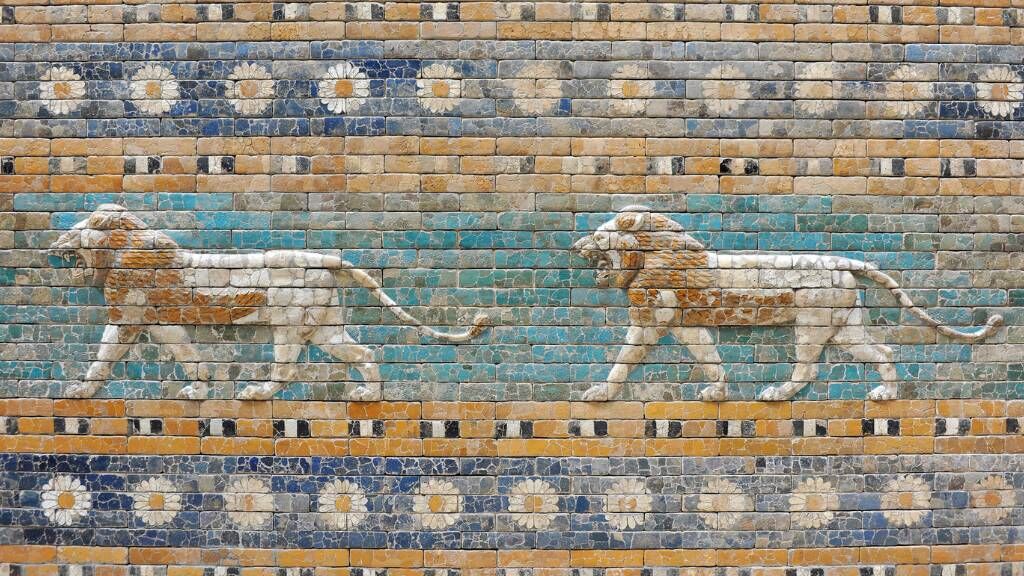
According to Daniel’s interpretation, the different parts of the statue made of various materials represent successive kingdoms. Daniel first identifies the head of gold as none other than the king of Babylon, symbolizing the Neo-Babylonian Empire. The symbolic gold represents the nobility and splendor of Babylon, which Nebuchadnezzar himself had expanded.
According to the prophecy, however, after the Neo-Babylonian Empire, another kingdom was to arise, represented by the silver chest. The state that conquered Babylon in 539 B.C. was the Persian Empire (also known as the Medo-Persian Empire or the Achaemenid Empire). The original text suggests that this was not to be a lesser kingdom but rather a less noble one.3 Indeed, the Persian Empire did not have the same splendor as Babylon.
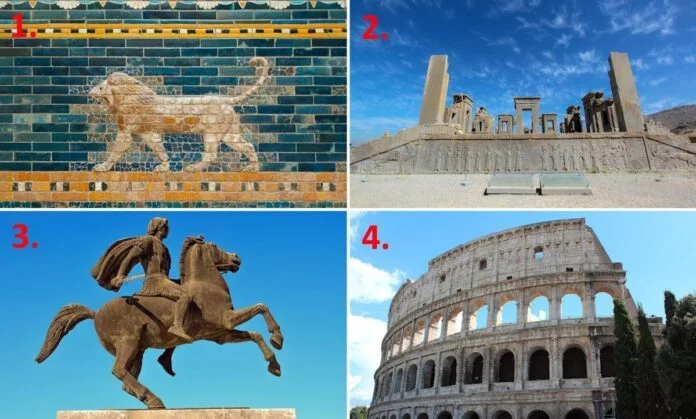
After the second kingdom, a third was to arise, represented by bronze thighs. From 334-324 B.C., the vast Persian Empire was swiftly conquered by the small kingdom of Macedonia, ruled by Alexander the Great. Alexander conquered the known world, specifically the civilized territories recognized by the Jews of his era. The use of bronze as a symbol for his empire is fitting, as it mirrors the material of the Macedonian army’s armor, made from an alloy of copper and tin.
After the third kingdom, a fourth was to arise, symbolized by iron legs. Alexander’s empire, which fragmented after his death in 323 B.C., quickly gave way to the growing power of Rome. The Roman Republic, and later the Roman Empire, conquered the Hellenistic states and much of Europe with an army of legionnaires clad in iron armor.
The Divided Fourth Kingdom
At this point, the prophecy from King Nebuchadnezzar’s dream took an intriguing turn. The prophet Daniel went on to explain to the king:
‘Whereas you saw the feet and toes, partly of potter’s clay and partly of iron, the kingdom shall be divided; yet the strength of the iron shall be in it, just as you saw the iron mixed with ceramic clay. And as the toes of the feet were partly of iron and partly of clay, so the kingdom shall be partly strong and partly fragile. As you saw iron mixed with ceramic clay, they will mingle with the seed of men; but they will not adhere to one another, just as iron does not mix with clay’ (Daniel 2:41-43).
The Division of the Roman Empire into Smaller Kingdoms
The prophecy states that the fourth kingdom will break into many parts, with no single smaller kingdom achieving dominance over the others. The Western Roman Empire lasted only until 476 A.D. In the fifth century, the western part of the empire was invaded by Germanic tribes, which resulted in the formation of several smaller Germanic kingdoms across its former territories. Among these were the Kingdoms of the Franks, Visigoths, Ostrogoths, Suebi, Burgundians, Vandals, Anglo-Saxons, and later, the Lombards. The Alemanni also created their own tribal confederation.

Some of these kingdoms eventually fell, but most underwent a complex evolution that spanned over 1,500 years. Today, they have given rise to the following nations: France, Germany, Italy, Spain, the United Kingdom (particularly England), the Netherlands, Belgium, Portugal, Austria, and Switzerland, as well as smaller states like Luxembourg and microstates such as Monaco. Historically, these countries—though not all of them—played a significant role in the development of European civilisation. They spearheaded ventures such as the Crusades and the establishment of vast colonial empires. Furthermore, they exerted influence over or directly ruled other European nations outside this group, including Poland, the Czech Republic, Hungary, and Ireland.4
Interestingly, there have been several attempts to unify Europe. Charlemagne, Charles V of the Habsburgs, Napoleon Bonaparte, and Adolf Hitler came closest to achieving this goal.5 Otto III also pursued a similar vision. Today, a form of European unity exists through the European Union. However, Brexit has highlighted centrifugal forces that could threaten its cohesion. Similar forces have also played a role in the decline of European colonial empires in the Americas, Africa, and Asia. Consequently, the prophecy regarding the division of the fourth kingdom can be interpreted as referring not only to the political fragmentation of Europe but also to the broader disintegration of empires across much of the world, if not all of it.
The Culmination of the Prophecy
Regardless of the exact interpretation of the division of the fourth kingdom, it appears that almost the entire prophecy from King Nebuchadnezzar’s dream has come true. How is this possible? It is highly unlikely that the prophet Daniel, without divine inspiration, would have accurately predicted four successive empires, with the last one breaking apart permanently.
Almost the entire prophecy has been fulfilled. The final, most dramatic part is yet to come. As Daniel explains:
‘And in the days of these kings the God of heaven will set up a kingdom which shall never be destroyed; and the kingdom shall not be left to other people; it shall break in pieces and consume all these kingdoms, and it shall stand forever. Inasmuch as you saw that the stone was cut out of the mountain without hands, and that it broke in pieces the iron, the bronze, the clay, the silver, and the gold—the great God has made known to the king what will come to pass after this. The dream is certain, and its interpretation is sure’ (Daniel 2:44-45).
The central focus of the entire Bible is Jesus Christ,6 and He is also at the heart of this prophecy. King Nebuchadnezzar’s dream illustrates that all earthly kingdoms will ultimately be reduced to dust, while God’s eternal kingdom will endure. Just as the previous elements of the prophecy—the four historical kingdoms and the division of the fourth kingdom into smaller states, which continues to this day—have been concluded, we can be assured that this final aspect of the prophecy will also come to pass.
Conclusion
King Nebuchadnezzar’s dream serves as direct evidence that there truly ‘is a God in heaven’ (Daniel 2:28), who governs the course of world history. It further affirms that the entire Bible is the true word of God, conveying the truth about our origins, our fallen state, and the salvation that God has prepared for us all through the sacrifice of Jesus Christ. As foretold in the prophecy of King Nebuchadnezzar’s dream, He will soon return.
By the way, we recommend reading the articles:
- Does the Bible Justify Slavery?
- The Flat Earth Myth in Christian History
- Social Darwinism and Its Impact on Society
- The Tower of Babel – Extra-Biblical Narratives
- The Origin of Viruses: Three Possible Variants
Footnotes
- The most important differences include whether the second kingdom is to be the Persian empire or the empire of the Medes. If the Medes, then the third kingdom would be Persia, and the fourth would be the empire of Alexander the Great, which itself quickly disintegrated. Thus, the prophecy would end with the first coming of Jesus Christ. See: Gurney, R.J.M. (1977) The four kingdoms of Daniel 2 and 7. Themelios, 2(2). Available at: https://www.thegospelcoalition.org/themelios/article/the-four-kingdoms-of-daniel-2-and-7/.
- Jehovah’s Witnesses also have their own interpretation, according to which the fourth kingdom (the Roman Empire) lasted in another form until the 18th century. That is when the “division” of the British Empire was supposed to have taken place, with the creation of the United States of America behind it. Both alternative interpretations to the one presented in this article, however, contain serious inaccuracies.
- In other words, the second kingdom would be literally more ‘earthly’, less ‘heavenly’, less noble than Nebuchadnezzar’s kingdom. See: Blue Letter Bible. Available at: https://www.blueletterbible.org/lexicon/h772/kjv/wlc/0-1/.
- This was especially the case in the modern period, up to World War I and its aftermath.
- Heinz, H. (1993) Radykalne zmiany przed nami. Warszawa: Wydawnictwo „Znaki Czasu”, pp. 43-45.
- Smethurst, M. (2021) Your Whole Bible Is About Jesus. Gospel Coalition, 22 April. Available at: https://secundumscripturas.com/2012/10/19/the-bible-is-about-jesus/.
© Source of main image: Canva.

The portal EvolutionOfThinking.org, created by the Research and Education Institute, focuses on education and the dissemination of knowledge related to research on various aspects of human well-being.

