
Comets are some of the most striking celestial bodies observed from Earth. However, their presence raises questions about the standard model that dates the Solar System as being billions of years old.
The media has recently circulated dramatic reports about the largest comet ever discovered approaching Earth. The Bernardinelli Bernstein comet has a nucleus measuring approximately 129 kilometres in diameter, which is around 50 times larger than that of a typical comet.1 To put this into perspective, 129 kilometres is roughly the straight-line distance between Warsaw and Łódź, including the widths of both cities.² Fortunately, this comet poses no threat. Even at its closest approach to the Sun in 2031, it will remain too distant to be visible to the naked eye.
Comets do, however, on occasion, appear in our skies. One of the most well-known is Halley’s Comet, last observed in 1986. In 1997, Comet Hale-Bopp made its appearance. Between 2006 and 2007, the exceptionally bright Comet McNaught was visible, reaching a magnitude of –5.5,3 although it was unfortunately not visible from Poland. More recently, two years ago, the faintly visible Comet NEOWISE passed through our sky, reaching a peak brightness of 1.5 magnitude.4
What are comets?
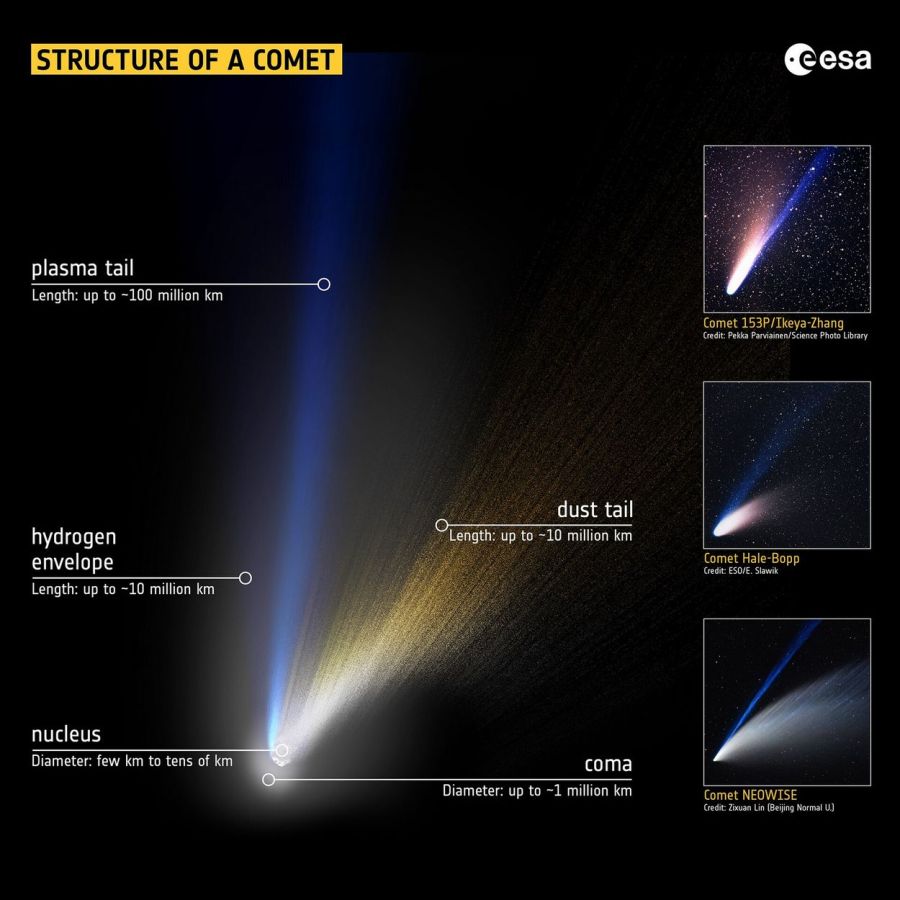
A comet is a small celestial body made of dust, rock fragments, and ice, which occasionally visits the Solar System, orbits the Sun, and then returns to its distant orbit. When a comet is sufficiently close to the Sun, it emits two distinct tails: a gas tail and a dust tail, making it visible in our sky. Both tails form under the influence of the solar wind. The gas tail arises due to sublimation of ice (direct transformation of ice into water vapor) and moves in the direction opposite to the Sun. Meanwhile, the direction of the dust tail, being heavier than the gas tail, is the resultant of the solar wind and the comet’s trajectory.
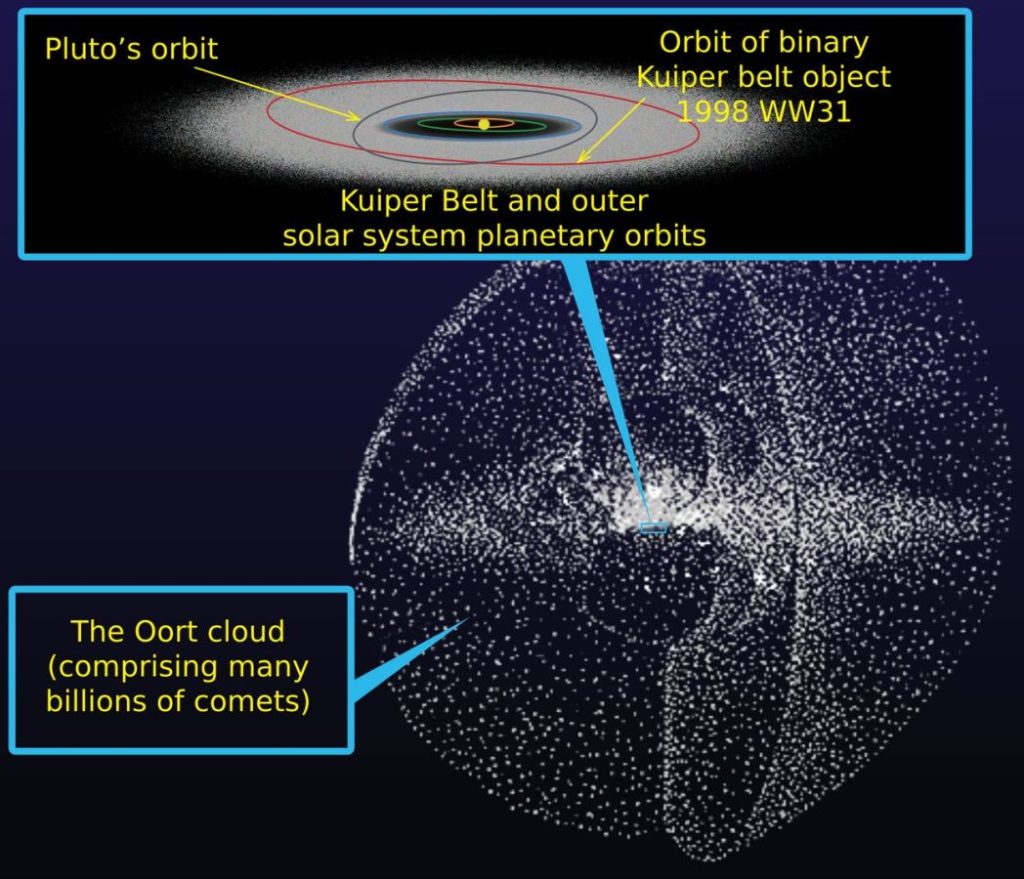
Comets can be divided into short-period, long-period, and non-periodic comets. Short-period comets, appearing at intervals shorter than 200 years, originate from a region called the Kuiper Belt, located beyond Neptune’s orbit. In contrast, long-period comets appear at intervals longer than 200 years and come from regions outside the Solar System. Finally, non-periodic comets, or one-time visitors, come to us from interstellar space and appear only once around the Sun.
How long do comets last?
Like many other celestial bodies, comets are not eternal. As previously mentioned, when a comet approaches the Sun, it develops two tails composed of dust and gases. This process results in the gradual loss of material from the comet’s nucleus. With each successive orbit around the Sun, the nucleus continues to erode. Over time, this can lead to its complete disintegration. A notable example is Comet ATLAS, which broke apart before astronomers’ eyes in 2020.5 Halley’s Comet, which passes through the inner Solar System approximately every 76 years (for example, in 1834, 1910, and 1986), is also expected to disintegrate after another 45 to 65 returns,6 i.e., in about 3400-5000 years.
Comets may also disappear in two other ways, both resulting from interactions with the planets of the Solar System. When a comet passes too close to a planet, particularly a massive one, the planet’s gravitational field can alter the comet’s trajectory. As a result, the comet may either be flung far beyond the Solar System, never to return, or, if the gravitational pull is sufficiently strong, it may collide with the planet. This was the fate of Comet Shoemaker–Levy 9, which struck Jupiter in 1994.7 In short, the lifespan of a comet is finite.
Comets and the Oort cloud
These facts are well known to secular astronomers, who recognise that they raise a problem regarding the age of the Solar System. If comets formed at the same time as the Solar System, which is believed to be 4.5 billion years old, then, given their current rate of disintegration, they should no longer exist. This points to the possibility that the Solar System is much younger than commonly assumed. Evolutionary scientists, however, reject this conclusion. They argue that beyond the Kuiper Belt lies the Oort Cloud, a distant region from which long-period comets, such as Comet Hale-Bopp, are believed to originate. These comets are thought to continually replace those that are lost. The Oort cloud is estimated to have a radius of around 0.5 light-years, with a total mass between 10 and 40 times that of Earth.8
The problem is that, although the Oort cloud is often presented as an established fact, there is no evidence for its existence. Astronomers do not yet have instruments capable of detecting objects as small as comet nuclei, which are believed to make up the Oort cloud. It therefore remains an unconfirmed hypothesis.9
This does not mean the Oort Cloud does not exist; it may well be real. Nevertheless, a further issue has emerged. A 2001 article published in Nature suggests that the mass of the Oort cloud is far smaller than the estimated 10 to 40 Earth masses. According to the authors, frequent collisions between comets during the formation of the Solar System would have destroyed many of them. In short, there may be too few comets in the supposed Oort cloud to account for the number observed in the Solar System.10
A young Solar System
The fast rate at which comets break apart, along with the issues surrounding the supposed Oort cloud, suggests the Solar System might not be billions of years old. Since comets disintegrate quickly and there is no clear evidence that new ones are replacing them, this points to the possibility that the Solar System is much younger. It may be only a few thousand years old, as stated in the Book of Genesis.
By the way, we recommend reading the articles:
- Did Dinosaurs Live in Alaska?
- The Sun – A Unique Star
- The Origin of the Moon: Coincidence or Design?
- The James Webb Space Telescope and Its Surprising Discoveries
- The Fate of the Universe – What Awaits Our Cosmos?
Footnotes
- Kowal, A., 2022. To największe znane nauce jądro komety. Jest 50-krotnie większe niż zazwyczaj. Chip, 12 April. Available at: https://www.chip.pl/2022/04/rekordowe-jadro-komety-bernardinelli-bernstein/
- Own calculations based on Google Earth program.
- Magnitudo, also known as apparent magnitude—a unit of measurement used to estimate the brightness of celestial bodies. The lower the value (including negative values), the brighter the object.
- International Comet Quarterly, n.d. Brightest comets seen since 1935. Available at: http://www.icq.eps.harvard.edu/brightest.html
- Hurcewicz, A., 2020. Rozpad komety C/2019 Y4 (ATLAS). Kosmonauta.net, 14 April. Available at: https://kosmonauta.net/2020/04/rozpad-komety-c-2019-y4-atlas/
- Wallis, M. K. & Wickramasinghe, N. C., 1985. Halley’s comet: its size and decay rate. Monthly Notices of the Royal Astronomical Society, 216(2), pp. 453–458. Available at: https://academic.oup.com/mnras/article/216/2/453/1038794
- Kanawka, K., 2014. 20 lat od uderzenia komety Shoemaker-Levy 9 w Jowisza. Kosmonauta.net, 16 July. Available at: https://kosmonauta.net/2014/07/20-lat-od-uderzenia-komety-shoemaker-levy-9-w-jowisza/
- Usidus, M., n.d. Zagadkowe peryferia Układu Słonecznego. Młody Technik. Available at: https://mlodytechnik.pl/technika/29048-zagadkowe-peryferia-ukladu-slonecznego
- Faulkner, D. R., 2011. More Problems for the ‘Oort Comet Cloud’. Journal of Creation, 15(2), p. 11. Available at: https://answersingenesis.org/astronomy/comets/more-problems-for-the-oort-comet-cloud/
- Faulkner, D. R., 2011. More Problems for the ‘Oort Comet Cloud’. Journal of Creation, 15(2), p. 11.
© Source of main image: Canva.

The portal EvolutionOfThinking.org, created by the Research and Education Institute, focuses on education and the dissemination of knowledge related to research on various aspects of human well-being.

