
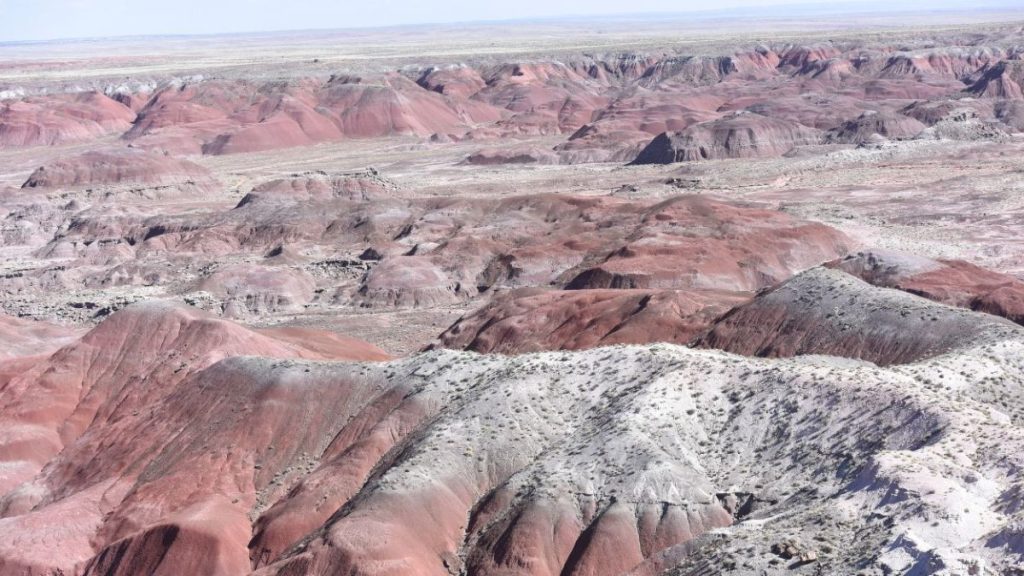
In northern Arizona, the Painted Desert stretches for 190 kilometres. Its sedimentary rocks form layers in vivid colours: orange, yellow, white, grey, and even purple. Within this area is the Petrified Forest National Park, named after the many petrified tree trunks found there. Fossils of various animals have also been uncovered, from the well-known, like clams, to the less familiar, such as aetosaurs and archosaurs.
From a small river to a great Flood?
Rainfall in the Painted Desert is limited today, yet the structure of its rock layers clearly shows they were shaped by water. The origin of the region is discussed in the book Dawn of the Dinosaurs,1 available at the Painted Desert Visitor Center.
The Chinle Formation, spanning from Wyoming to Texas and from Oklahoma to Nevada, is known for its many petrified trees, including those found within the park. According to Dawn of the Dinosaurs, this area was formed when ‘energetic, sediment-laden rivers flowed through this area’.2 In relation to large amphibians buried in the region, the book notes that perhaps ‘a river seasonally overflowed its banks’.3
This explanation is hard to accept, as seasonal floods today do not form fossils. The creation of such colourful layers across large areas would have needed vast amounts of water, not small rivers.
Similar deposits are found at Ghost Ranch in New Mexico, north of Santa Fe. Dinosaurs and other fossils built up there ‘after floods’.4 Some quarries at Ghost Ranch hold hundreds of Coelophysis skeletons that ‘appear to have been deposited during a single event, likely a great flood’.5 How deep must the water have been, and how vast the scale of that flood? Truly colossal.
Imaginary soils
The banded, colourful layers of the Painted Desert are often explained as ancient soils that formed in river floodplains.3 They do not, however, resemble modern soil horizons. Real soil profiles show root systems and a gradual build-up of organic matter. In contrast, the Painted Desert displays distinct, separate layers that stretch for many kilometres in all directions.
Petrified trees
The Blue Mesa Member, part of the Chinle Formation, contains petrified tree trunks that are known worldwide, some measuring up to 55 metres in length. It is claimed that this former lowland area ‘was at some point flooded, submerging the trees’.2 However, simple flooding does not separate trunks from their roots, and these petrified trees are rarely found with roots. Their petrification was helped by silica-rich minerals from widespread volcanic activity.
Forty years ago, the eruption of Mount St. Helens stripped thousands of trees of their branches, bark, and roots within minutes. Vegetation is also brought down on a large scale by the force of powerful tsunami waves. Once again, ordinary river flooding does not account for this.
A collision of sea and land
Dawn of the Dinosaurs states, ‘In the Blue Mesa Member, a variety of aquatic and terrestrial creatures are preserved’,6 and this is true for other parts of the Chinle Formation as well. Fossils include mammals, reptiles, frogs, and birds7, as well as sharks and coelacanths. Coelacanths today live at depths of about 150 meters or more.8 Most sharks are marine species. Some great cataclysm brought marine creatures onto land and mixed them with terrestrial creatures, creating fossil graveyards. In fact, marine and terrestrial fossils are buried together on every continent. This is clearly evidence of a global flood.9,10
Today’s soils and river systems bear no resemblance to the fossils and rocks of the Painted Desert. Only a global flood can explain the vast distribution of each rock layer. During such a catastrophic event, ash and silica from volcanic eruptions caused the petrification of trees rapidly buried in sediment, while the receding and retreating floodwaters sculpted the terrain.
The distinctive features of the Painted Desert are consistent with the effects of a global flood. Could this landscape in Arizona serve as evidence supporting the reliability of the Genesis account?
By the way, we recommend reading the articles:
- Did Evolution Create Beauty and Aesthetics?
- The Power of Spoken Words
- Giants in the Bible and Other Writings
- Reevaluating the Concept of Evolutionary Time
- Noah’s Flood – Global or Local in Extent?
Footnotes
- Sadler, K., Parker, W. and Ash, S., 2015. Dawn of the Dinosaurs. Petrified Forest, AZ: Petrified Forest Museum Association.
- Sadler, K., Parker, W. and Ash, S., 2015. Dawn of the Dinosaurs. Petrified Forest, AZ: Petrified Forest Museum Association, p. 35.
- Sadler, K., Parker, W. and Ash, S., 2015. Dawn of the Dinosaurs. Petrified Forest, AZ: Petrified Forest Museum Association, p. 45.
- Sadler, K., Parker, W. and Ash, S., 2015. Dawn of the Dinosaurs. Petrified Forest, AZ: Petrified Forest Museum Association, p. 86.
- Sadler, K., Parker, W. and Ash, S., 2015. Dawn of the Dinosaurs. Petrified Forest, AZ: Petrified Forest Museum Association, p. 92.
- Sadler, K., Parker, W. and Ash, S., 2015. Dawn of the Dinosaurs. Petrified Forest, AZ: Petrified Forest Museum Association, p. 48.
- Chatterjee, S., 2015. The Rise of Birds: 225 Million Years of Evolution, 2nd ed. Baltimore, MD: Johns Hopkins University Press.
- Tomkins, J. P., 2021. ‘The Fossils Still Say No: The Fins-To-Feet Transition’, Acts & Facts, 50(3), pp. 10–13.
- Clarey, T., 2015. ‘Dinosaurs in Marine Sediments: A Worldwide Phenomenon’, Acts & Facts, 44(6), p. 16.
- Clarey, T., 2019. ‘Marine Fossils Mixed with Hell Creek Dinosaurs’, Acts & Facts, 48(4), p. 10.
Based on: B. Thomas, T. Clarey, The Painted Desert: Fossils in Flooded Mud Flats, Acts & Facts, Institute for Creation Research, April 2021, pp. 16–19.
© Source of main image: Canva.

The portal EvolutionOfThinking.org, created by the Research and Education Institute, focuses on education and the dissemination of knowledge related to research on various aspects of human well-being.

