
Why do humans perceive certain things as beautiful and others as unattractive? Our aesthetic sense enables us to recognise beauty in people, objects, and the natural world. Yet, is evolution genuinely responsible for the existence of this aesthetic perception?
When observing beautiful flowers, such as roses, people typically do not question why these flowers are appealing. Rather, they directly appreciate the flowers’ colours, petal arrangements, and overall appearance. Such experiences are referred to as aesthetic sensations, which predominantly engage human emotions rather than reason or intentionality.
Of course, our perception of beauty is not limited to plants. We also see beauty in landscapes, animals, the cosmos, various natural patterns (including mathematical ones), and other people. Additionally, we recognise beauty in human-created art, such as painting, sculpture, architecture, and design.
Aesthetic experiences arise not only from what we see but also from what we hear and smell. Music, singing (whether human or birdsong), animal sounds, and even the melody of someone’s voice can be beautiful. Many flowers have pleasing fragrances. Lastly, we sometimes find beauty in thoughts expressed through literature or theatrical performances.
The beauty of plants
Nevertheless, nature remains the primary source of our aesthetic sensations. The green and blue colours of natural landscapes please the eye and soothe the mind. It appears no coincidence that the Earth, with its abundant vegetation, is green, while the sky above is blue. If both Earth and sky were the same colour, either green or blue, that would lack visual appeal. If we were continuously surrounded by red, that would hardly produce a calming effect.1
Occasionally, however, we have the opportunity to admire warm colors in nature. This happens, for instance, during sunsets. Flowers also appear in a variety of hues such as red, pink, yellow, white and blue. Once more, it seems no coincidence that vegetation is green, since it provides a suitable backdrop for brighter colours. Imagining green or dark blue flowers against red foliage beneath a yellow sky would create an unusual and perhaps surreal impression.
The beauty of animals
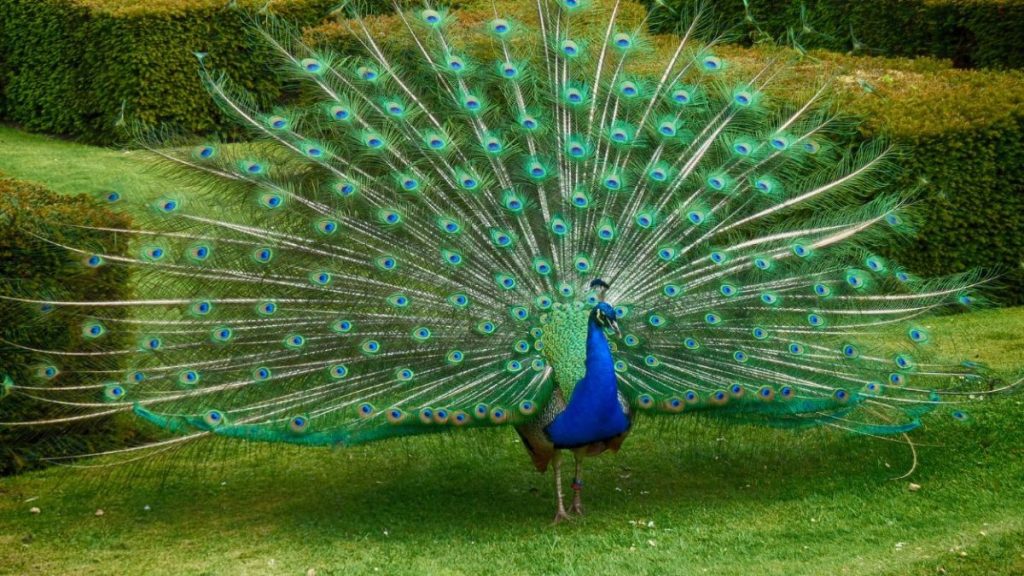
Animals provide us with aesthetic experiences as well. This applies not only to domestic dogs and cats, which dominate online and are undeniably beautiful, but also to wild creatures. Some wild species display astonishing colouration that evolutionary theory struggles to explain. The peacock, with its vividly coloured tail, puzzled Charles Darwin. In a letter to Asa Gray dated 3 April 1860, Darwin wrote, ‘The sight of a feather in a peacock’s tail, whenever I gaze at it, makes me sick!’.2
This is only the beginning. Numerous animal species exhibit such extraordinary colours that it is difficult to regard them as mere evolutionary coincidences. Among these are mandrills, Bolivian golden bats, various parrots, mandarin ducks, keel-billed toucans, azure kingfishers, lilac-breasted rollers and poison-dart frogs. Many reptiles, including chameleons, lizards and snakes, also display remarkable hues, as do certain fish, insects (predominantly butterflies), arachnids, crustaceans and molluscs.3
Sometimes vivid coloration serves a specific purpose, such as camouflage or deterring predators. Some species can even change colors. In other cases, however, the colouration appears unrelated to survival and exists purely as decoration. For some animals, a colourful appearance plays a part in courtship. A peahen, nonetheless, does not view a peacock as humans do.4 Humans, by contrast, regard the peacock as aesthetically pleasing.
Is beauty subjective?
Why did Charles Darwin detest peacocks so much? Evolutionary theory maintains that the animal kingdom is governed solely by a ruthless struggle for survival and reproduction. In Darwin’s view, his theory could not account for why certain animals appear so strikingly beautiful to the human eye.
It is important to clarify that this refers to objective beauty. Many people assume that beauty is entirely subjective and dependent on individual preference. Design experts, however, describe objective beauty in terms of particular features such as patterns, curves, brightness, contrast and smoothness.5 When these elements are skilfully combined, they often produce exceptional compositions that captivate any observer.
Added beauty
We observe this in the natural world as added beauty. Can evolution, driven by random mutation and centred on the struggle for existence, produce beauty that appeals to the human eye? This appears highly improbable. After all, such beauty in plants and animals confers no survival advantage.
Perhaps the issue resides not with plants and animals but with humans. Only humans possess such a refined aesthetic sense that they can appreciate the works of both nature and human culture.6 The human eye contains three types of cone cell, allowing us to perceive specific wavelengths of light as red, green or blue. But could evolution have done more than simply enable us to distinguish colours?
The God of beauty
Believers who regard the Bible as authoritative approach this question differently from evolutionists. In their view, the beauty of the world, together with its creation, is the work of Almighty God.7 Thus, God alone is responsible for the splendour of nature and for granting humans a sense of aesthetics. The beauty of the natural world not only attests to God’s existence but also confirms that He fashioned all things, including humanity, which is capable of appreciating His handiwork. As the Apostle Paul writes: ‘For since the creation of the world His invisible attributes are clearly seen, being understood by the things that are made, even His eternal power and Godhead, so that they are without excuse’ (Romans 1:20).
By the way, we recommend reading the articles:
- Rainforests in Antarctica
- Extrabiblical Testimonies of the Flood
- Natural Selection – Truth or Fiction?
- The Syrinx: The Secret Behind Birds’ Songs
- Where Did Snake Venom Come From?
Footnotes
- Burgess, S., 2016. Piękno – niepodważalne świadectwo. Answers in Genesis. Available at: https://answersingenesis.org/pl/odpowiedzi/pi%C4%99kno-niepodwa%C5%BCalne-%C5%9Bwiadectwo/.
- Darwin, F. (ed.), 1887. Letter to Asa Gray, April 3, 1860. In: The Life and Letters of Charles Darwin, Vol. 2. London: John Murray, p.296; 1911 ed. New York and London: D. Appleton and Company, Vol. 2, pp.90–91; cited in: Burgess, S., 2001. The Beauty of the Peacock Tail and the Problems with the Theory of Sexual Selection. Journal of Creation, 15(2), pp.94–102. Available at: https://creation.com/the-beauty-of-the-peacock-tail-and-the-problems-with-the-theory-of-sexual-selection.
- Kochamy Zwierzaki, n.d. Kolorowe zwierzęta. Available at: https://kochamyzwierzaki.pl/kolorowe-zwierzeta/; Everywhere Wild, n.d. Colorful Animals. Available at: https://everywherewild.com/colorful-animals/.
- Utaraitė, N., n.d. This Is How Birds See The World As Compared To Humans And It’s Pretty Amazing. BoredPanda.
- BoredPanda, n.d. Human vs. Bird Vision. Available at: https://www.boredpanda.com/human-vs-bird-vision/.
- Burgess, S., 2016. Piękno – niepodważalne świadectwo, op. cit.
- Brandstater, B., 2004. Intelligent Design: The Argument from Beauty. Journal of the Adventist Theological Society, 15(1), pp.12–20. Available at: https://www.readkong.com/page/intelligent-design-the-argument-from-beauty-3143562.
© Source of main image: Canva.

The portal EvolutionOfThinking.org, created by the Research and Education Institute, focuses on education and the dissemination of knowledge related to research on various aspects of human well-being.

