
Neanderthals buried their dead, just like Homo sapiens. New evidence suggests that they also buried members of other species.
According to the evolutionary timeline, Neanderthals lived in Europe and the Middle East between 400,000 and 40,000 years ago. They are generally regarded as a distinct species from Homo sapiens and were long considered lower on the evolutionary scale due to the absence of certain features found in modern humans.
Was the Neanderthal really so different from us? The evidence suggests otherwise. While the genetic differences between Neanderthals and modern humans are notable, they are too slight to justify classifying Neanderthals as a separate species. Neanderthal DNA still exists in the genomes of European and Asian populations, making up around 1–4% of their genetic makeup. Although this is a small percentage, it would not have survived to the present day if Neanderthals had struggled to produce fertile offspring with Homo sapiens.1
How did Neanderthals bury their loved ones?
The same is true of Neanderthal spiritual culture. It is now widely recognised that they buried their dead. As of 2007, approximately 475 remains had been discovered at around 124 sites. At least 258 of these, accounting for 54 percent of all finds, appear to be individuals buried in excavated graves.2 How do researchers know these were graves? The evidence indicates that the bodies were placed deliberately, often in specific positions, and items such as flowers were found nearby.3
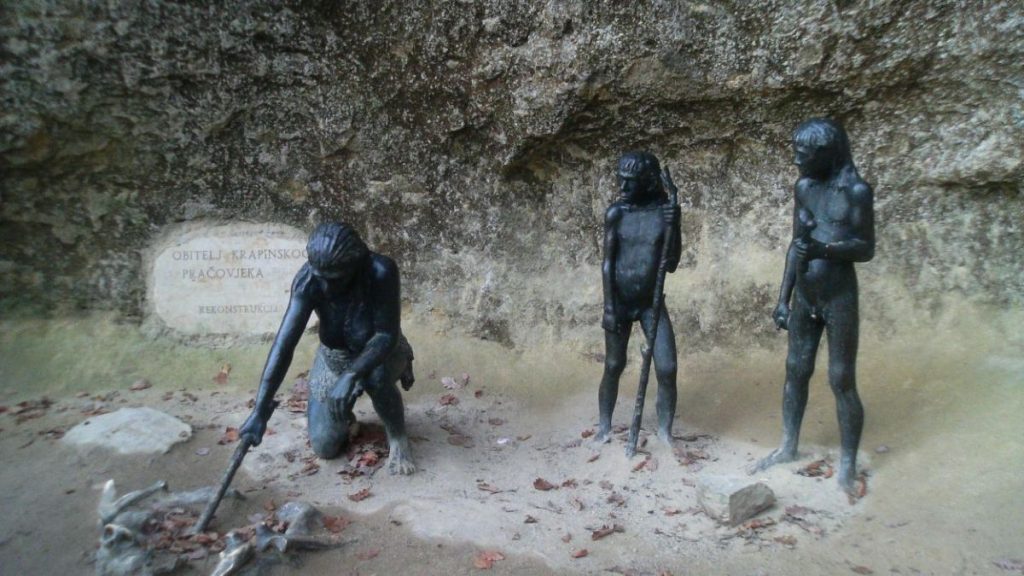
They were also often buried in groups. A rock shelter in Krapina, Croatia, contains the remains of 75 to 82 individuals. Richard Klein, professor of biology and anthropology at Stanford University, stated, ‘It seems that Krapina was a specialized burial site because it contains relatively little evidence of residential function.’4 In other words, it was a cemetery. Several similar cemeteries have been found in France, Spain, and Israel, each concealing the remains of at least 12 individuals.5
The fact that Neanderthals buried their dead is well documented and widely known. They appear to have understood the concept of death and may have believed in life after death. This indicates a presence of spiritual or religious beliefs.
Neanderthals and Homo sapiens in the same grave
It is less well known that archaeologists sometimes find Neanderthal remains directly alongside those of Homo sapiens. For example, Skhul Cave on Mount Carmel in Israel contains a Homo sapiens cemetery. However, among the anatomically modern skulls are Skhul IV and Skhul IX, which show Neanderthal traits. Similarly, skull number 6 from Qafzeh Cave in Israel, also a Homo sapiens burial site, displays Neanderthal features. Occasionally, more anatomically modern bones are found among Neanderthal remains. This is the case in Tabun Cave in Israel, where the Tabun C2 mandible was discovered, and in Krapina Cave in Croatia, where the Krapina 1 skull was found.6
It appears that Neanderthals and individuals classified as Homo sapiens were sometimes buried together in the same grave. How can this be the case if they were considered two distinct species? The evidence indicates that during the Neanderthal period, some individuals exhibited a more modern appearance, others a more Neanderthal appearance, and some displayed features that lay between the two. This intermediate group includes at least 133 individuals discovered at 11 separate sites. Among them, at least 26 were classified as Neanderthals and at least 107 as anatomically modern humans. Yet, when compared, they seem to share notable similarities, as if they formed a distinct group occupying a space between Neanderthals and modern humans.7
Conclusion
In other words, rather than two distinct species, there is a single human species exhibiting a range of traits from modern to Neanderthal forms. These individuals lived together and were buried together. Archaeological evidence, particularly from cemeteries, supports this conclusion. The Neanderthal, seen as a separate species (Homo neanderthalensis) existing alongside Homo sapiens, never existed. The Bible states that all nations descend from a single human pair,8 and scientific evidence indicates that some of these groups had Neanderthal traits. They were human, just like us.
By the way, we recommend reading the articles:
- The Sun – A Unique Star
- Understanding Rivalry Among Children
- Hyperbaric Oxygen Therapy and Pre-Flood Longevity
- Did Dragons Exist in the Middle Ages?
- The Origin of Music and Singing
Footnotes
- Lubenow, M., 2006. The Neanderthals: Our Worthy Ancestors. Answers in Genesis. Available at: https://answersingenesis.org/human-evolution/neanderthal/the-neandertals-our-worthy-ancestors/.
- Lubenow, M., 2007. The Neanderthals: Our Worthy Ancestors, Part II. Answers in Genesis. Available at: https://answersingenesis.org/human-evolution/neanderthal/the-neandertals-our-worthy-ancestors-part-ii/.
- Pomeroy, E. et al., 2020. New Neanderthal remains associated with the ‘flower burial’ at Shanidar Cave. Antiquity, 94(373), pp.11–26. Available at: https://www.cambridge.org/core/journals/antiquity/article/new-neanderthal-remains-associated-with-the-flower-burial-at-shanidar-cave/E7E94F650FF5488680829048FA72E32A.
- Klein, R.G., 1989. The Human Career: Human Biological and Cultural Origins. Chicago: The University of Chicago Press, p.467; quoted in: Lubenow, M., 2007. The Neanderthals: Our Worthy Ancestors, Part II, op. cit. (translation mine).
- Lubenow, M., 2007. The Neanderthals: Our Worthy Ancestors, Part II, op. cit.
- Ibid.
- Ibid.
- The Bible, New King James Version, 1982, Acts 17:26.
© Source of main image: Canva.

The portal EvolutionOfThinking.org, created by the Research and Education Institute, focuses on education and the dissemination of knowledge related to research on various aspects of human well-being.

