
Music and singing are uniquely human abilities, yet they are not vital for survival. What is the purpose of these skills?
In today’s world, music is a constant presence in our lives. It surrounds us at home, during our commutes, and even in the workplace. This is hardly surprising, given that humans have a natural affinity for music, and most people develop distinct tastes in the genre they enjoy. Each element of music—rhythm, harmony, and melody—elicits a particular response, often influencing our emotions. Music has the power to evoke happiness or sadness. It can energise us for a challenge (e.g. by using military drums), prompt us to dance, or simply provide a sense of calm and tranquillity that lulls us to sleep. Regardless of whether it’s classical, instrumental, pop, or heavy metal, its impact on us is undeniable.1
The Physics and Biology of Music
What has long been apparent through personal experience is now supported by scientific research. In January 2008, UCLA published a fascinating article examining how the human nervous system processes sounds that we perceive as music. While it was already established that the human ear can differentiate between various sound frequencies—whether the tone is high or low or the sound source is near or far—the capacity of the ear is far surpassed by the extraordinary abilities of individual neurons in the human brain.
Humans are capable of detecting even the smallest differences in pitch, as slight as one-tenth of an octave. What is particularly fascinating is how this compares to the auditory sensitivity of various animals. Cats, for instance, can discern differences equivalent to a full octave, while rats can detect variations of one-third of an octave, and macaques (a type of monkey) can perceive differences of either half an octave or a full octave. Additionally, the nerve cells responsible for hearing are up to 30 times more sensitive than the auditory nerve, which transmits signals to the brain.2 In other words, such remarkable sound recognition abilities suggest that humans are, in many ways, uniquely suited for music.
Singing
Humans have the remarkable ability not only to create and recognise music, but also to sing. Like speech, singing involves the full use of the vocal apparatus. We can actively control and adjust our voices, allowing us to sing in a variety of styles. Professional singers, such as choristers, dedicate themselves to training their voices to perform across different vocal ranges, including soprano, alto, tenor, and bass. Singing is a unique skill that distinguishes humans,3 or at least some of them, from other species.
Music as a Typically Human Invention
It is not surprising that the theory of evolution faces challenges in explaining the origins of the human musical sense. Initially, it is hard to understand how the abilities to compose, perceive, and sing music could offer any evolutionary benefit. These traits are not crucial for survival. Additionally, apes, our closest evolutionary relatives, are incapable of singing, creating music, or even recognising it. The macaques previously mentioned display much lower neurological sensitivity to sound frequencies compared to humans, with their sensitivity resembling that of cats.4
It is important to recognise that animals can still benefit from music in certain ways. For instance, studies have demonstrated that cows produce more milk when exposed to Mozart’s music.5 Similar effects have been observed in mice, which are able to navigate mazes more efficiently when music is played. This phenomenon is often referred to as the Mozart Effect.6 These responses, however, are not the result of animals intentionally listening to or seeking out music. Instead, their reactions are based on the pleasantness and calming nature of the sounds. In contrast, humans have a far more advanced sense of music, engaging with it consciously through listening, composition, and singing.
Neanderthal Music?
Evolutionary scientists struggle to explain the origins of the musical sense in humans, particularly since it is absent in modern apes. What about the extinct Neanderthals? Some evidence indicates that they too may have had a well-developed sense of music. In 1995, archaeologists discovered a flute made from a bear leg bone in the Divje Babe cave in Slovenia. Though there is some debate, it is believed that this artifact could have belonged to Neanderthals.7 Genetic studies also suggest that Neanderthals were capable of both speech and singing. They carried the same mutation of the FOXP2 gene as modern humans, a gene linked to speech and language. While chimpanzees also have the FOXP2 gene, its structure differs from that of humans and Neanderthals.8
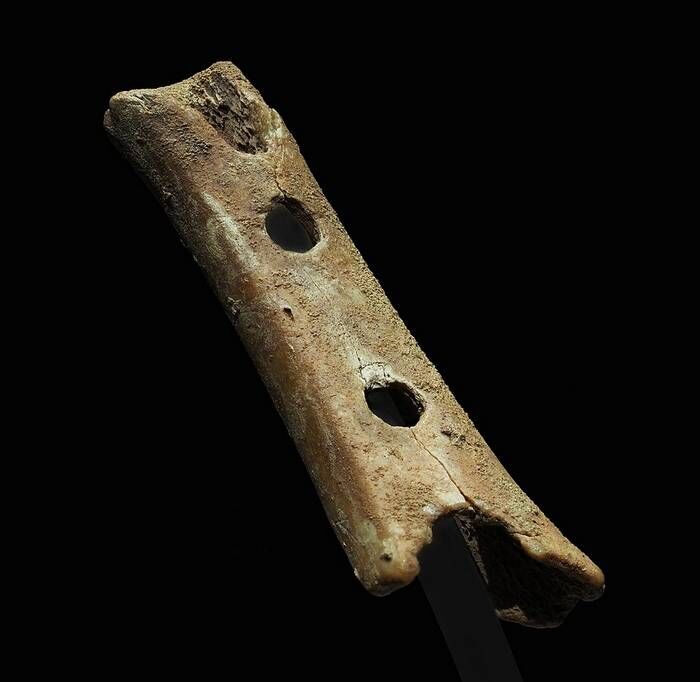
All of this provides compelling evidence that Neanderthals were humans in much the same way we are. It also supports the view that the Homo genus (comprising both Homo sapiens and Homo neanderthalensis) is entirely distinct from other primates.9 This raises several questions: how did genetic changes occur that made speech and singing possible? Furthermore, how did the Homo genus develop such highly responsive auditory nerve cells, which are crucial to our enjoyment of music?
The True Source of Music
Evolutionary theory offers no clear explanation for these phenomena. The development of musical ability and the capacity to sing in humans cannot be understood through the lens of Darwinian natural selection, which focuses on survival needs. Neither music, singing, nor any other form of art is necessary for human survival. This raises the possibility that the origin of humans is something truly extraordinary. It seems plausible that humans were deliberately designed by a Creator with an inherent appreciation for music and song. Music and singing are recurrent themes in the Bible, especially in the Book of Psalms.10 God Himself also loves music,11 which explains why He would have wanted humans to share this same affection.
By the way, we recommend reading the articles:
- Fish Intelligence: A Match for Apes?
- Does TRAPPIST-1 Harbor Extraterrestrial Life?
- How Long Did Crude Oil Actually Take to Form?
- The Potential Impact of Extraterrestrial Beings on Religious Systems
- Which Came First: The Flood or the Pyramids?
Footnotes
- Doolan R., Music—evidence of creation, Creation, 7(3), June 1985, pp. 18-19, creation.com.
- Human auditory neurons more sensitive than those of other mammals, Medical Press, January 16, 2008, medicalxpress.com.
- O’Brien J., Music: A crucial gift, Creation Ministries International, February 6, 2018, creation.com.
- Human auditory neurons, op. cit.
- Nelson C., Mozart and the miracles, The Guardian, January 10, 2003, theguardian.com.
- Curtin T., Mozart and the Cultured Cow, Black Dot Messaging, September 25, 2018, blackdotmessaging.com.
- Focus: news of interest about creation and evolution, Creation, 18(3), June 1996, pp. 7-9, creation.com.
- Swaminathan N., Cave Speak: Did Neandertals Talk?, Scientific American, October 19, 2007, scientificamerican.com.
- Wieland C., Speech, music—and Neandertals, Creation Ministries International, February 27, 2008, creation.com.
- See, e.g., Psalm 98:4-6.
- See, e.g., Revelation 4:8.
© Source of main image: Canva.

The portal EvolutionOfThinking.org, created by the Research and Education Institute, focuses on education and the dissemination of knowledge related to research on various aspects of human well-being.

