
Atheists often ridicule the Bible for mentioning unicorns alongside other animals. Let us explore what the biblical unicorn could have actually been.
Today, unicorns are considered purely mythical creatures that supposedly never existed, like dragons. Multiple ancient legends provide information regarding unicorns.They are typically depicted as horses with a single, long spiral-shaped horn protruding from their foreheads. Various ancient myths tell us about unicorns. They first appear in the myths and art of early Mesopotamia. Unicorns are also present in the myths of ancient India and China, and were also described by Ctesias (440-380 BC), a Greek historian and physician.1
What is most surprising is that it seems the Bible also mentions unicorns. This belief comes from the fact that the Greek Septuagint translated the Hebrew word re’em as monokeros, which literally means “unicorn”. Unicorns are referenced in Polish translations such as the Biblia Gdańska and the Jakub Wujek Bible, as well as in English versions such as the King James Version and Webster’s Bible. These translations of the Bible were read by many, leading to the widespread belief that unicorns are mentioned in the Holy Scriptures. This fact became a reason for militant atheists to mock the Bible.2 But is this justified?
Modern Translations
Today, the vast majority of translations render this word most commonly as “buffalo”, “wild ox” and even “rhinoceros”, but the reason for this is unknown. Jewish scholars have differing interpretations of the Hebrew term re’em due to its ambiguous meaning. In modern Hebrew, it means “wild buffalo”, and it could have meant the same in ancient times, but it is believed that the translators were deliberate in their decision to translate re’em as monokeros, which refers to a one-horned creature.3
Because of this, the Bible appears to suggest the presence of mythical unicorns. Hence, it is worthwhile to consider the perspective of modern zoology and paleontology on the topic.
Real Unicorns
To begin, it is important to clarify that we are not discussing a mystical white horse with a spiral horn on its forehead. Nonetheless, animal species in the natural world that possess only one horn do in fact exist. The rhinoceros is the only living example of a mammal with one horn (although some species have two horns, with the smaller horn positioned higher), which makes them unique in the animal kingdom. It is worth noting that there are other animals that have developed a horn in the center of their heads on their own. This phenomenon has been observed in both sheep4 and deer.5
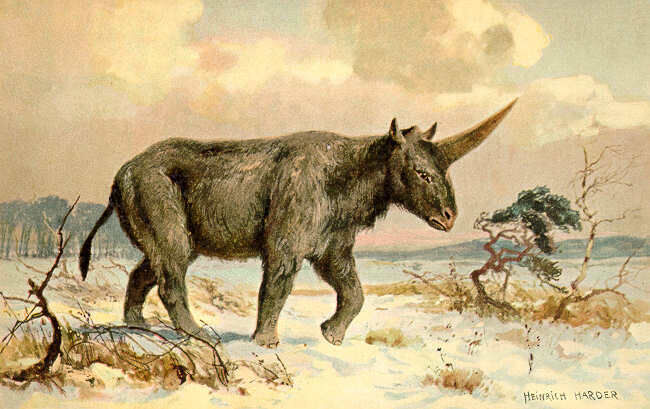
Throughout history, various species of rhinoceros-like creatures with huge horns have also been documented. One of them was the Elasmotherium sibiricum, also known as the Siberian unicorn.6 It was a massive rhinoceros, reaching up to 5 meters in length, covered in fur, with a horn that could have been up to 2 meters long. The Elasmotherium sibiricum lived in the Eurasian Great Steppe and was once believed to have gone extinct between 200,000 and 100,000 years ago. Today, however, it is believed to have gone extinct around 37,000 years ago, which suggests that prehistoric humans may have been familiar with this creature.7
The Elasmotherium sibiricum as conceived by Heinrich Harder (1858-1935). The creature might have been heavyset and more closely resembling the modern rhinoceros.
Could the Elasmotherium sibiricum be the re’em that is found in the Bible? The re’em is described as a powerful and fierce beast that is far stronger than a human and can be tamed only by God.8 God’s powerful arm, which guided the Israelites out of Egypt, is compared to the creature’s impressive horn.9 This does not align with the peaceful character of the unicorns in Greek mythology.
Another Possible Explanation for Re’em
The Hebrew re’em may also refer to a different extinct animal. In Aramaic, the word rimu refers to the aurochs, a strong ox with two large horns. Aramaic and Hebrew belong to the Semitic language group, so it is possible that the Hebrew re’em also referred to this animal.10
Conclusion
Whether the Hebrew re’em refers to a large rhinoceros with a massive horn or an aurochs, one thing is certain: the Bible describes a real animal that existed long ago and is now extinct.11 This suggests that the unicorn existed, but it did not look like the horse portrayed in folklore and legends. The same is true for dragons, which were likely different animals that have gone extinct. Therefore, the claim made by atheists that the Bible mentions fictional, fairy-tale unicorns is completely unfounded.
By the way, we recommend reading the articles:
- What is the Higgs Boson?
- Does the Bible Imply that the Earth is Flat?
- Human Races: A Scientific Perspective
- Earth’s Axial Precession in Ancient Thought
- What Happened to the Waters Above the Firmament?
Footnotes
- Encyclopaedia Britannica (n.d.) ‘Unicorn’, Encyclopaedia Britannica. Available at: https://www.britannica.com/topic/unicorn.
- Vice (n.d.) ‘Holy Unicorns’. Available at: https://www.vice.com/pl/article/dp44dq/holy-unicorns-0000191-v19n6.
- Mitchell, E. (2011) ‘Will the Real Unicorn Please Stand Up?’, Answers in Genesis, 15 June. Available at: https://answersingenesis.org/extinct-animals/will-the-real-unicorn-please-stand-up.
- BBC News (2017) ‘Farmers Find “Unicorn” Among Their Sheep in Iceland’, BBC News, 25 April. Available at: https://www.bbc.com/news/blogs-news-from-elsewhere-39704683.
- Kington, T. (2008) ‘“Unicorn” Found in Tuscany Wildlife Park’, The Guardian, 11 June. Available at: https://www.theguardian.com/world/2008/jun/11/italy1.
- Ham, K. (2022) ‘Unicorns – “More Legit Than You Think”?’, Answers in Genesis, 10 February. Available at: https://answersingenesis.org/extinct-animals/unicorns-more-legit-than-you-think.
- Ekologia.pl (2020) ‘Jednorożec Syberyjski Żył Wśród Ludzi’, Ekologia.pl, 26 March. Available at: https://www.ekologia.pl/ciekawostki/jednorozec-syberyjski-zyl-wsrod-ludzi,24708.html.
- The Bible, New King James Version, 1982, Job 39:9-10.
- The Bible, New King James Version, 1982, Numbers 23:22; 24:8.
- Mitchell, E. (2011) ‘Will the Real Unicorn Please Stand Up?’, Answers in Genesis, 15 June. Available at: https://answersingenesis.org/extinct-animals/will-the-real-unicorn-please-stand-up.
- Mitchell, E. (2008) ‘Unicorns in the Bible?’, Answers in Genesis, 18 August. Available at: https://answersingenesis.org/extinct-animals/unicorns-in-the-bible.
© Source of main image: Canva.

The portal EvolutionOfThinking.org, created by the Research and Education Institute, focuses on education and the dissemination of knowledge related to research on various aspects of human well-being.

